


July 28, 2026, 4:11 am | Read time: 4 minutes
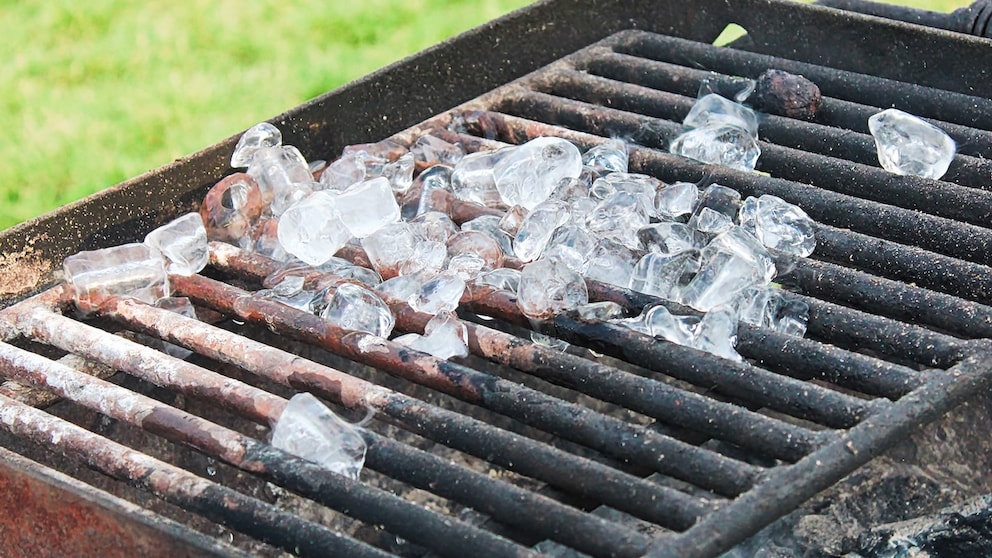
In the household, there are hardly any tricks you haven’t seen or heard of before. But this video, which has gone viral on social media, shows something magical. A person cleans a crusty grill grate with an ice cube. The grate is sparkling clean afterward. To find out if it really works that easily, myHOMEBOOK spoke with a household expert.
How the Expert Reacts
Elke Messerschmidt works in knowledge management and communication at the Competence Center for Household Management in Weidenbach, Bavaria. The household expert is familiar with almost every household life hack. But even she is amazed when watching the video: “I don’t know this method, and I can’t imagine it actually works that easily. I’d be interested to know how long the uncut film takes.”
That’s always the problem with such short social media clips. The film first shows a person pouring dish soap into an ice cube tray. According to the video, it then spends several hours in the freezer. The dish soap ice cube is then used on the greasy, crusty grill grate. It’s clearly visible how the black layer of dirt comes off effortlessly.
“With all these ‘cleaning tips,’ it’s mainly about generating clicks. And the more unusual a method is for a difficult task like cleaning a grill grate, the higher the likelihood of many clicks,” the expert says after the first viewing.

How to Quickly Clean Your Grill Grate
How to Clean the Oven Rack Without Tedious Scrubbing
Time + Temperature + Chemistry + Mechanics = Clean
But what does the household expert think of the method? “Basically, cleanliness is achieved through a combination of time, temperature, chemistry, and mechanics. Here, chemistry and mechanics are at play, possibly time as well,” Messerschmidt concludes.
First, there’s the chemical aspect, meaning the dish soap in high concentration. “In the ice cube tray, the normal dosage of five milliliters is exceeded by three to four times. This enormous dosage makes the water highly alkaline and adds many surfactants. Both help remove protein and fat residues from the grill grate.”
Chemically, the method should work. Mechanically, the household expert has no concerns either: “As long as the dish soap ice cube is frozen, there’s a hard rubbing surface and thus a high mechanical effort. Toward the end, however, only gloved fingers are used, which can naturally grip the bars of the grate well and reach the dirty spots.”
However, time is a critical factor. The clip doesn’t show any possible preliminary work: “In some places, it looks like the grill dirt is already quite softened. It could be that the grill grate was soaked in water beforehand to soften the dirt. But I don’t know that. It might also take several ice cubes and thus more time until each grid bar is completely clean.”
These Alternatives Also Work
Elke Messerschmidt’s final verdict is that the method with the dish soap ice cubes could work as shown in the video. However, a bathtub filled with hot water, in which the grill grate is placed, combined with a similarly high dish soap dosage, would likely have the same effect, though it would look pretty dull in a social media clip.
Finally, the expert shares a few alternatives to get the grill grate sparkling clean again. “What always works is high heat, meaning temperatures of 300 to 400 degrees. This burns off the residues on the grid bars. With a gas grill, this works excellently.”
And the household expert recently discovered an unusual method online, though she hasn’t tried it yet. “Wrap the grate in damp newspaper and leave it in the garden for one to two days. The newspaper absorbs mainly fatty dirt. Combined with the moisture, the protein-based dirt also dissolves. However, scrubbing with a sponge or brush and some dish soap is still necessary with this method.”