


November 14, 2025, 12:03 pm | Read time: 3 minutes
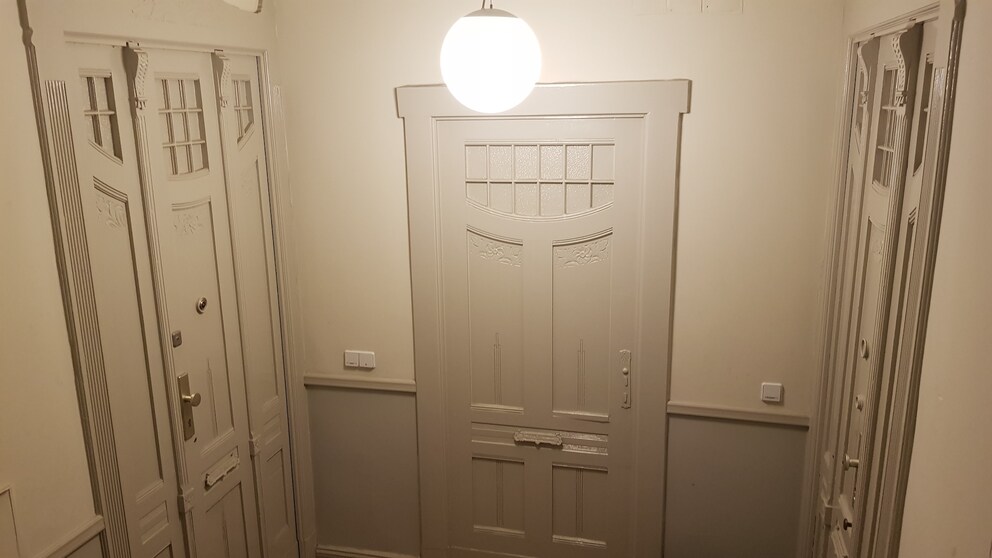
You often encounter them in old apartment buildings in German cities: mysterious doors located in stairwells between two apartments, yet inaccessible. Where do they lead? And what’s the story behind them?
Many people pass by these doors daily, which have no nameplate and are firmly locked. Typically, this situation repeats on every floor: In the middle of two apartments, there’s a mysterious door. It’s quickly apparent that no one lives behind it, as there’s neither a doorbell nor a nameplate. If curiosity leads you to try to open the door, you’ll be disappointed—it’s firmly locked. What’s the deal with this facade? It’s actually a relic from the past.
What’s the Story Behind the Locked Door?
Today, it’s hard to imagine having to leave your apartment with a roll of toilet paper in hand to use an outdoor toilet. In fact, not long ago, many rental apartments in big cities didn’t have their own toilets. This was especially common in old buildings in Berlin—in the eastern part of the city, it persisted even after reunification.
According to the Berlin Tenants’ Association, as late as 1991, there were more than 11,000 apartments with outdoor toilets in the Prenzlauer Berg district—also known as “toilets on the half-landing.” They existed in other cities too, but they are primarily characteristic of Berlin rental buildings. Initially, they were even considered an important advancement.
How Did the “Toilet on the Half-landing” Come About?
The Building Police Regulations of 1887 first stipulated that the so-called “public conveniences and bathhouses” needed a window to allow light and air to enter. Structurally, this meant that the toilet room had to be on an exterior wall. The result: long and narrow rooms extending from the stairwell to the outer wall. At the end was the toilet, above it the window–and the outdoor toilet was complete.
Even back then, living space in urban centers was limited—and real estate speculators wanted to rent out as much living space as possible. The result: tenants on a floor had to share the toilet, also known as a landing toilet. In some cases, up to four parties shared it. This construction was also supported by the Building Police Regulations, as there was no requirement for each tenant to have their own toilet.

How to Keep Burglars Out of Your Apartment Building

Cologne Resident Lived Illegally in Apartment for 13 Years Despite Lease
The Outdoor Toilet as an Improvement in Hygiene
The introduction of outdoor toilets was actually an improvement over the previous situation. Even among the upper classes, it was common to use a pit latrine in the courtyard. These were cesspits with simple wooden structures above them.
With the introduction of outdoor toilets, at least tenants no longer had to leave the building, only their apartment. Additionally, the courtyard toilets led to hygiene issues, as wells for drinking water were often located there. Diseases like cholera and typhus were the result.
In the 1880s, more and more apartments in Berlin were connected to the public water supply, gradually moving toilets indoors. However, outdoor toilets persisted well into the 20th century.
What Happened to the “Half-Landing”?
According to surveys, in 1968, there were still more than 110,000 apartments in West Berlin without their own toilet, accounting for 12 percent of the housing market at the time. In East Berlin, outdoor toilets even survived the reunification. Afterward, the apartments were modernized, the landing toilets were demolished, and the space was incorporated into the apartments on each floor.