

October 8, 2026, 12:11 pm | Read time: 4 minutes
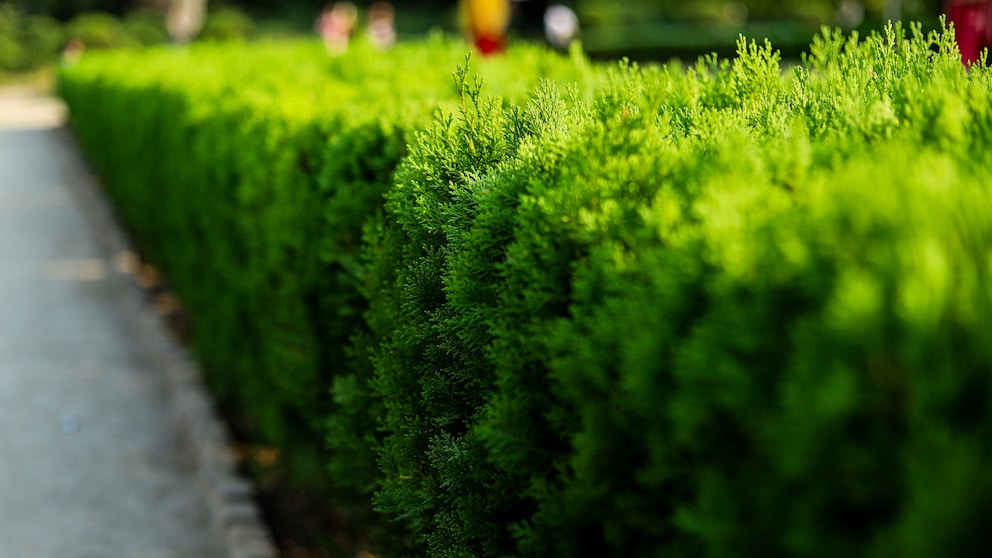
The thuja hedge is one of the classic hedge plants in German gardens. However, its planting is not unrestrictedly allowed everywhere. In 2023, the Brandenburg State Association of Garden Friends e.V. listed thuja as a prohibited plant in its framework garden regulations. Do garden owners across Germany now have to fear that they will have to do without the hedge?
As an evergreen hedge, the thuja, also known as the arborvitae, is almost indispensable in many gardens. It is considered easy to care for and is often used as a privacy screen against prying eyes. However, the hedge does not only have supporters. The Brandenburg State Association of Garden Friends e.V. already prohibited the planting of thuja in allotment gardens in its framework garden regulations in May 2023. myHOMEBOOK spoke with the association about the reasons for the regulation and asked attorney Nicole Mutschke whether a similar requirement could also be conceivable in private gardens.
Follow myHOMEBOOK on WhatsApp now
What speaks against the thuja hedge
Despite its high popularity, the thuja hedge is criticized. Conservation organizations such as NABU criticize its low ecological value. Unlike other species, thuja does not provide habitat or food for native birds and insects.
Jens Knillmann, second chairman of the Brandenburg State Association of Garden Friends e.V., explained to myHOMEBOOK: “[Thuja] acidifies the soil with its hard-to-decompose needles and displaces useful plants with its dense shallow root system. There is also a significant fire safety risk. Due to their high content of essential oils and resins, dried thuja burns explosively in the event of flying sparks and acts as fire bridges between garden sheds.” Botanically, thuja is classified as a higher-order conifer or forest and park tree. Its planting and maintenance contradict the allotment garden character according to § 1 of the Federal Allotment Garden Act (BKleingG), Knillmann said.
Also interesting: Remove a hedge in the garden in 4 steps
Do association gardeners have to remove their hedge?
As Knillmann explains, existing protection does not grant a permanent right to tolerate thuja. At the latest, when a tenant changes, existing thuja hedges must be professionally removed to restore the legally required original condition of the plot. During ongoing lease agreements, the hedge cannot simply remain. Specific deadlines and removal requirements are determined on a case-by-case basis by association boards or when tenants change, Knillmann explains.
However, there is an exception regarding the removal of the hedge: “If a thuja planting directly affects the neighboring plot (e.g., by casting shadows) or poses an acute fire hazard, it must be removed immediately or within a set period until the next pruning season,” explains Jens Knillmann. Compliance with the requirements is monitored by the boards of the individual allotment garden associations. Gardeners also receive support from local consultants who suggest ecologically valuable alternatives, Knillmann further states. Native species such as hornbeam, privet, or berry bushes are particularly suitable.

What Are the Legal Implications if You’re Allergic to Your Neighbor’s Plants?

What Is the Difference Between an Allotment Garden and a Recreational Garden?
Will there be a nationwide restriction?
The regulation of the Brandenburg State Association of Garden Friends e.V. is currently an exception. There is no clear answer to the question of whether and to what extent a restriction on the hedge can be established elsewhere or even nationwide. For attorney Nicole Mutschke, the low ecological value of thuja does not justify a nationwide ban. “Significant reasons related to nature or species conservation would have to be present, as a ban affecting private properties would need to be objectively justified and proportionate,” the attorney said.
Although the thuja, originating from North America and East Asia, is not a native species, the Federal Nature Conservation Act currently does not mandate the removal of thuja hedges. According to Mutschke, such a regulation would also need to be proportionate for hedges that were legally planted before the regulation took effect. “A subsequent obligation to remove would therefore be much harder to justify than a ban on new plantings. Transitional periods or exceptions could be conceivable,” Mutschke said.
Who would bear the cost of removal?
As Mutschke explains, in the case of a legal ban, the specific regulation determines who bears the cost of potentially removing the thuja hedge in private gardens. According to the attorney, there is no general principle that designates the state as the cost bearer for the removal of a plant. In the event of a nationwide ban, several instances would be involved in the removal of existing hedges, Mutschke said. For owners of private gardens who have legally planted a thuja, the potential cost issue could be decisive. If owners incur a financial disadvantage due to the removal, this could also play a role in determining whether such a regulation is still proportionate, according to Mutschke.