

March 15, 2026, 5:13 am | Read time: 4 minutes
When the first hedgehogs roam through gardens in the spring, many garden owners want to help the animals—after all, they often appear emaciated after hibernation. But this is where the debate begins: While some experts recommend feeding them, others strongly advise against it. Could well-intentioned help actually pose a danger to the animals?
Why Do Hedgehogs Seem So Weak in the Spring?
By the end of March, the first hedgehogs can be observed in gardens during mild weather. During hibernation, they have lived solely off their previously stored fat reserves. As a result, many animals appear slim—sometimes even emaciated—after waking up. It’s no wonder that many people assume the hedgehogs are malnourished and urgently need additional food. Numerous websites indeed recommend supporting the animals in spring to help them regain strength more quickly.
At the same time, there are warning voices: Offering large amounts of food to hedgehogs immediately after waking up can do more harm than good. In extreme cases, it could even be fatal.
Danger from Feeding Right After Hibernation?
On Instagram, authors Sigrid Tinz and Birgit Schattling, author and organizer of the Bio-Balkon Congresses, drew attention to a little-known problem last year. Even on the websites of conservation organizations, it is often recommended to feed hedgehogs during times of food scarcity.

Tinz and Schattling, however, strongly advise against feeding hedgehogs immediately after hibernation. At this point, the organism is still running on low power. If the animal receives a large portion of food now, its metabolism could become unbalanced. In the worst case, organ failure or cardiac arrest—and thus the death of the hedgehog—could occur. However, there are no scientific studies that clearly prove this danger.
Water Is Especially Important During the Waking Phase
The Swiss Hedgehog Center points out that hedgehogs that have overwintered in human care and have not yet eaten after waking should be gradually accustomed to food over the first three days. This recommendation primarily applies to animals in need of care.
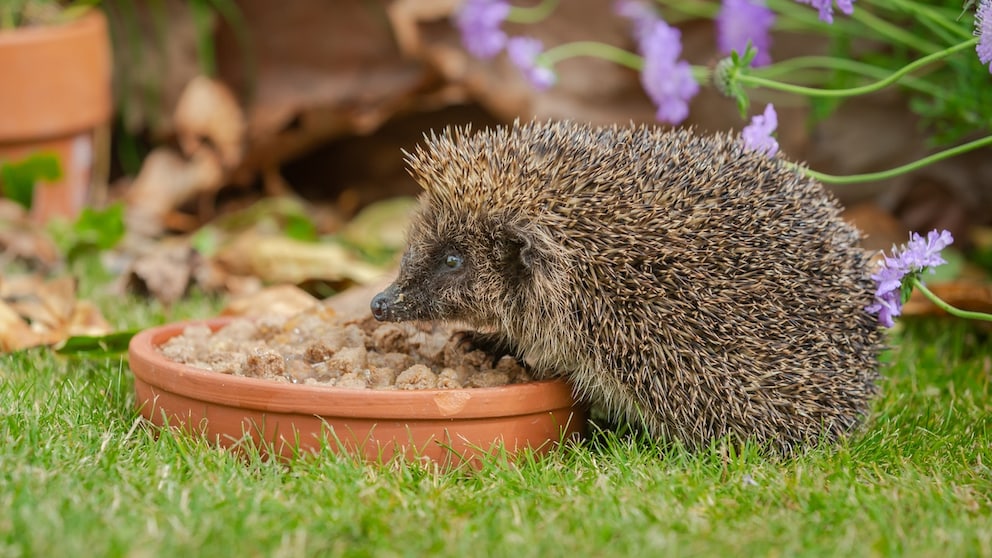
If hedgehogs are given the usual amount of food immediately, it can lead to stomach overload. The digestive tract must first get used to processing food again. It usually takes about eight days for a hedgehog to become fully active again after hibernation. During this phase, one thing is particularly crucial: water. Therefore, anyone operating a feeding station in the garden should first provide fresh water and offer food slowly and in small amounts. In nature, the food supply is still limited at the beginning of spring.
Year-Round Feeding—Yes or No?
Opinions also differ fundamentally. Conservation authorities such as the BUND Naturschutz in Bayern e.V. advise against year-round feeding, as it could lead to behavioral changes in hedgehogs.
Hedgehog stations, on the other hand, often hold a different position. Cornelia Schlicker from Anton’s Hedgehog Pension explains upon request: “With an insect decline of over 70 percent, it is absolutely important to offer food to the animals.” Hedgehogs are quite capable of regulating their own food intake: “I have never seen the animals overeat excessively.”
The project “NatureTec,” which observes and feeds wild birds and hedgehogs, also clearly advocates for support. Due to the decline in insects, hedgehogs find less and less food in nature. Estimates suggest that 60 to 80 percent of young hedgehogs do not survive their first winter because they cannot find enough food. Declining populations and increasing malnutrition show that the natural food supply is no longer sufficient in many places, making feeding necessary.

How to Build a Hedgehog House in 6 Steps – Video Guide
Should You Feed Squirrels in Winter?
“Please Do Not Feed Hedgehogs!”
The Swiss Hedgehog Center, on the other hand, takes a clear opposing stance: “Please do not feed hedgehogs!” While feeding wild animals is well-intentioned and has a social component, the hedgehog remains a wild animal that does not rely on human contact. Intentionally attracting hedgehogs with food is “misguided animal love.” Another aspect is that more hedgehogs meet at feeding stations than under natural conditions, explains the BUND Naturschutz in Bayern e.V. This not only means stress and competition but also increases the risk of disease transmission.
An Individual Decision
Whether to feed hedgehogs in the spring ultimately remains a personal decision. However, the concern of immediately risking the animals’ death through moderate feeding is likely low. The key is—if one decides to support—to proceed cautiously and keep the needs of the wild animals in mind.