

June 23, 2021, 9:03 am | Read time: 2 minutes
If you don’t have an outdoor faucet in your garden, you’ll need to make many trips with a watering can to water the plants—at least without a rain barrel. But even for balcony gardeners, a garden hose connection to the kitchen or bathroom faucet can be practical. It can be installed with just a few simple steps.
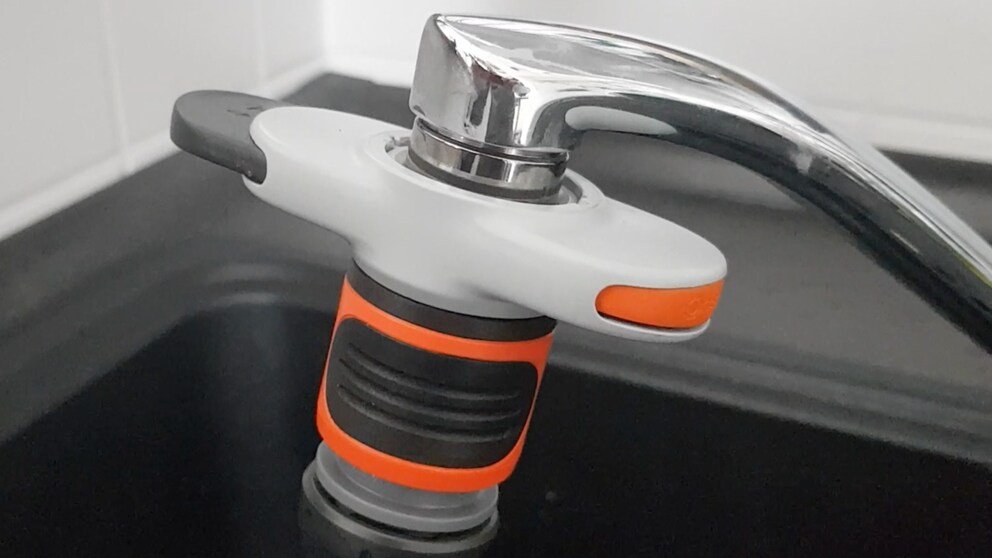
Not every garden has a faucet that can be used for watering the beds and lawn. And how do you fill the kiddie pool if there’s no water connection nearby? A simple solution is to connect the garden hose to an indoor faucet. However, this isn’t possible without a special adapter. This faucet connector is available at hardware stores for a little over ten euros. We also explain step-by-step in the video how to connect the garden hose to the faucet.
Connecting a Garden Hose to an Indoor Faucet – Instructions
The only tool needed to install the faucet connector is a pipe wrench or water pump pliers. This guide uses a model from Gardena. Some sets also include a suitable wrench for attaching and removing the aerator (“perlator”). This is the first step when you want to connect the garden hose to the faucet.
- First, unscrew the existing aerator from the faucet.
- Then attach the new aerator (included in the set) to the faucet and secure it with the pliers.
- Now attach and lock the adapter.
- Finally, connect the garden hose coupling to the adapter until it clicks into place.
The installation is very straightforward. Generally, you can leave the new aerator on the faucet. However, when removing the hose from the faucet connection, keep in mind that there may still be water in the hose. Simply pulling off the hose can quickly lead to a wet kitchen or bathroom.
Related: Changing and Cleaning Aerators – Instructions with Video
What Are the Alternatives?
Essentially, the faucet connector method is a practical option for those who can’t access an outdoor faucet. However, it’s worth mentioning that tap water isn’t ideal for watering plants, as it’s usually too hard. Using rainwater in the garden or on the balcony is much better—and more sustainable.
Also interesting: What You Need to Know Before Buying a Lawn Sprinkler