

November 1, 2026, 11:58 am | Read time: 4 minutes
Before moisture and frost set in the garden, there’s plenty to do. In addition to the lawn and plants, don’t forget the garden equipment. Especially with trampolines, the question arises: How can they best endure the fall and winter months?
The trampoline is a perennial favorite outdoor play equipment for families. When the jumping season ends, it’s important to secure the equipment properly. Weather conditions like rain, storms, and snow can strain the trampoline and compromise safety. To prevent this, myHOMEBOOK spoke with Robert Ziegler from TÜV SÜD to show how to make your trampoline storm- and winter-proof.
Follow myHOMEBOOK on WhatsApp now
More Stability in Storms with Ground Anchors
To protect the trampoline well against storms, it’s crucial to secure the frame adequately. “Suitable measures include ground anchors or a fastening set provided by the manufacturer to anchor the trampoline to the ground,” explains Robert Ziegler, product expert at TÜV SÜD. Ground anchors are best used during the trampoline’s setup to be prepared for wind and storms at all times.
For the correct installation of ground anchors, there’s a guide on the website of the Federal Association for More Safety for Children. The association also warns against careless fastening methods, such as weighing down the frame with stones. These can not only shift in strong winds but also pose a safety risk.
In case of a storm warning, you should also remove the jumping mat and safety net, as they offer a large surface area for the wind to attack. “After a storm, check if the trampoline has shifted and if the frame, connections, anchors, jumping mat, springs, and safety net show any damage,” Ziegler further explains.
Also interesting: What to consider with a trampoline in the garden
Tarps Provide Short-Term Protection Against Rain and Dirt
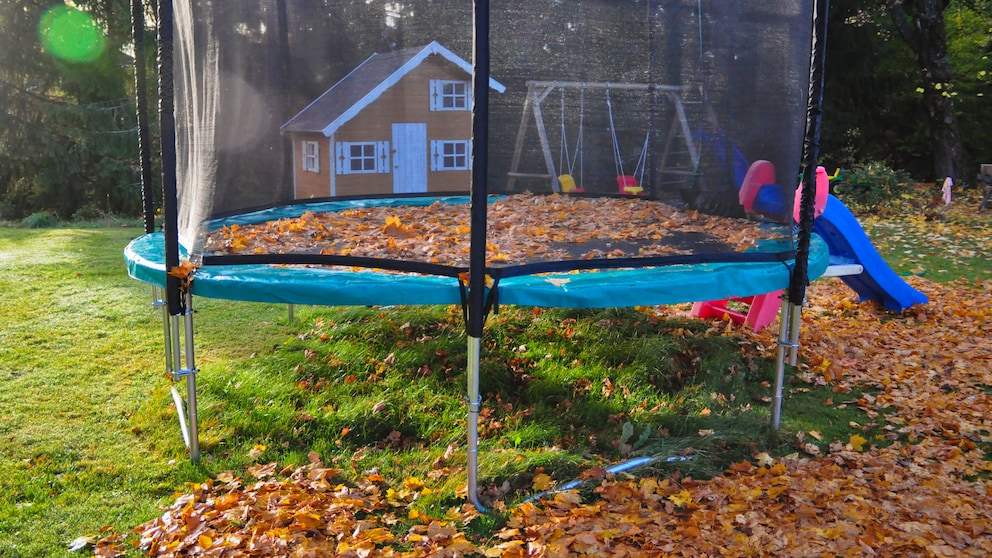
Especially in fall, leaves, mud, and wet grass are common in the garden. A tarp can protect the trampoline from such dirt. However, Robert Ziegler limits the benefits of such a tarp. “A tarp does not make the trampoline weatherproof and does not replace the proper storage of sensitive components, especially during longer periods of non-use,” says the expert.
The problem with tarps lies in their duration of use. Prolonged use can lead to moisture buildup underneath, which not only promotes mold but can also damage the trampoline’s material, Ziegler explains. To avoid this, tarps should only be used according to the manufacturer’s instructions and regularly lifted to allow the material to dry.
To protect trampolines from dirt and damage in the long term, Robert Ziegler advises cleaning the equipment of leaves and dirt during the fall months. According to the expert, it’s also important to check for rust, loose screws, damaged or porous padding, and wear on the jumping mat and safety net.

These Mistakes Shorten Battery Life

What Is Mobile Decking and Who Is It Suitable for?
How to Make the Trampoline Winter-Proof
Even in winter, additional weather influences can strain the trampoline. “Basically, a trampoline can overwinter outdoors depending on its construction and manufacturer’s instructions,” says Ziegler. However, it is exposed to harsh weather conditions there. Therefore, the trampoline should be regularly checked for stability, moisture, and frost and corrosion damage.
To be on the safe side, don’t leave the trampoline in the garden over the winter months. According to Robert Ziegler, you should dismantle the safety net, protective edge, and jumping mat, clean, dry, and store them in a dry place. Additionally, check the trampoline for rust spots, loose parts, and material damage.
Cold can be particularly problematic for certain plastics. They become brittle and can break during later use, the expert explains. Not only for most manufacturers but also from TÜV SÜD’s perspective, storing the trampoline over the winter is the safest option. This not only protects the material from damage but also affects the safety and longevity of the trampoline.
Caution with Large Amounts of Snow in Winter
With a freestanding trampoline, snowfall can quickly become a problem. “Large amounts of snow can significantly strain the jumping mat, springs, and other parts of the trampoline due to their weight,” says Ziegler. Not only can the frame be damaged, but the material can also be affected by large amounts of snow. This is another reason against storing it outdoors during the winter months.
If you still choose to leave your trampoline outside over the winter, Ziegler advises ensuring that not too much snow accumulates on the jumping surface. “The snow should be removed regularly and carefully, meaning without sharp-edged tools.”