


December 2, 2019, 9:50 am | Read time: 4 minutes
Even if it sounds unrealistic, it can still happen: A meteorite lands in the front yard. This sensation has now occurred in Flensburg. Can you actually keep the find if it’s on your own property? And does insurance pay if the rock from space hits the roof of the house? myHOMEBOOK asked experts.
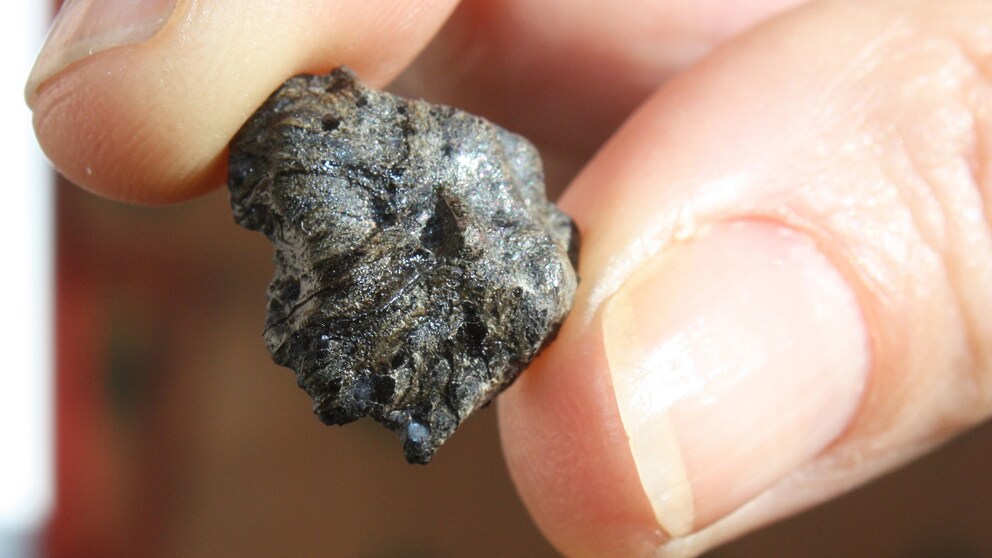
Even if it sounds relatively unlikely, a resident of Flensburg actually found a real meteorite in his garden. Initially, he wasn’t sure what the rock was that he discovered shortly after a meteor shower on September 12 on his property. The very next day, he sent his find to scientists for verification, reports the Hamburger Morgenpost. Now, researchers have confirmed that it is indeed a real meteorite.
Most meteorites are tiny, and many also land in uninhabited forest areas or the sea. But it can happen–as in the current case in Flensburg–that a real meteorite lands on your own property. How can you recognize it? And can you simply keep the extraterrestrial stone from the front yard?
“Meteorites are incredibly rare”
Meteorites are objects from space that do not completely burn up upon entering the Earth’s atmosphere and therefore strike the Earth’s surface. While in space, they are still called meteoroids. For laypeople, it’s not easy to recognize a real meteorite. “Meteorites are incredibly rare,” says Dieter Heinlein, Technical Director of the Fireball Network at the German Aerospace Center (DLR). “Just because the stone wasn’t there yesterday doesn’t mean it’s a meteorite.” Heinlein receives countless rock samples from supposed finders. In the last 20 years, the suspicion has only been confirmed twice.
How to recognize a real meteorite
The Institute of Planetary Research at the German Aerospace Center (DLR) offers a checklist to help you distinguish a meteorite from an ordinary pebble in the garden:
- Is the object particularly heavy and yet small in size?
- Does the object react to magnets?
- Is the surface of the object rather matte?
- Do you see a metallic sheen or even metallic inclusions?
- Does the find have a dark crust?
- Is the object solid?
If you can answer all these questions with “Yes,” it might indeed be a real meteorite. Document and photograph the location as best as you can. “Try not to touch it with your hands,” recommends Heinlein. While the stones are generally not dangerous, the material can be affected by the oils on your skin. If you’re unsure, the DLR also offers a scientific analysis upon request. Then the samples end up on Dieter Heinlein’s desk. However, the institute explicitly points out that the chances of a genuine find are very low. “One in a thousand stones sent in is a meteorite,” explains the expert.
Meteorite landed on the property–what to do?
Things that come from space and thus have no owner can be kept by the finder. This also applies to meteorites that land in the garden. What the lucky person does with it is up to them. For example, they can keep the meteorite, offer it at auction houses, or donate it to science, such as geological institutes or museums.
Also interesting: Up to what height does my property belong to me?
Selling a found meteorite–is it worth it?
“There are people who sell a worthless stone for a few hundred euros,” says meteorite expert Heinlein, pointing to fraud cases on the internet. But institutes and museums also pay money if the authenticity of a meteorite is confirmed after examination. According to the auction platform Catawiki, the most expensive meteorite was sold for 1.7 million euros. It was the Fukang meteorite, a very rare and beautiful pallasite made of nickel-iron with crystalline inclusions, said to be about 4.5 billion years old.
Also interesting: When you have to let your neighbors onto your property

Neighbor lights a fire pit in the garden every evening – are fire pits allowed?

Rock leads to dispute between neighbors! What a lawyer advises
Does insurance pay if a meteorite hits my house?
If the meteorite doesn’t land in the vegetable patch but on the roof, the impact can cause severe damage to the building. According to Henning Engelage from the German Insurance Association (GDV), a meteorite is considered a celestial body and is not insured. “Fire, however, is an insured risk, regardless of how the fire was caused,” explains the insurance expert. “A fire resulting from a meteorite impact would therefore be insured.”
And what about a satellite on the property?
“Satellites usually burn up when they enter the atmosphere,” Heinlein notes. Nevertheless, a horse breeder in Michigan recently found the remains of a satellite in her pasture. Fortunately, no one was harmed. Engelage defines satellites, unlike meteorites, not as celestial bodies but as aircraft. Whether manned or unmanned, if damage is caused by satellites, the insurance usually covers it, typically the homeowners insurance.