


February 28, 2026, 5:51 am | Read time: 4 minutes
If you’re looking for a hedge that offers year-round privacy and a modern look, you’ll quickly come across the photinia. Particularly because of its bright red new growth, it has become one of the most popular hedge plants in recent years—and is now considered a real alternative to traditional evergreens. But how well does the photinia really work as a garden hedge? And what should you pay attention to?
What Makes the Photinia So Attractive as a Hedge Plant?
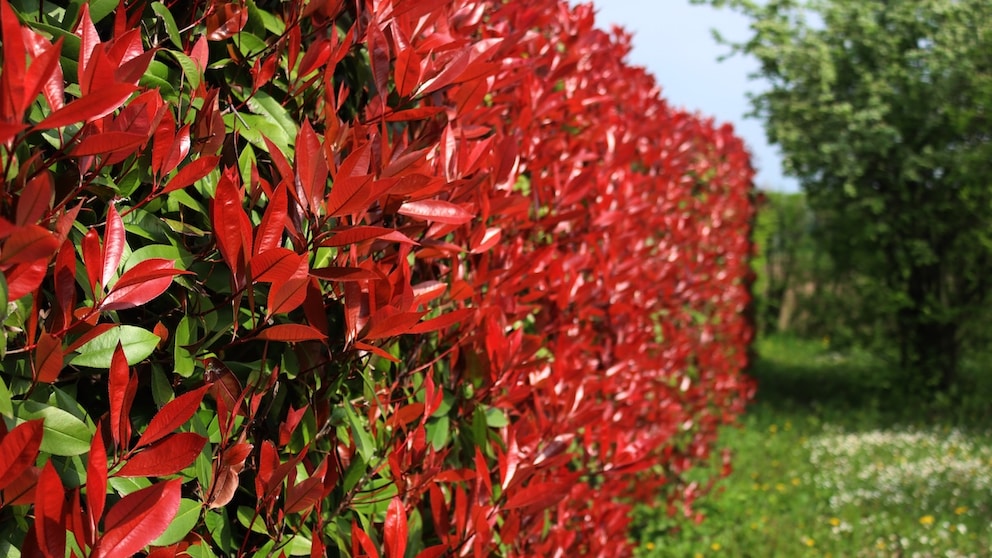
The photinia is an evergreen to semi-evergreen shrub that stands out mainly for its colorful new growth. In spring, the young leaves emerge a vibrant red before turning dark green over the summer. This color change adds vibrancy—even in tightly trimmed hedges. As a hedge, the photinia impresses with:
- dense growth and good privacy
- a modern, slightly looser appearance compared to traditional hedge plants such as privet
- good tolerance for pruning
This makes it particularly well-suited for modern gardens, but also as a contrast in more natural settings.
Location: Sun Brings Color
For a beautiful, robust hedge, the right location is crucial. Photinias prefer bright to sunny spots. The more sun the plants receive, the more intense the red new growth will be. They also grow in partial shade, but tend to remain greener there. The soil should be:
- loose and well-drained
- free of waterlogging
- nutrient-rich but not too heavy
- Waterlogging is one of the most common causes of problems, especially in the first few years.
How Fast Does a Photinia Hedge Grow?
Photinias grow at a moderate pace. An annual growth of about 8 to 12 inches is realistic. This makes them significantly faster than boxwoods, but not as vigorous as cherry laurels. Patience is needed for a closed hedge—but it is rewarded with a long-lasting, stable planting.
Care: Less Work Than Expected
In terms of care, the photinia is surprisingly low-maintenance:
- Watering: Regularly in the first few years, later only during extended dry periods
- Fertilizing: Once in spring is usually sufficient
- Pruning: One to two cuts per year are ideal
The best time for pruning is after the first growth in late spring to early summer. Pruning then encourages a second, often reddish new growth.
Is the Photinia Winter-Hardy?
Generally, yes—but with some limitations. Young plants are more susceptible to frost than older ones. In harsh areas or during very cold winters, leaf or shoot damage can occur. However, they usually regrow in spring. A wind-protected location and sufficient moisture before winter help prevent damage.
What Diseases Can Occur
One point that should not be overlooked: Photinias can be prone to leaf spot diseases, especially in persistently damp weather and poor ventilation. Particularly densely planted or shady hedges are affected. Preventive measures include:
- adequate planting distance
- an airy location
- avoiding watering over the leaves
- Well-maintained plants are significantly more robust
Dense, Fast-Growing, Evergreen – 14 Popular Hedge Species for the Garden

5 Evergreen Shrubs for Gardens and Balconies
Photinia as a Hedge Instead of Boxwood or Cherry Laurel?
Many consciously choose photinia as an alternative to boxwood or cherry laurel. It appears less formal than boxwood, is more ecologically valuable than cherry laurel, and offers more visual variety. Especially in gardens where structure is desired without appearing sterile, it plays to its strengths.
Ecological Role in the Garden
Even though the photinia is not a native shrub, it offers more ecological benefits than often credited. In late spring, it produces white flower clusters visited by bees, bumblebees, and other insects. In fall, small, dark berries develop, which—depending on the region and winter conditions—can serve as a food source for birds.
As a dense hedge, the photinia also provides shelter and retreat spaces for birds, especially in otherwise very tidy gardens. It’s important not to prune too radically during the breeding season. Allowing the hedge to grow a bit looser or combining it with native shrubs can significantly enhance its ecological value.

The Mix is Key–Even for Hedges
“If you can’t decide on a single plant for a newly planned hedge, you don’t have to. Mixed hedges also have their advantages. First, they are visually more diverse: Mixing privet with photinia, beech, and hawthorn creates a different look depending on the season. Second, each hedge plant has its benefits for garden wildlife. This way, the garden is made more natural just by the hedge.”