



June 18, 2026, 11:53 am | Read time: 5 minutes
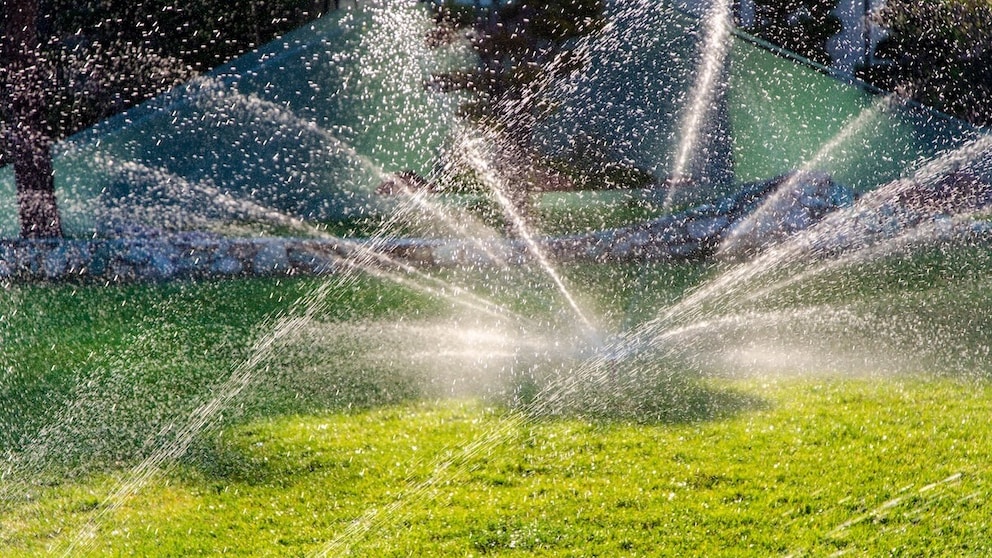
For many garden owners, a lush, green lawn is the showcase of their garden. However, especially during the summer months, extended dry periods often thwart this desire. To keep the lawn healthy and strong, adequate water supply is essential. An expert explains how to optimally water the lawn on hot days with minimal effort.
The water needs of a lawn primarily depend on the current temperatures and the soil properties. “Grass consists of almost 90 percent water. When water is lacking, the metabolism collapses, and the grass dies,” explains Dr. Harald Nonn, former chairman of the German Lawn Society, in an interview with myHOMEBOOK. The expert shares his key recommendations on the most sensible watering strategy during summer heat and what garden owners should pay attention to.
Overview
Watering lawns in heat and preventing “perpetual drinkers”
Frequent, insufficient watering can cost you the lush green. Since the soil is not deeply moistened, the roots become shallow. The volume of soil penetrated by roots, and thus the water supply accessible to the grass, decreases. The result: The lawn becomes more susceptible to drought, and its watering needs increase.
Watering the lawn on a fixed schedule every one to two days creates “perpetual drinkers,” as Nonn explains. “If I water a little every day, I draw the roots of the lawn upward. Then I have to water more often than with deeper roots.”
Related: Can you save dried-out grass?
When should you water the lawn?
Nonn advises watering only when the grass starts to droop. This can happen after three days or even after a week. However, you should avoid letting the soil dry out completely. “Then it seals off, and the water runs off unused,” explains Michael Henze from the Federal Association of Garden, Landscape, and Sports Facility Construction (BGL).
Also interesting: Why dry lawns are becoming more popular
How much should you water?
How much water should you give? For ten centimeters of root depth, you need about 15 liters for sandy soils. For clay soils, it’s 25 liters of water per square meter to replenish the soil’s supply, Nonn explains. Then the plants develop deep roots that can absorb the water well.
Tips for proper lawn watering
- Do not water the lawn in homeopathic doses. The rule here is: Go big, not small. During drought, you should thoroughly water the lawn once or twice a week.
- Moisten the soil to root depth, preferably early in the morning and over the entire lawn area. This keeps the roots in deeper soil layers. With insufficient watering, they dry out, and the root system becomes shallow.
- Another positive effect: Deep roots can absorb water from deeper soil layers. This reduces the required water amounts and watering frequency. Keep in mind that grass under trees needs water more often.
- In extreme heat and drought, you can let the grass grow one to two centimeters longer. The leaves then shade each other more, reducing evaporation.
- Avoid mowing the lawn in extreme heat, as a lot of water escapes from the plant through the cut surface.
Tip: In extreme heat, cooling the lawn by briefly moistening it, similar to a quick dip in water for us humans, can be beneficial. The grass cools down a bit and doesn’t suffer heat death. According to lawn experts, you don’t have to worry about “burns” from water droplets on the fine grass blades.
Also interesting: The best tips against clover in the lawn
Should you scarify lawn in the fall? A professional explains

These 6 Care Mistakes Make Plants Suffer Even More in Heat
Why fertilizer is important during dry periods
Another tip from the lawn expert: “Fertilizing with a lot of potassium before summer begins makes the grass use water more sparingly. Potassium reduces the water evaporation of the leaves and simultaneously increases heat tolerance.”
Nutrient supply is crucial for how well the lawn withstands dry and hot periods. “A depot fertilizer with nitrogen, phosphorus, potassium, and magnesium, as well as liming the lawn, is recommended,” explains Michael Henze from the BGL.
Fertilizing is done in April, June, and August. “Potassium is particularly important because it ensures that the plants use water more sparingly,” adds Nonn. “Potassium-rich lawn fertilizers are actually recommended for the fall but are also useful in early summer, especially on sandy soils.”
Should you continue watering brown spots?
Brown spots don’t necessarily mean the lawn is dead there. “Some grasses regenerate when they get enough water again,” explains Gert Schulte-Bunert, president of the Greenkeeper Association Germany in Wiesbaden.
Tip: To find out if the lawn is still alive, you can take out a piece. If the root is white, there’s a good chance it will come back. However, if the root is brown, it’s too late.