


July 8, 2026, 5:34 am | Read time: 3 minutes
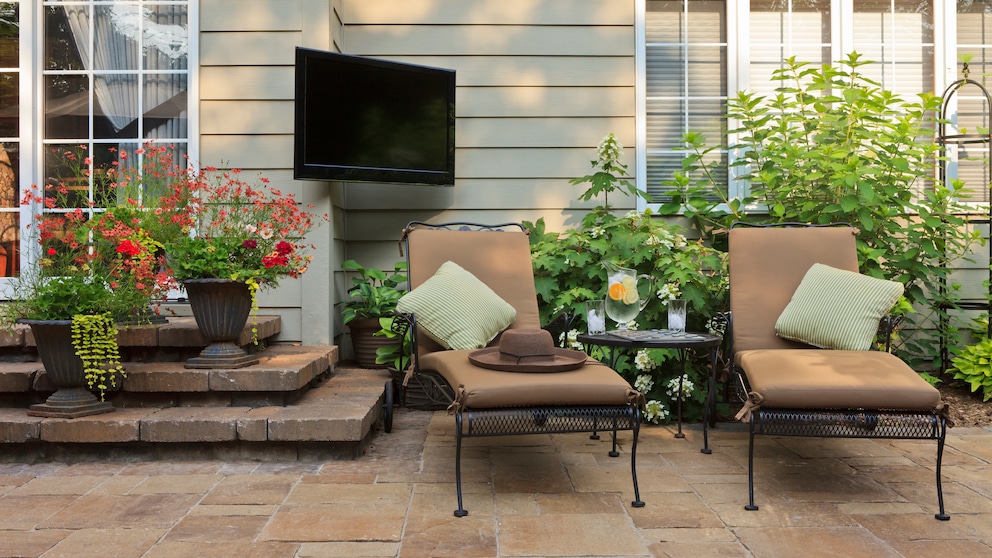
A summer evening, the international match is on, friends are sitting on the patio, and the grill is humming in the background. It’s for moments like these that the TV is quickly moved outside. But what about permanent outdoor use? myHOMEBOOK explains what to consider when setting up a TV outdoors.
Regular TVs Are Not Made for Outdoor Use
Electrical devices like TVs need protection from precipitation. A sudden heavy rain can cause a short circuit and permanently damage the device. A permanent patio cover or pergola is therefore essential. But even under a solid roof, using a regular TV outdoors quickly becomes problematic.
Standard TVs are designed only for indoor use, where the temperature is constant and humidity barely fluctuates. Outside, it’s a different story. Moisture seeps into the casing. Condensation collects behind the display, and ports and connections are at risk of damage. Hendrik Schäfer, head of marketing and corporate communications at the VDE Testing and Certification Institute, also points this out. He advises against the permanent use of a regular TV outdoors:
“The intended use for conventional TV devices is only indoors. Therefore, it is not advisable to set up and operate such a TV permanently outdoors.” Schäfer mentions another issue: Outdoors, the risk of insects getting into the device increases. They move around uncontrollably and can cause short circuits. There’s also a legal aspect: Manufacturers only provide a warranty for “intended use.” Outdoor operation is not included.
Always unplug the toaster after use
What You Should Know About Vertical Awnings
Only Take It Outside in Dry and Calm Weather
But it is possible. The expert agrees: “In principle, there’s nothing against using the TV outdoors for an evening in dry weather.” Modern TVs with large screens carry their weight in the stand. This makes them susceptible to gusts of wind. Therefore, the expert advises paying attention to stability.
If the patio or balcony is covered and protected from strong winds, there’s nothing to stop an outdoor TV evening. For operation, a regular outdoor socket or an extension cord is sufficient. “If the conditions are met, then there is no danger to the device and viewers from one-time outdoor use,” Schäfer says.
Are There Solutions for Permanent Outdoor TV Use?
If gardens, patios, or balconies are to become a permanent extension of the living room, the solution is an outdoor TV. Such devices are “protected against hazards with appropriate protective measures and usually also produce a brighter picture,” the expert explains.
Outdoor TVs have an IP protection rating. This rating indicates how well a device is protected against dust and water. The IP55 rating, for example, stands for protection against dust and water jets. In general, the higher the second digit, the better the protection against water.
Outdoor TVs can also withstand extreme temperatures. They usually operate between plus fifty and minus twenty degrees. Whether anyone would still want to watch TV outside in such cold is another matter.