


September 22, 2026, 1:44 pm | Read time: 4 minutes
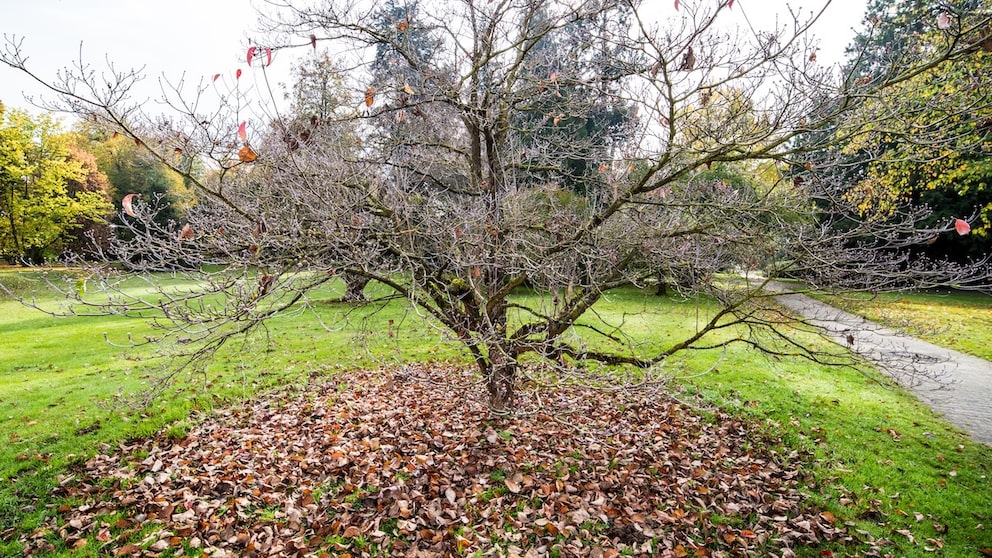
Anyone walking through parks or residential areas these days will notice many trees that have already lost a significant number of leaves by September. Some even appear almost bare. What initially looks like an early start to fall often has entirely different causes. Primarily, dryness and prolonged heat are taking a toll on many trees. myHOMEBOOK consulted an expert.
Follow myHOMEBOOK on WhatsApp now
Premature Leaf Fall Is Usually a Result of Drought Stress
The unusual early shedding of leaves by trees is often linked to the weather conditions of recent months. “Premature leaf fall is primarily due to drought stress, with prolonged heat also playing a role,” explains Hajo Hinrichs, president of the Federal Association of German Tree Nurseries (BdB).
The loss of leaves is not necessarily a targeted protective measure by the tree. According to Hinrichs, it is more a consequence of stress. “Leaf fall is a consequence, less a protection, but should be understood as a warning,” says the expert. In response to stress, the tree often produces an abundance of fruit to ensure its reproduction.
Also interesting: These plants have intense fall colors
These Tree Species Suffer the Most
Species with high water needs are particularly under pressure. According to the BdB, native tree species that rely on sufficient moisture are often affected. This includes the silver birch. But tree species that struggle with increasingly long heat periods in summer are also increasingly damaged. Hinrichs cites the European beech as an example.
Many pedunculate oaks are also struggling with the effects of dry years. “Due to the lowering of the groundwater level, tree roots no longer reach the water-bearing layers,” the expert says.
Whether a Tree Is Damaged Often Becomes Apparent Only Next Spring
For garden owners, it is often difficult to determine whether a tree is merely reacting to the weather or is already seriously damaged. A clear assessment is often only possible after winter, Hinrichs explains: “Actually, only really in the next spring, when the growth or sprouting shows,” says the expert. Those who want to check the condition of their tree now can use a tip from the expert. “If you lightly scratch the bark of the smaller branches, it should be green,” Hinrichs explains. If green tissue is visible underneath, it indicates that the branch is still alive. Soil moisture should also be monitored.
Many Garden Owners Overlook Heat Damage to Trees
Understanding Frost Drought in Plants
Can Trees Recover?
In principle, trees can recover from dry spells if they are sufficiently supplied with water in the long term. However, recurring drought years often leave lasting damage.
“We’ve had hot summers since 2018,” says Hinrichs. The main problem is that the fine young root tips in the soil can dry out. “If the outer young, white root tips dry out and continue to die over the years, the tree is at long-term risk and usually unable to absorb enough water.”
Younger trees can often better compensate for the formation of new roots than older specimens.
The effects are now particularly drastic in some birches. “We are now noticing the complete death of individual trees (birches) that have repeatedly suffered from 2018 to 2023,” reports Hinrichs. His conclusion: “A tree dies slowly and quietly.”
What Garden Owners Should Do Now
Even if more rain falls again in the fall, garden owners should continue to monitor the water supply of their trees. Evergreen plants, in particular, need support.
“Even if it seems (feels) like a lot of rain is falling, evergreens, that is, plants that carry needles or leaves in winter, need our support,” says Hinrichs. Therefore, they should be well supplied with moisture going into winter. Additional watering can be beneficial during frost-free periods.
Many evergreen trees do not die in winter from frost but from a lack of water. “Most evergreen trees do not freeze in winter–they dry out!” warns the expert.
It is also advisable to check for dead shoots and branches. These should be removed to provide less opportunity for pathogens. For the next summer, Hinrichs recommends planting or mulching the soil as completely as possible. This reduces water evaporation and better protects the roots. “So avoid bare, open areas, even over the winter,” advises the president of the Federal Association of German Tree Nurseries.