

November 26, 2026, 5:13 am | Read time: 4 minutes
Not everything we humans find beautiful or cute is good for the animal. For example, tailless cats and dogs with extremely shortened snouts suffer from health problems. Animal welfare advocates therefore advise against breeding them. Are there similar problematic breeds among guinea pigs?
Follow myHOMEBOOK on WhatsApp now
Overview
What is meant by problematic breeding?
According to Section 11 of the Animal Welfare Act, it states: “It is prohibited to breed vertebrates […] if, as a result of breeding or modification […], hereditary behavioral disorders associated with suffering occur in the offspring, any species-appropriate contact with conspecifics leads to pain or avoidable suffering or damage in them or a conspecific, or if keeping them is only possible with pain or avoidable suffering or leads to damage.”
The law does not specify which pet breeds specifically have genetically induced “avoidable suffering or damage.” Therefore, experts, such as those from the Veterinary Association for Animal Welfare (TVT), are consulted to classify certain traits as problematic breeding in the legal sense. Breeding of the affected breeds is then prohibited. Additionally, animal welfare organizations provide their own assessments of problematic breeding–including for guinea pigs.
Which guinea pigs are problematic breeds?
The last expert report on the interpretation of Section 11 of the Animal Welfare Act dates back to 1999. Guinea pigs are practically not mentioned in it. Therefore, there are hardly any breeds whose breeding is actually prohibited in Germany. Nevertheless, many animal welfare organizations, as well as the Berlin Chamber of Veterinarians, warn against various breeds with certain traits that they see as meeting the criteria for problematic breeding.
Hairless guinea pigs
Baldwin guinea pigs are completely hairless. They have neither a warming coat nor whiskers or eyelashes. As a result, the Baldwins’ temperature regulation is disrupted, and they are prone to parasites and injuries. Due to the lack of vibrissae, commonly known as whiskers, these animals can hardly orient themselves. Hairlessness and missing vibrissae are considered problematic breeding traits according to expert reports, although guinea pigs are not specifically mentioned in them.
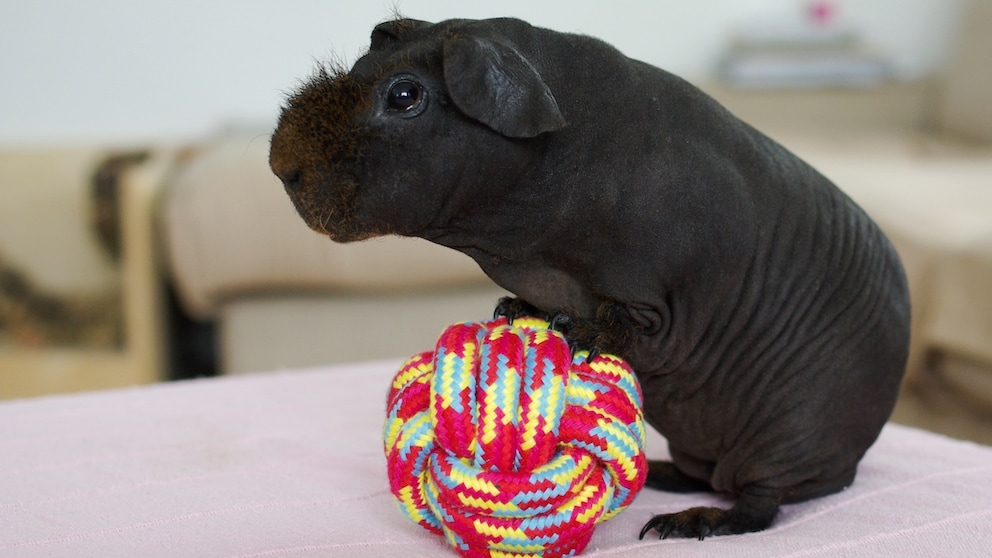
Skinny guinea pigs are almost hairless. They have some remaining hair around the snout, but the whiskers are stunted. According to Austrian animal welfare law, breeding hairless guinea pigs is generally prohibited. In Germany, only Baldwins fall under the problematic breeding ban due to their complete hairlessness under Section 11. However, animal welfare advocates also see Skinnys as fulfilling the criteria for problematic breeding.
Also interesting: 10 tips to make your home small-pet safe
Breeds with curled whiskers
In various breeds such as Teddy, Alpaca, Texel, and Rex guinea pigs, curled, stunted, or shortened whiskers occur. This disrupts the sensory perception of the rodents. Although only breeds with completely missing whiskers are considered problematic breeding, animal welfare advocates also advise against breeding guinea pigs with wavy vibrissae.
Roan and Dalmatian
Dalmatian and Roan guinea pigs have spotted or white fur. Even if the animals themselves are healthy, they can carry the so-called lethal factor. If two animals carrying this gene are mated, the offspring can suffer severe damage. “Lethal White babies” are often born dead or die shortly after birth due to severe deformities.
Satin guinea pigs
They have a shiny coat but often suffer from a severe disease: Satin guinea pigs are prone to osteodystrophy, an incurable bone metabolism disorder. The change in hair structure is caused by a genetic defect. About one-third of the animals carrying the Satin gene develop osteodystrophy at a young age, which is accompanied by pain and a hopping gait.