

September 24, 2026, 9:26 am | Read time: 5 minutes
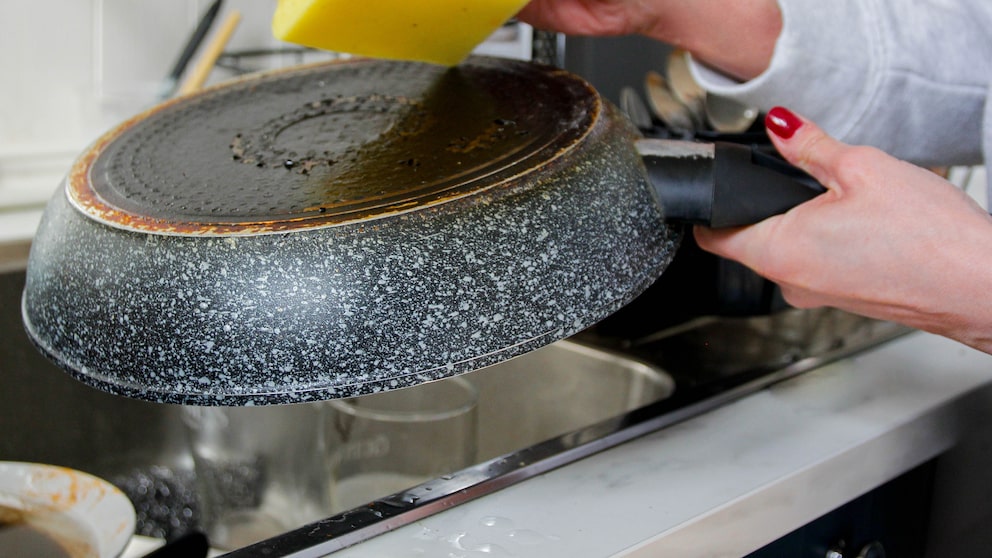
Home cooks know the problem: You buy a new pan, use it several times, and soon a brownish-black layer forms on the bottom. There are numerous home remedies that supposedly help against these deposits. myHOMEBOOK editor Greta Mülverstedt tested three methods and spoke with an expert from the Consumer Center of Saxony-Anhalt.
Whether it’s a stainless steel pan, a coated pan, or a copper pan–a black coating on the bottom appears on many types of pans. When water and dish soap alone are no longer enough, many turn to home remedies. But which ones really work?
Follow myHOMEBOOK on WhatsApp now
How Discolorations Occur
Discolorations quickly accumulate on the bottom of pans. As Alexander Heinrich, a food consultant at the Consumer Center of Saxony-Anhalt, explains, these are residues of organic substances like fats, other food components, and dust that decompose when the pan is heated intensely. This creates “a complex mixture of various decomposition products, some of which can further carbonize. On gas stoves, soot from combustion can also contribute to the dirt,” says the expert.
Baking Soda, Salt, and Dish Soap
The first home remedy promises a quick and efficient cleaning of the pan’s bottom. For this, mix two tablespoons of baking soda, two tablespoons of salt, two tablespoons of dish soap, and one teaspoon of water, then generously spread the paste on the pan. In the test, we used a pan with clearly visible discolorations. Then cover the area with plastic wrap and let it sit for about an hour.
After the soaking time, the dark deposits could not be wiped away easily. In the test, vigorous scrubbing was necessary to remove the layer. Even then, residues remained. For stubborn discolorations, it may be necessary to repeat the application once or twice.
One reason for the reduced effectiveness of this home remedy lies in the chemical structure of baking soda. As a weak base, baking soda can neutralize acidic residues and soften dirt. On grease residues on the pan, baking soda works only to a limited extent due to its low alkalinity, explains Alexander Heinrich. Therefore, the home remedy cannot easily dissolve strong carbonizations.
Also interesting: How to Properly Clean a Cast Iron Pan
Citric Acid Powder and Water
The second home remedy is much simpler: For this, two tablespoons of citric acid powder are mixed with one tablespoon of water until a thick paste forms. This is then generously spread on the bottom of the pan.
The soaking time is 30 minutes. During this time, the paste hardens. To remove the crust, the bottom of the pan should be gently rinsed with some hot water after soaking. Then clean as usual with a sponge. In the test, a difference was noted: The deposits could be removed more quickly than with the first home remedy. However, the pan was not completely clean with citric acid either. For particularly stubborn residues, a second round is necessary.

9 Tips to Remove Deodorant Stains
How to Properly Clean a Cast-Iron Skillet
Soda Solution
The third home remedy uses soda. In a deep container, such as a plate or a large pan, pour about 200 milliliters of water, add a teaspoon of pure soda, and mix it into a solution. Then place the dirty pan with the bottom in the water bath and let the solution work for about an hour.
The soda solution proved surprisingly effective in the test. The deposits separated in the solution, and the remnants could then be removed with a sponge. Since soda has a higher alkalinity than baking soda, it was somewhat easier to remove dirt, Heinrich explains. Especially for grease residues on the bottom of the pan that have not yet carbonized from heat, the addition of soda can help. However, this does not apply to heavily burned-on residues, according to the expert.
The Pan Material is Crucial
Some home remedies not only react to dirt but can also attack the material of the pan. Especially with aluminum pans, alkaline and acidic solutions can cause damage as they attack and alter the pan’s oxide layer, explains Alexander Heinrich. Stainless steel pans are much more resistant to cleaning agents, but the coating can be damaged by aggressive scrubbing.
The Consumer Center of Saxony-Anhalt therefore does not issue a blanket recommendation for home remedies. “Which home remedy is suitable depends on both the chemical composition of the deposits and the material and surface treatment of the pan. What an uncoated steel pan can handle without issue may already cause damage to a coated pan with an aluminum base,” says Alexander Heinrich.
Another important point concerns the consequences of such deposits. Generally, there is no hygienic or health risk if a pan’s bottom is not treated for an extended period. Nevertheless, the expert advises always cleaning the bottom of the pan and following the manufacturer’s care instructions.