


May 21, 2026, 2:57 pm | Read time: 3 minutes
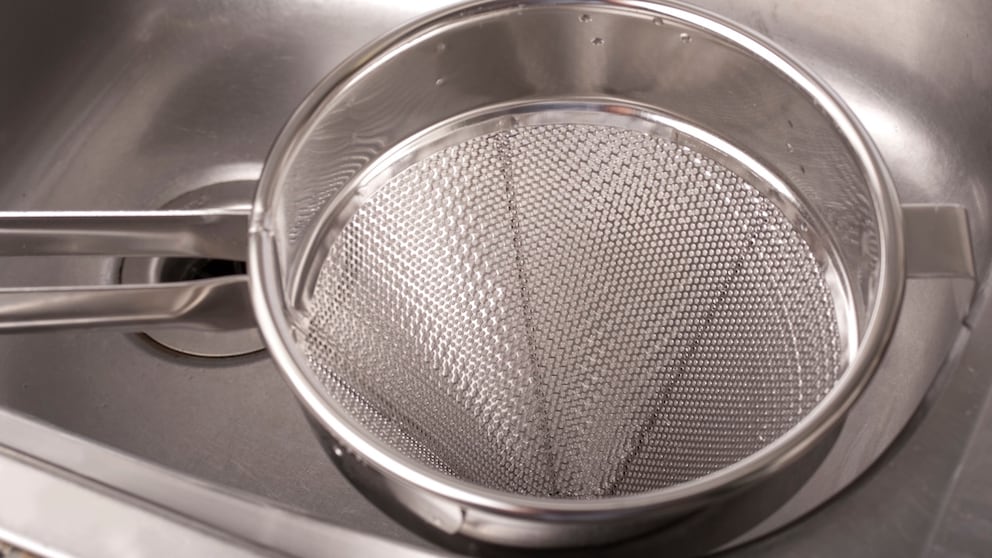
There are kitchen utensils that you use almost daily but never really enjoy cleaning. The kitchen sieve is definitely one of them. Whether after pasta, rice, salad, or fruit: Small food particles often get stuck in the fine mesh and are difficult to remove. When you clean it with dish soap and try to rinse it with water, it’s often hard for the water to reach all areas of the sieve. But myHOMEBOOK reveals a simple trick that makes cleaning the kitchen sieve a breeze in just a few seconds.
The Surprisingly Clever Spoon Trick
Most people probably clean their kitchen sieve like this: You apply some dish soap to the sieve and work it in with a sponge to loosen the dirt. Then you hold the sieve under running water. Here’s the crucial trick: Hold a tablespoon between the water stream and the sieve—with the spoon’s bottom facing up.

This small intermediate step makes all the difference. Instead of the water hitting just one small spot in the center with full force, the stream is fanned out by the curve of the spoon. This allows the water to spread much more evenly over the entire surface of the sieve. As a result, the dish soap reaches all areas of the fine mesh and can more thoroughly dissolve grease, starch, and small food residues. At the same time, the residues are rinsed out more effectively without the need for extensive scrubbing.

With This Simple Trick, Your Blender Will Be Clean in No Time

5 Cleaning Hacks That Save Time
Why Cleaning Kitchen Sieves Is Usually So Tedious
Fine kitchen sieves are practical, but their structure makes them real dirt traps. The tiny openings are particularly problematic, as food residues can get wedged in them. If the sieve is only briefly rinsed, some of it often remains. Once dried, these residues become firmly attached and are difficult to remove later. Often, only intensive cleaning with dish soap and a sponge helps.
Additionally, a normal water stream is usually too concentrated. It mainly hits the center of the sieve, while the edges are barely rinsed. That’s why you usually have to constantly rotate the sieve or clean it from multiple angles.
The spoon trick solves this problem surprisingly efficiently: The broader water distribution reaches the entire sieve at once.
Less Scrubbing, Faster Cleaning
This method is especially practical in everyday life when time is of the essence. After cooking, a quick clean with dish soap and water is often enough, and with the help of the trick, the kitchen sieve is clean again faster. This not only saves time but also protects the fine mesh, which could be damaged by hard scrubbing or scraping.