


May 15, 2026, 11:00 am | Read time: 4 minutes
While in some households the washing machine is filled to the absolute limit, elsewhere it remains half empty. How does this affect the laundry? And what should be considered when dosing the detergent?
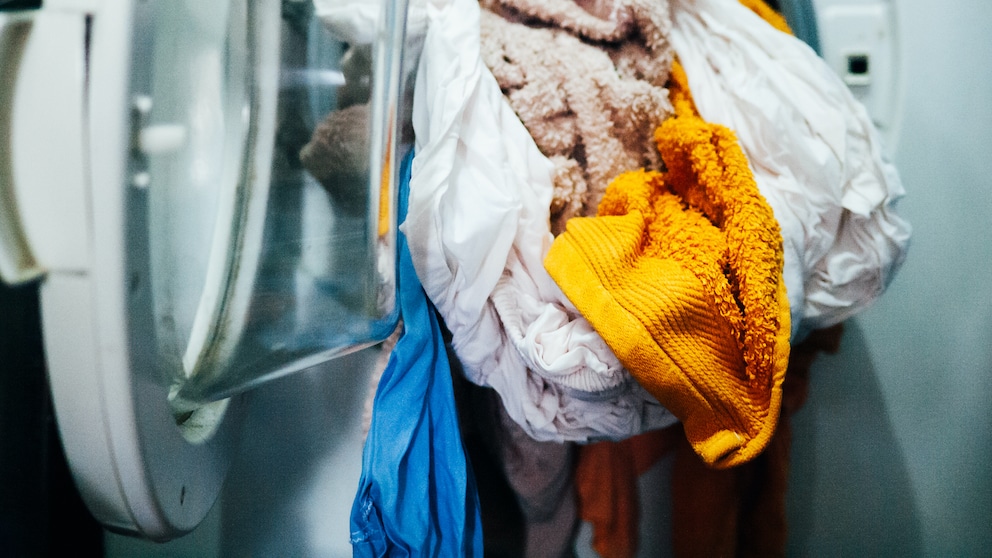
There are some details to pay attention to when washing. Essentially, the small care labels already indicate which wash cycle is suitable for the respective textile. But what about the amount with which you should load the drum? How much can really go into the washing machine—and is it bad if it’s packed to the brim? myHOMEBOOK consulted an expert.
How Full Can You Load the Washing Machine?
“It depends on the type of textiles,” answers Bernd Glassl from the German Cosmetic, Toiletry, Perfumery and Detergent Association (IKW) to the question. You should take a look at the small symbols on the labels. The expert advises:
- For durable textiles with the pictogram “wash tub without a line underneath” on the care label, you can fill the washing machine completely. No space needs to be left.
- For very dense, heavy fabrics, you might want to weigh the laundry beforehand to avoid overloading the machine by weight.
- For more delicate textiles like dress shirts or blouses with the pictogram “wash tub with a line underneath” on the care label, you should only fill the washing machine about halfway.
- If it involves very delicate textiles, such as wool, with the pictogram “wash tub with two lines underneath” on the care label, you should only fill the washing machine about a quarter full.
What Happens if You Overfill the Washing Machine?
If you don’t follow the guidelines, it can sometimes negatively affect the result. “In the less severe case, delicate textiles wrinkle significantly; in very delicate textiles, it can lead to felting,” explains Glassl. Caution is especially advised with wool.
What if There’s Too Little Laundry in the Machine?
But the other case—that is, if the washing machine is underloaded—is not ideal either. The laundry won’t become wrinkled or felted, but the cost per wash cycle skyrockets. Ultimately, the environment also suffers, as Glassl explains. He refers to a study by the Technical University of Berlin, commissioned by the IKW. According to it, the greenhouse potential is 45 percent lower when the drum is loaded with seven kilograms instead of just 3.5 kilograms of laundry.

Should You Wash Clothes and Towels Together?

7 Common Mistakes When Loading and Operating the Washing Machine
What’s the Deal With the “Rule of Thumb”?
There is also a rule of thumb on this topic—literally. According to it, a fist should still fit in the drum. What does the detergent expert say about this? “Actually, the maximum load depends on the mass of textiles,” says Glassl. And the load also concerns the weight. With particularly dense fabrics, such as jeans, this load is reached faster than with light materials because they are heavier. “With a load of many textiles made of ‘heavy’ denim, more than a hand’s width of space remains in the drum if it is not overloaded.” In contrast, with a load consisting almost entirely of synthetic textiles, no hand’s width of space remains.
Should You Then Use Less or More Detergent?
Here, it’s worth looking at the dosing recommendations on the detergent boxes. The quantities differ depending on the type of detergent. Glassl refers to the so-called “Detergent Regulation.” According to it, the dosages for full, universal, and color detergents are based on 4.5 kilograms of dry laundry. For delicate detergents, it’s only 2.5 kilograms of dry textiles.
“If fewer textiles are washed, correspondingly less detergent should be used and vice versa,” explains the detergent expert. Most washing machines can hold seven to nine kilograms of dry, non-delicate textiles. “So if a new washing machine is filled properly, the dosing recommendation can be multiplied by 1.5 or 2,” advises Glassl.
Source:
German Cosmetic, Toiletry, Perfumery, and Detergent Association (IKW)