

July 22, 2021, 9:04 am | Read time: 2 minutes
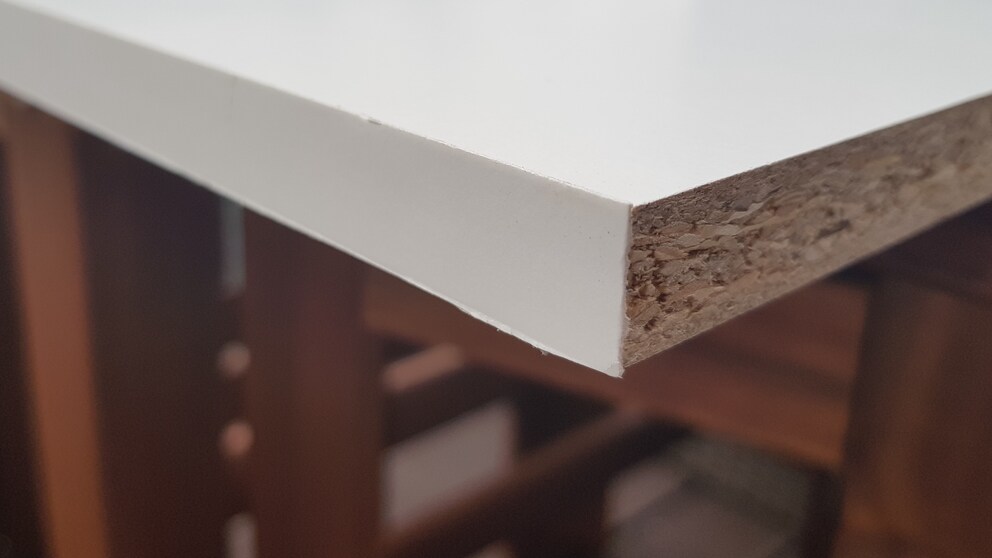
When attaching veneered or lacquered shelves, unsightly and rough saw edges often remain. However, these can be easily concealed with edge banding in the matching color.
There are two types of edge banding. Those that require ironing, for which you need an iron to activate the adhesive, and self-adhesive ones, which require little to no tools. The video tutorial demonstrates the second method.
Applying Edge Banding – Step by Step
In hardware stores, self-adhesive edge banding is available for a few dollars and in various thicknesses. It’s advisable to use one slightly wider than the board. The excess is then trimmed. All you need is a sharp utility knife—or a special edge trimmer, which is also available inexpensively at hardware stores. In this example, a white particle board is used, so a white edge banding was chosen. Here’s how to proceed:
- Remove the protective film from the edge banding.
- Stick the edge banding centrally on the edge and press it down so that it slightly overhangs the top and bottom.
- Carefully trim the excess with the utility knife or edge trimmer.
- If necessary, straighten the edge with a file.
Tip: Some hardware stores with a cutting service also offer edge banding application. It’s best to ask directly if you want to save yourself the work. And a note: In high temperatures or high humidity, there is a risk that the self-adhesive variant may come loose. In that case, the process must be repeated.
Also of interest: Installing furniture knobs and easily sprucing up dressers
Applying Alternative Edge Banding
In furniture construction, it was long common to iron on edge banding. They were equipped with a special hot-melt adhesive that softens under heat and holds securely after drying. Edge clamps provide the necessary pressure. However, this method is somewhat more labor-intensive than applying self-adhesive strips.
There are also edge bandings available without adhesive. For application, contact or construction adhesive is recommended. Apply it to the surface and press it down to allow it to set. Be sure to follow the manufacturer’s instructions. These adhesives hold even at higher temperatures or humidity—such as in the bathroom.