

January 23, 2026, 7:09 am | Read time: 9 minutes
What could be more calming than watching silvery fish behind glass? However, before you set up a small, dazzling underwater world in your own four walls, you should clarify a few basic questions.
An aquarium in your house or apartment is the perfect balance to the hectic pace of everyday life. But before you get started, there are a few important decisions to make and steps to follow. So let’s get down to business and get started!
1. Finding the Right Location
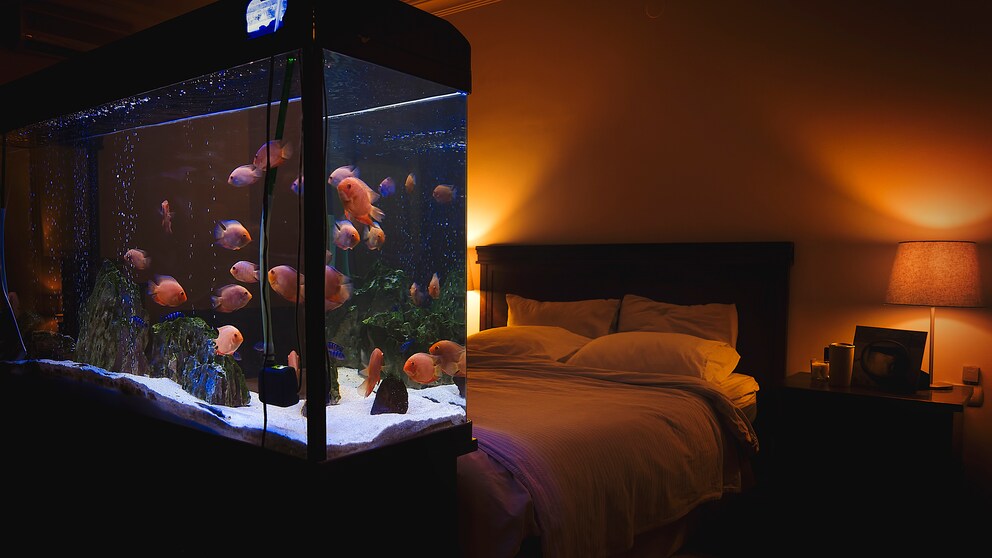
It’s best to think about where you want to place the aquarium in your home before you buy it. Then you can adjust the dimensions accordingly. The further away the aquarium is from direct sunlight, the better! This is because the sun causes algae to form. Aquarium expert Michael Madeya recommends: “The aquarium should ideally be placed in the darkest part of the room. And the room should have a normal living room temperature.” As fish are sensitive to sound waves, please do not install the aquarium directly next to loudspeakers or a stereo system.
2. Choosing a Base Cabinet
The base cabinet is also important, as an aquarium with its contents can become really heavy. With dimensions of 80 x 35 x 40 centimeters, you should expect a total weight of 100 kilograms. Smaller aquariums can be placed on a chest of drawers or a shelf. For larger tanks, it is advisable to buy a suitable base cabinet from a specialist retailer or a combination model. You can store equipment and accessories in the lower cabinet space. If you opt for a DIY version, you can build your own cabinet from aerated concrete, bricks, aluminum shelves, or square timber.
To ensure that the aquarium is level, a foam base or thin polystyrene sheet should be placed between the tank and the substrate. The carpet pad also prevents the glass bottom from cracking due to punctual loads, for example, from a grain of sand. A spirit level can be used during installation to check that everything is really level.
3. Buying an Aquarium
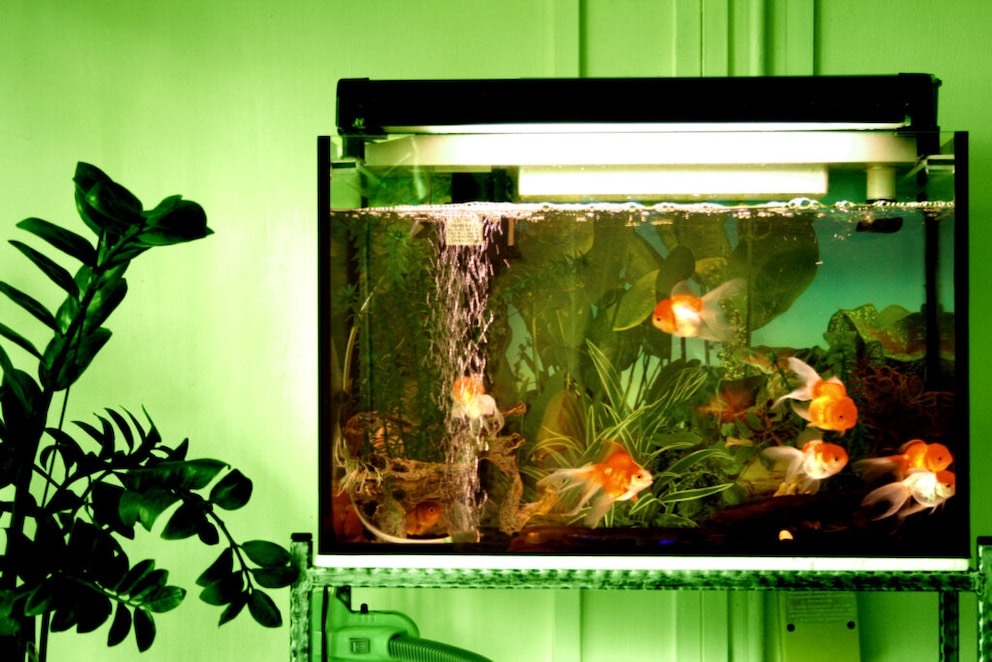
Everything is possible, from a small “nano-cube” to a pentagonal custom-made aquarium. The standard sizes are 60 and 80 centimeters in length. However, you can also keep only shrimps and suitable mini fish in a nano tank. If you want to keep certain fish, ask your pet shop about the ideal tank size. A freshwater aquarium is definitely suitable for beginners.
“The fewer liters, the more difficult it is to maintain the biological balance,” Madeya points out. “The water can therefore tip over more easily.” Incidentally, you can’t keep the famous goldfish in a bowl. “According to the Animal Welfare Act, this is cruelty to animals. Fish need a reference point, which is not provided in a round bowl. A filter system is always recommended—whether 10 liters or 50,000 liters.”
4. Setting Up the Substrate and Decoration in the Aquarium
Depot fertilizer is used as the bottom layer, as it contains important plant nutrients. Special sand or gravel is filled on top. Fine-grained quartz gravel is suitable as a substrate for most types of aquariums. It must not be sharp-edged, as bottom-digging fish, such as small catfish, could otherwise injure themselves. It is ideal for the plants if the substrate is not too low. For a 60-centimeter aquarium, it should be at least 6 centimeters high. If you are laying underfloor heating cables, you should not use fine sand, as the heat dissipation will then no longer work. Another disadvantage of sand is that the soil is less aerated, which can lead to rotting. You should also be careful with lava soil. Although it is very suitable for sculpting, it is extremely sharp-edged.
Decorative elements are not just for the sake of appearance, but are also important as hiding places for the fish. Black slate, basalt, or granite are ideal. They do not contain lime and can be stacked easily. Stones containing lime are only suitable for hard water fish. You should only choose one type of stone, as otherwise it could look very unbalanced. Aquarium roots (bogwood or stone roots) also offer hiding places, and you can attach sit-on plants to them. Some fish species, such as dwarf cichlids or loricariid catfish, love small caves. These can be bought ready-made from clay or coconut in specialist shops.
Caution: Never put fresh wood from the forest or garden in the aquarium! Care should also be taken when adding fertilizer, as it can swirl up and cloud the water.
5. Installing a Light Source
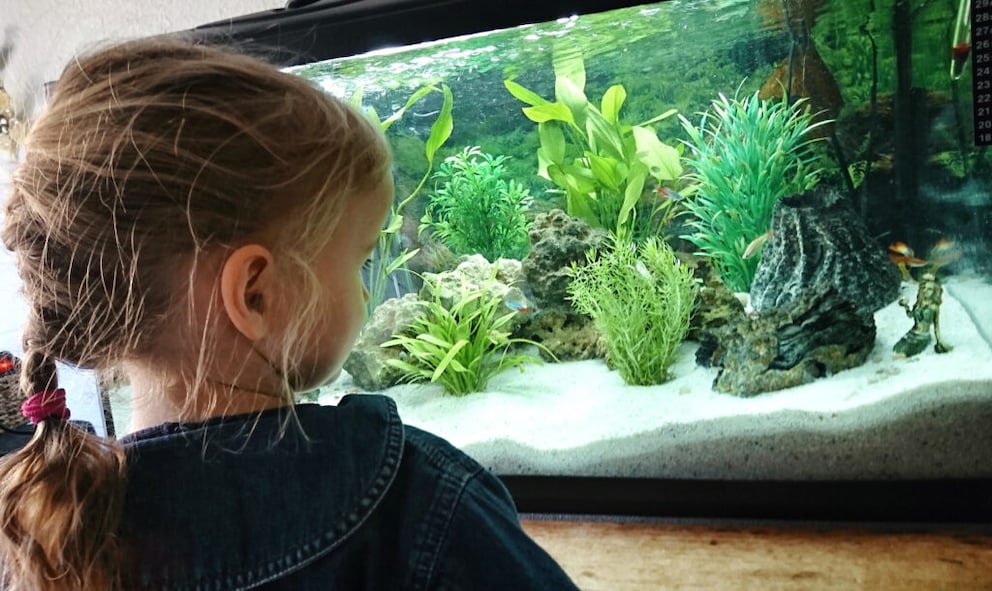
When setting up the aquarium, don’t forget the light. The right lighting not only supports the growth of the plants but also ensures a balanced day-night rhythm. If necessary, the lighting can be controlled using a timer. Some aquarium covers already have integrated lighting. Alternatively, there are adjustable LED top lights. These allow you to influence the lighting effect particularly well.
6. Setting Up the Technology in the Aquarium
In tropical waters, water temperatures of around 24 degrees Celsius prevail all year round. This water temperature is also recommended for almost all aquarium fish. The easiest way to keep this temperature stable is to use a rod heater. The control heater should be placed in a rear corner of the aquarium where it is easily accessible but still inconspicuous. A thermometer should be used to keep an eye on the heating values on a daily basis.
The heart of a healthy ecosystem is the filter. Both internal and external filters are available from specialist retailers. The choice is ultimately a matter of taste, as the filter performance depends primarily on the quality and volume of the filter material. Cartridge filters, which can be attached to the glass using suction cups, are particularly popular as internal filters. The “Hamburg mat filters” are more voluminous, but also more efficient. Here, the motor pump is hidden behind a foam mat. Canister external filters have a longer service life and are well-suited for large and heavily stocked aquariums.
7. Choosing the Right Plants
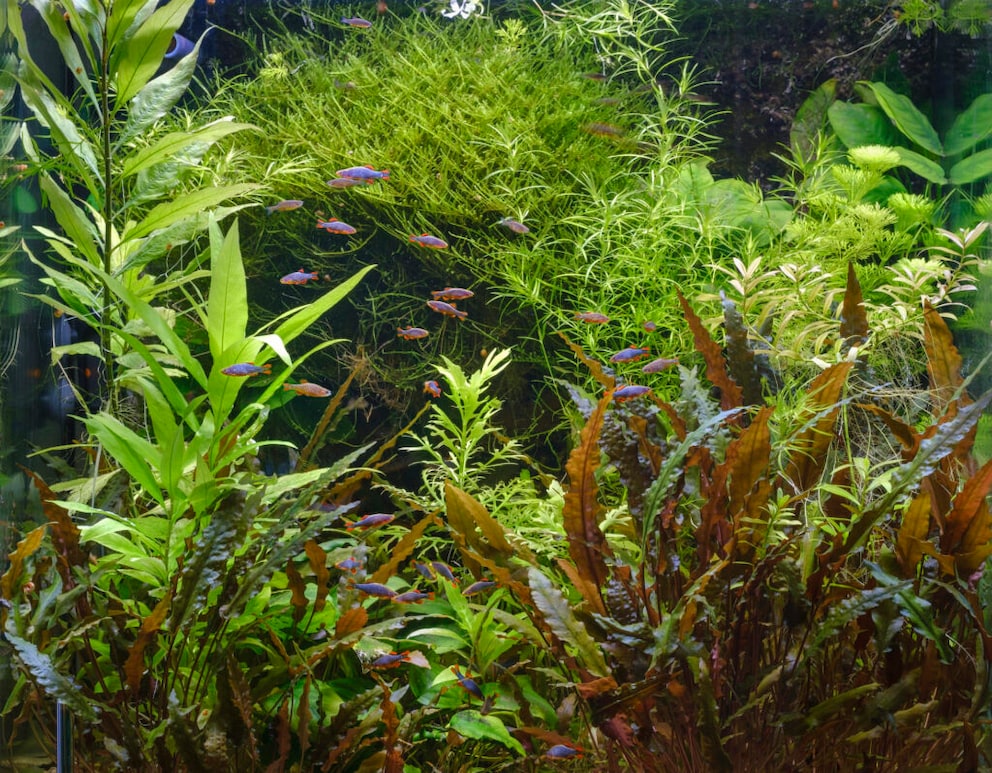
Plants can not only be used to create beautiful underwater landscapes, but they also ensure a clean, stable environment in the aquarium. They also offer fish protection and orientation. The following plants, for example, are suitable for beginners setting up an aquarium:
- Hornwort (Ceratophyllum demersum): ideal as an initial planting, grows quickly and binds excess nutrients in the water, displaces algae and, as a floating plant, also provides fish with cover from above.
- Black Amazon sword plant (Echinodorus parviflorus): requires plenty of light and sufficient bottom fertilization.
- Water spiral (Vallisneria americana): Favorite for all aquariums, also does well in very hard water.
- Brazilian pennywort (Hydrocotyle leucocephala): easy to care for and decorative, especially for soft water aquaria.
- Java moss (Vesicularia dubyana): rich green color and beautiful structure, very undemanding in terms of water quality.
- Round-leaved Rotala (Rotala rotundifolia): grows quickly, with beautiful reddish to pink coloration.
8. Filling and Regulating the Water
Water can be added using either a hose or a bucket. In any case, you should place a flat plate on the substrate and pour the water slowly onto it so that the substrate is not stirred up. Initially, only fill the water to a height of 10 to 15 centimeters. Now introduce the plants. Larger plants should be placed in the background.
Remove the purchased plants from the pots and trim the roots slightly with scissors. Drill holes in the substrate with your fingers and place the plant in them. The water will automatically become a little cloudy during planting. A day later, however, the aquarium will be clear again. It may take a few weeks before the plants look lush.
Should You Repot Plants Immediately After Purchase?
Discount Steamer Put to the Test–Is It Really Worth It?
9. Introducing Fish and Other Inhabitants
“While aquatic plants are introduced immediately, you have to start slowly with animals,” explains Michael Madeya. “You should wait two to three days after the first water intake. Then the first animals can move in. Our recommendation is to start with five to six antenna catfish, which helps the biology get going. The nitrite level must be checked every two days, and if it rises too high, a partial water change must be carried out. This is the running-in phase (with the so-called nitrite pick), which can last around four to six weeks. The aquarium can then be stocked with more fish. There are also starter bacteria on the market that can speed up the process.”
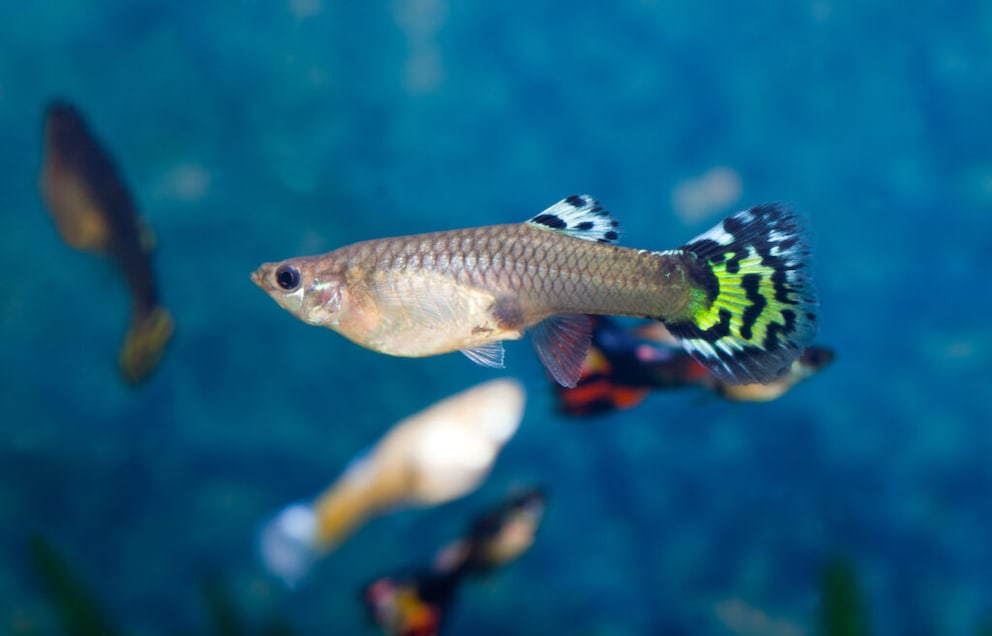
These fish are well-suited for the first attempts with your own aquarium:
- Cardinals (Tanichthys albonubens): super beginner fish, eager to eat and spawn, no great demands on water quality.
- Zebrafish (Danio rerio): active swimmer, needs a shoal of at least 10 animals.
- Swordtail (Xiphophorus helleri): one of the best-known aquarium fish, ideal for slightly larger aquariums, with offspring every two months.
- Red neon tetra (Paracheirodon axelrodi): likes soft water and occasional live food, schooling fish.
- Coral platy (Xiphophorus maculatus): bright red coloration, very undemanding.
- Dwarf gourami (Colisa lalia): very colorful, peaceful, likes to live in pairs.
- Hatchetfish (Thoracocharax securis): fast and active schooling fish, needs a cover over the aquarium as it likes to jump.
- Dwarf loricariid catfish (Otocinclus hoppei): Bottom fish, likes to eat algae and therefore resembles a natural cleaner.
- Greenfin barb (Crossocheilus siamensis): also an algae eater, lively, and needs at least 5 conspecifics.
Before setting up the aquarium, be sure to seek advice from a specialist retailer about which fish can be combined with each other and what their needs are. Shrimps and crayfish can be an exciting addition, but must also be carefully matched to the ecosystem. “However, it is better to create a species tank for these animals. For example, a separate shrimp or snail tank.”
10. Care Tips for the Set-Up Aquarium
According to Michael Madeya, you don’t actually need to spend a lot of time on maintenance once you have set up the aquarium. “You should feed them every day and check the temperature. You should also make sure that the fish are healthy and lively and, depending on the fertilizer system, add a daily fertilizer. A partial water change is recommended every fortnight. Depending on the fish population and filter size, the filter needs to be cleaned about once a month.”