


November 26, 2026, 12:18 pm | Read time: 6 minutes
Stiff in the back in the morning and tense in the neck during the day? Then it’s worth taking a look at your mattress. Without trying it out, buying one quickly becomes a mattress lottery. myHOMEBOOK asked Öko-Test what to consider when choosing one.
The right mattress depends primarily on your body, less on the bed. “A good mattress should ensure that we can truly recover during sleep: no back pain, no neck problems, no uncomfortable pressure,” explains Christine Throl from Öko-Test when asked by myHOMEBOOK. For this, the spine should lie relaxed and naturally. At the same time, the mattress adapts to the body, supporting in the right places and relieving pressure in others.
Innerspring, Foam, Latex: The Most Important Types of Mattresses
How well this works also depends on the mattress’s interior. The most common types are innerspring, foam, and latex mattresses. Innerspring mattresses contain steel springs. In pocket spring mattresses, each spring is encased in its own fabric pocket, so the mattress only gives where the body presses. The simpler Bonnell spring mattress does not have this individual springing. Foam mattresses come in various types, such as cold foam or viscoelastic foam, which slowly yields under pressure and gradually returns to its shape. There are also special forms like waterbeds, air core mattresses for individual filling, and futons, which are Japanese sleeping mats.
“All types of mattresses have their pros and cons,” the Öko-Test expert clarifies. The springs in innerspring mattresses create a pumping effect when moving, which ventilates the mattress well. This benefits people who sweat heavily at night. Foam, on the other hand, insulates well against cold, which is advantageous for people who get cold easily. Foam mattresses are also elastic and usually lighter to lift than latex and innerspring mattresses. Viscoelastic foam relieves pressure from the body. On the other hand, you sink deeply into it at night and move less easily. Latex is considered particularly elastic. The material adapts to the body and provides support even for heavier weights.
The bed’s slatted frame is also crucial. Latex mattresses are very flexible and therefore fit well with adjustable slatted frames. Cold foam mattresses also bend well when the head or foot section is raised. Pocket spring mattresses are only somewhat suitable for this, while Bonnell springs are too rigid.
Related: 6 Tips to Extend the Life of a Mattress
How the Right Mattress Feels
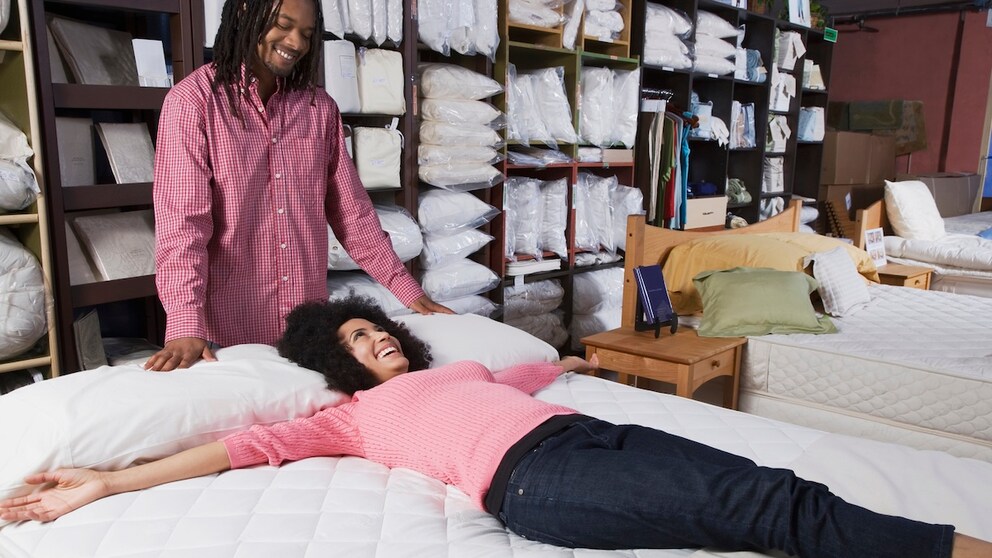
Which type of mattress ultimately fits is only revealed by lying on it. “Extensive trial lying is very important when buying a mattress,” emphasizes Christine Throl. You lie well when the spine maintains its natural shape and the lumbar area feels supported. A hollow back does not form. In a side position, the shoulders should not be too high.
A mattress that is too hard does not allow the shoulders and hips to sink in when lying on your side, causing the spine to bend. On a mattress that is too soft, the body sinks in too deeply. “If it’s too soft in the hip area, it can feel like lying in a hammock. Then the body is not supported well enough,” describes the Öko-Test expert.
The zones also have an impact. Many mattresses are softer at the shoulders and hips than at the lumbar region. According to the lab commissioned by Öko-Test, highly zoned mattresses are more suitable for people with pronounced body contours. This includes women with very narrow waists compared to shoulders and hips, men with broad shoulders, and people with a hollow back. Less zoned models are more suitable if shoulders, waist, and hips are about the same width. For some people, a highly zoned mattress creates too much pressure in certain areas. Those sensitive to pressure should look for good point elasticity. The mattress then only gives at the loaded spot.
In the Öko-Test practical test with latex mattresses, the same lab tested the support effect for three body sizes and weight classes. Some models suited everyone, while others were mainly suitable for smaller and lighter people.
Also interesting: Yellow stains on the mattress? Here’s how to clean them properly
Tips for Trying Out Mattresses
To make the trial lying in the store meaningful, a few tips help:
- Remove coat, jacket, thick scarf, and belt. This creates a real sleep situation without pressure points.
- Bring your own pillow or choose one that matches the mattress.
- Bring your partner if both will sleep on the mattress.
- Try lying in the position you usually fall asleep in.
- Check if the spine lies naturally and the lumbar area feels supported.
- In a side position, ensure the shoulders are not too high.
Firmness, Material, Size–How to Find the Right Mattress

5 Criteria That Play an Important Role in Children’s Mattresses
Price, Care, and Durability
Besides the feel, price is also important when buying. In the current mattress test by Stiftung Warentest, the tested models cost between 70 and 1,300 euros. Latex mattresses are more complex to produce, so their starting price is higher than that of traditional foam and innerspring mattresses. In the Öko-Test practical test, the latex models cost between 649 and 1,130 euros.
Latex is also considered particularly durable and dimensionally stable. However, other mattresses can also last a long time, emphasizes Christine Throl. For foam, the density provides a clue. It describes how dense the foam is. The higher the value, the more elastic and durable the material. The optimal range is 45 to 55 kilograms per cubic meter. Öko-Test advises against buying below 35 kilograms. Öko-Test also considers innerspring mattresses to be long-lasting.
When buying latex, it’s worth looking at some details. Latex mattresses have a typical inherent odor. In the practical test, it was noticeable in all models but varied in intensity. A new latex mattress is best aired out for a few days in a little-used room. The label of the Quality Association for Environmentally Friendly Latex Mattresses (QUL) provides guidance. The association tests for substances, elasticity, and durability, among other things. Because latex mattresses are heavy, handles make turning easier. Too tight bed sheets also hinder elasticity.
Regular turning ensures even wear for most mattresses. During the day, it’s best to leave the mattress uncovered. This allows the night’s moisture to escape, preventing mold. A removable, washable cover makes care easier.
House dust mites thrive in all types of mattresses. For allergy sufferers, there are special covers that reduce exposure. Öko-Test also recommends that allergy sufferers give the mattress plenty of fresh air and regularly vacuum it with the upholstery nozzle.
When a Mattress Has Worn Out
Over the years, even the best care reaches its limits. Sweat and skin flakes penetrate the mattress core despite bedding and covers. After seven to ten years, a mattress is often considered worn out. Manufacturers also recommend a change within this period for hygiene reasons. A permanent indentation also indicates when a replacement is due. “If you regularly wake up tense and unrested, you might want to consider how long you’ve had your mattress,” summarizes the Öko-Test expert.