

October 2, 2026, 10:04 am | Read time: 5 minutes
What could be more beautiful in the fall than a long walk through the colorful, changing forests? If you’re in the mood, you can also look for fruits during this time, as there are quite a few to find in the fall. And the best part: some of them are even edible. myHOMEBOOK explains which fruits you can collect and what you should consider when preparing them.
Follow myHOMEBOOK on WhatsApp now
These Fruits You Can Collect and Eat in the Fall
Many of us associate fall more with carving pumpkins or collecting mushrooms. But few think about the fact that nature has so much more delicious to offer. Especially in the fall, you can find some tasty fruits.
Acorns
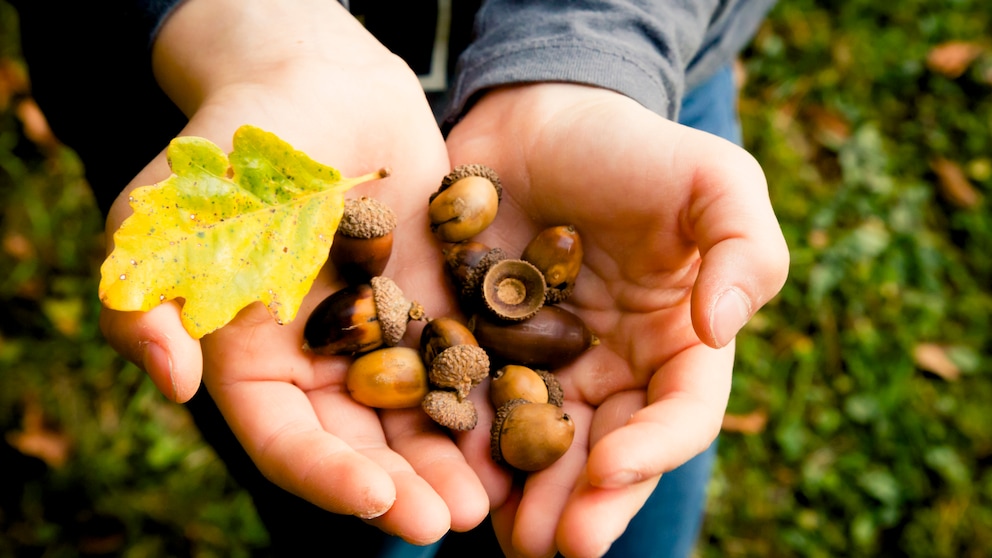
Acorns ripen from September to October on oak trees, then fall down and are a popular collectible for small children. Sometimes the little caps of the acorns land on the ground with or without the acorn. If you want to find these small fruits, you should look in parks, deciduous or mixed forests, but also at the edge of the forest. Because: Acorns can not only be collected in the fall but also eaten!
Note: Acorns should never be eaten raw but always prepared. In their raw state, the fruits contain tannins–the so-called tannins. These are bitter and can cause stomach pain, nausea, and diarrhea.
If you want to prepare acorns, you should soak them beforehand. This process can last a whole week, but it is important because it allows the bitter substances to be removed easily. First, the acorns are peeled and freed from the seed coat. The remaining kernels should then be placed in a bowl of lukewarm water. This water must be poured off and renewed up to five times a day. You should repeat this process every day for a week. Until the water is no longer brownish and the fruits have lost their bitter taste. After that, you can dry the kernels and finally consume and process them.
Also interesting: Do you have to peel edible pumpkins?
Chestnuts
Chestnuts are considered a popular snack, especially in the fall. They are often referred to as “sweet chestnuts,” but even though both fruits are related, they are not the same. The chestnut belongs to the sweet chestnuts but is a subspecies that is specially bred and more refined than the pure sweet chestnut.
Chestnuts and sweet chestnuts should not be confused with regular chestnuts, which can be found in the forest or often by the roadside. The leaves of sweet chestnuts are serrated at the edges, and the fruit shell is covered with small spines. Inside, there are usually two to three fruits tapering to a point at the top and bottom.
The common chestnut is characterized by hand-shaped leaves, while the fruit shell shows more individual spines. Looking inside, you find a rather round fruit. The common chestnut should not be eaten. It is inedible and causes stomach pain, nausea, and vomiting. The culprits are the so-called saponins, plant substances that taste slightly bitter.
If you want to prepare chestnuts yourself, you should clean them first, then score them crosswise with a knife and bake them in the oven until they are lightly browned.
Rose Hips
Rose hips are common fruits in the fall. They can be found not only in your own garden but also in forests or by the roadside. You should collect them before the first frosty temperatures, so rather in September and October–at least if you want to use them for a tasty tea. On the one hand, the fruits are still firmer then, and on the other hand, thanks to the still dry and mostly sunny days, their vitamin C content is still at its highest.
If you want to make jam from rose hips, you should wait until November or until the first frost. Then the fruits taste sweeter. The reason for this is the conversion of starch into sugar in the fruit flesh.
Sea Buckthorn
Sea buckthorn is also one of the most popular fruits that can be collected and eaten in the fall. Between early September and mid-October, you should pick the berries, as they still shine in a vibrant orange and are softer. That’s exactly when you should definitely harvest the fruits, or the birds will do it, as sea buckthorn is also popular with thrushes, starlings, and waxwings.
If you want to process the berries and prepare them into a delicious juice, you should first wash them thoroughly under cold water. Then the berries should be heated with water (water/berries ratio 1:4) and briefly boiled. Let the mixture steep for a few minutes with low heat under the lid. After that, you can press the liquid through a sieve. This way, you separate the seeds and the peel from the actual juice. If desired, you can also sweeten it with sugar.
Important for everything: Always collect only the fruits that you can clearly recognize and identify as such.