


March 15, 2024, 1:09 pm | Read time: 5 minutes
For some privacy in the garden or on the balcony, you can plant evergreen shrubs. As their name suggests, these plants add color with their foliage even in ice and snow. Plant enthusiasts can learn how to properly plant and care for them at myHOMEBOOK.
In the cooler months, both gardens and balconies or terraces often look bare and bleak. The flower beds and planters reflect the dull gray of the sky. Evergreen shrubs provide some color during this time. But not only that: In summer, these plants can also be quite a sight. They often bear lush blooms and bring an exotic flair to the garden bed. Other species are suitable as borders or privacy screens. myHOMEBOOK presents some of the most popular ones.
5 Evergreen Shrubs for Garden and Balcony
There are many evergreen shrubs that also grow in local gardens. A selection:
1. Japanese Andromeda (Pieris japonica)

The Japanese Andromeda, also called Lily of the Valley shrub, originates from East Asia but also thrives in local gardens. Its leaves are leathery, glossy, and a deep green. In spring, it produces white or pink flower clusters that are also popular with bees.
In the garden bed, it’s best to choose a semi-shaded location. The soil should be well-drained, humus-rich, and acidic. In spring, you can prune the evergreen shrub. Good to know: The Lily of the Valley shrub is toxic in all parts.
2. Boxwood (Buxus sempervirens)

As a privacy screen or simply as decoration along the path, the evergreen Boxwood is ideal. It is particularly tolerant of pruning, allowing the shrub to be shaped into any desired form. The plant does not have high demands on its location: both sunny and shady spots are possible.
As a shallow-rooted plant, it’s important to regularly water Boxwood. However, waterlogging should be avoided. If you want to cultivate the shrub in a container, you should incorporate a drainage layer of clay shards or gravel.
3. Firethorn (Pyracantha)

Throughout the year, the Firethorn is an asset to the garden. In spring, it features cream-white flowers. Its upright and dense growth form provides privacy in summer. In fall, it boasts many orange and red berries. In winter, the green leaves remain, adding a splash of color.
The Firethorn requires little care. It hardly needs watering. Fertilizing is done once in spring with some compost.
4. Oregon Grape (Mahonia aquifolium)

When you plant the Oregon Grape in the garden, you can enjoy not only the visual appeal of the yellow flower clusters but also the pleasant honey scent. The ideal location is wind-protected and semi-shaded. There, the bright yellow flowers may appear as early as February.
Smaller varieties of Oregon Grape can also be cultivated in containers on the balcony. In that case, it can be helpful to integrate a drainage layer in the pot.
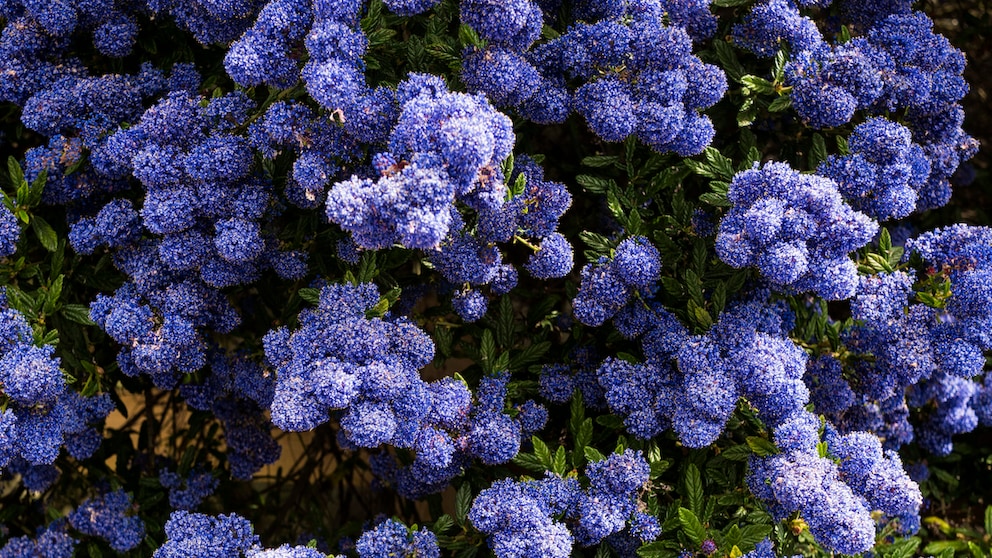
5. California Lilac (Ceanothus thyrsiflorus)

The genus Ceanothus is known for its evergreen nature–the California Lilac is no exception. This small shrub prefers a sunny and warm spot in the garden bed or on the balcony. The soil should be sandy and calcareous.
The evergreen shrub is relatively frost-sensitive. Therefore, planting in spring is recommended. Older plants are pruned again in spring.
The Right Time to Plant Evergreen Shrubs
Evergreen shrubs should be planted in spring or fall. Perennials like the Ceanothus are best planted from late September to early December, while frost-sensitive plants like yew or boxwood should be planted from early March to May, when the ground has thawed after winter.
Tip: Hornbeams, beeches, rhododendrons, and cherry laurels are a bit more demanding and root better if planted between April and March.

6 hardy potted plants for the garden and balcony

Dense, Fast-Growing, Evergreen – 14 Popular Hedge Species for the Garden
How to Prepare the Soil Before Planting
Besides the right timing, location and soil preparation are also important. Ideal growing conditions are created by loosening the soil 16 to 24 inches deep and removing stones and weeds before planting. A compacted, impermeable substrate is more prone to waterlogging after heavy rains and could cause water shortages during dry periods.
It is also important to give the roots enough space to spread by digging the planting hole at least one and a half times as wide as the plant. A drainage layer of gravel or sand further improves the soil’s water permeability. To ensure that the evergreen shrubs remain vibrant, they need essential nutrients. These can be worked into the soil during planting in the form of compost or bark humus.
Once the hole is filled with soil and lightly watered, it is advisable, especially for individual plants, to cover the soil with bark mulch. This keeps the soil moist, benefits soil life, and also protects against pesky weeds.
The Right Care for Evergreen Shrubs
Even evergreen plants need some care and especially water–even in winter. It’s best to water the plants on frost-free days. You can tell if the plants need water if the leaves lose color, turn brown in some areas, or curl up.
In case of snowfall, it’s best to remove the white burden from the branches as soon as possible to ensure the shoots are not damaged. Once a year, preferably before new growth in spring or in late fall, prune back the old, dead shoots to rejuvenate the plant and encourage new, healthy growth. Smaller shrubs like the Lily of the Valley shrub require no pruning due to their slow growth and manageable maximum size.