


August 6, 2026, 11:28 am | Read time: 6 minutes
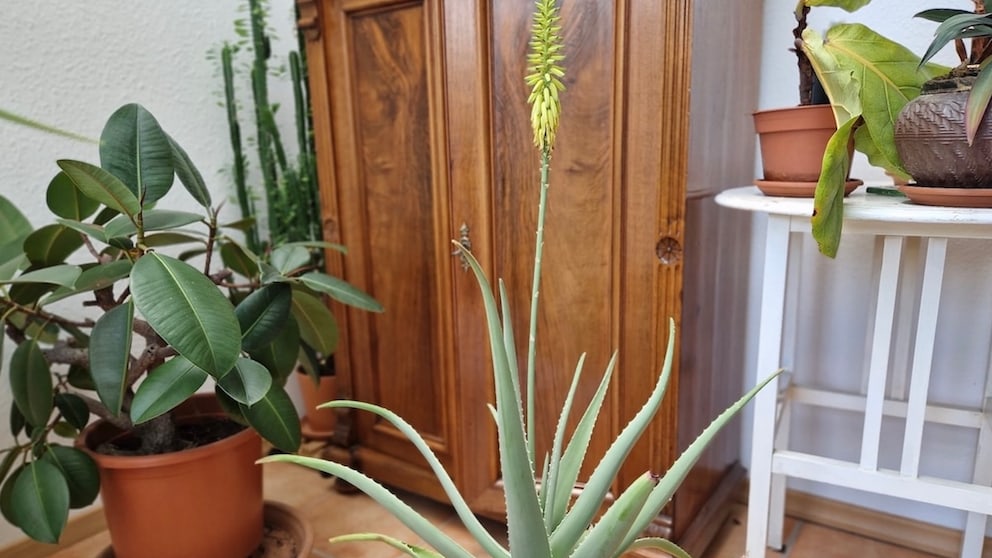
Aloe vera is considered an easy-care houseplant. Many know it for its healing gel, but few have seen its flowers. Under the right conditions, this succulent can develop an impressive flower spike with yellow, orange, or reddish tubular flowers. However, it requires some patience and proper care. myHOMEBOOK gardening expert Franka Kruse-Gering explains how to get Aloe vera to bloom.
Why Does Aloe Vera Rarely Bloom Indoors?
In its natural environment, Aloe vera blooms much more frequently than on a home windowsill. This is mainly because the plant finds much better conditions in the warm and sunny regions of its origin. There, it is exposed to many hours of intense sunlight and experiences natural temperature changes between seasons. These stimuli promote flower formation. Indoors, however, there is often a lack of sufficient light, and temperatures remain relatively constant year-round. Additionally, Aloe vera must reach a certain maturity before it can bloom. It often takes three to four years for a flower spike to appear for the first time. Under less favorable conditions, it can take significantly longer.
Light Is the Top Priority
If you want your Aloe vera to bloom, you should pay particular attention to the right location. The succulent originally comes from sunny and warm regions and therefore relies on as much light as possible. A spot at a south or west window is ideal, as the plant receives direct sunlight for many hours there. If the light supply is insufficient, Aloe vera focuses mainly on forming new leaves and often forgoes the energy-intensive blooming.
Particularly good conditions can be created if the plant is allowed to move outdoors in the summer. On a balcony or terrace, it usually gets significantly more light than indoors, which can promote flower formation. However, it is important not to place Aloe vera in direct sunlight immediately after winter. It is better to gradually acclimate it to the stronger sunlight to prevent leaf damage.
In general, the brighter the location, the greater the chances of blooming. To gather enough energy, the plant should receive several hours of direct sunlight daily. Only under such conditions does Aloe vera often develop the strength to produce a flower spike.
Remember the Winter Rest
For Aloe vera to develop flowers, it needs a rest period in winter. During this time, the plant should be kept significantly cooler than during the growth period. Ideal temperatures are between 50 and 59 degrees Fahrenheit, and the succulent still needs as much light as possible. This combination, however, presents a problem for many plant enthusiasts: Bright window spots are often in heated rooms, while cooler areas like stairwells, basements, or garages often do not offer enough daylight.
To give your Aloe vera the best chance of blooming, you should look for a spot that is as bright and cool as possible, such as in a minimally heated bedroom, a conservatory, or a frost-free stairwell with a window. During the winter rest, watering should also be very sparing. The soil should dry out largely between waterings, and additional fertilizer is not needed during this time.
The cool overwintering plays a crucial role in flower formation. It signals to Aloe vera that the rest phase has begun. When temperatures rise again in spring and light intensity increases, the plant essentially receives the signal for a restart. Only this change between winter rest and growth phase encourages many specimens to develop a flower stalk. If Aloe remains in a warm living room year-round, it often continues to grow without issue but blooms much less frequently.
Water Less Instead of Pampering
A common care mistake is excessive watering. Aloe vera comes from dry regions and is perfectly adapted to longer drought periods. In its thick, fleshy leaves, it can store large amounts of water and therefore copes much better with drought than with constantly moist soil. Many plant enthusiasts treat the succulent like a regular houseplant and reach for the watering can too often.
For healthy growth and later flower formation, it is important to let the soil dry out well between waterings. Only when the substrate is largely dry should it be watered again. If the plant is constantly moist, not only does the root system suffer. Aloe vera then invests its energy mainly in coping with the stress factor instead of building reserves for flower formation.
Waterlogging is particularly problematic. If water remains in the pot or saucer, the roots can rot. As a result, the plant often grows poorly, and the likelihood of blooming decreases significantly. Excess water should therefore always be able to drain freely. Equally important is the right substrate: A loose, well-draining cactus soil ensures that moisture quickly drains away and enough air reaches the roots. This creates conditions that are much closer to Aloe vera’s natural habitats.

Yellow Tips on Aloe Vera? Here’s What Could Be Causing It

5 Houseplants That Survive Vacation Without Care
Fertilize Sparingly
Restraint is also required when fertilizing. Aloe vera is one of the plants that manage well with relatively few nutrients. During the growing season from spring to summer, an occasional special cactus fertilizer can be useful to support growth. However, the undemanding succulent usually needs no more than that.
Over-fertilizing often achieves the opposite of the desired effect. If the plant has a constant supply of nutrients, it invests its energy mainly in forming new leaves. The result is a vigorously growing Aloe vera, but the hoped-for bloom often does not occur. For flower formation, the plant needs a certain balance: enough light, the right winter rest, and a rather restrained supply of water and nutrients. Only when these factors come together do the chances increase that a flower stalk will develop.
Additional fertilizer should therefore be used sparingly and selectively. Regular repotting into fresh substrate often provides the plant with everything it needs for healthy growth.
Patience Is Part of It
Even under optimal conditions, a bloom cannot be forced. Aloe vera must first reach a certain size and maturity. However, providing your plant with a sunny location, well-draining substrate, and cool overwintering significantly improves the chances.
Once the plant has gathered enough energy, a long flower stalk grows from the center of the leaf rosette, where numerous flowers gradually open. These can last for several weeks, turning the otherwise rather inconspicuous houseplant into a real eye-catcher.