

January 21, 2026, 2:18 pm | Read time: 3 minutes
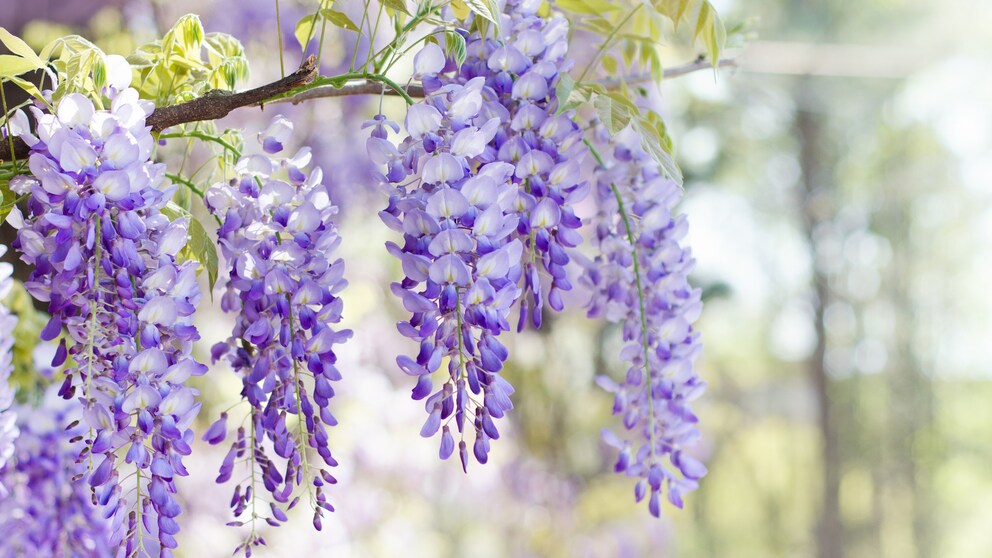
The wisteria has a very special allure in the spring. Its blossoms are a radiant blue and emit a strong fragrance. However, this vigorous climber is quite heavy, with implications.
It can take over entire house facades in no time at all, and its lush flower clusters are a spectacular sight in spring: The wisteria has more to offer than many other climbing plants. But it grows so heavy that it is not for every garden. Experts reveal what amateur gardeners should know.
Where in the Garden is Wisteria Suitable?
Wisteria, also known as blue rain, is a scaffold climber. It therefore needs a trellis on which the shoots can twine upwards. Wisteria is therefore suitable for a location on a pergola, archway, or wall, for example. Till Hägele from the Munich-Nymphenburg Botanical Garden also recommends the climber for banisters. The advantage here: You can easily reach the plant for pruning.
Which Walls Are Suitable for Wisteria?
As wisteria can develop great weight and strength over the years, a stable scaffold or trellis is required on the façade. This is because the climber can strangle and crush thin-walled trellises and rain gutters with its twisting movements.
“On a sunny day, individual tendrils can grow up to 20 centimetres,” reports Michael Henze from the German Federal Association of Gardening and Landscaping (BGL). The shoots also increase in size and should therefore be kept away from windows and blind boxes. Henze recommends a stainless steel or metal construction with struts at least four centimetres thick as a basic framework on the wall.
And the expert advises installing the scaffolding at a distance of 20 centimetres from the house wall. As a general rule, the façade should be intact, not ventilated, and not covered with shingles, or else there is a risk of damage from the wisteria.

4 Common Mistakes in Wisteria Care

Why Wisteria Might Not Bloom
What Should I Look Out for When Planting?
Wisteria is usually sold as a young plant in a pot—from around one meter with a pot size of twelve centimeters, explains Hägele. If the plant is still small, it may not yet produce any or only a few flowers.
Due to the rapid growth of wisteria, one plant is often enough. To green an entire façade, however, it may be a good idea to start from two points, says expert Henze.
Do You Have to Look After the Wisteria?
Wisteria is generally very robust and independent, explains expert Hägele. The plant does not suffer from a lack of nutrients.
However, chlorosis can occur in calcareous soils, where the veins of the leaves turn a deep green while the areas in between turn yellow. “However, this is only a visual defect and the plant does not die from it,” explains Hägele. The gardener can counteract this by lowering the pH value of the soil with an acidic fertilizer, for example.
Otherwise, you can simply let the wisteria grow—apart from pruning it if it gets too big. This is a good idea when the climber has shed its leaves, advises Markely. It also makes sense to shorten the side shoots in spring before they sprout. This thinning out also benefits the flowering, as flowers form on the woody shoots near the trunk and on horizontal branches, explains Henze.