


September 4, 2025, 3:03 pm | Read time: 4 minutes
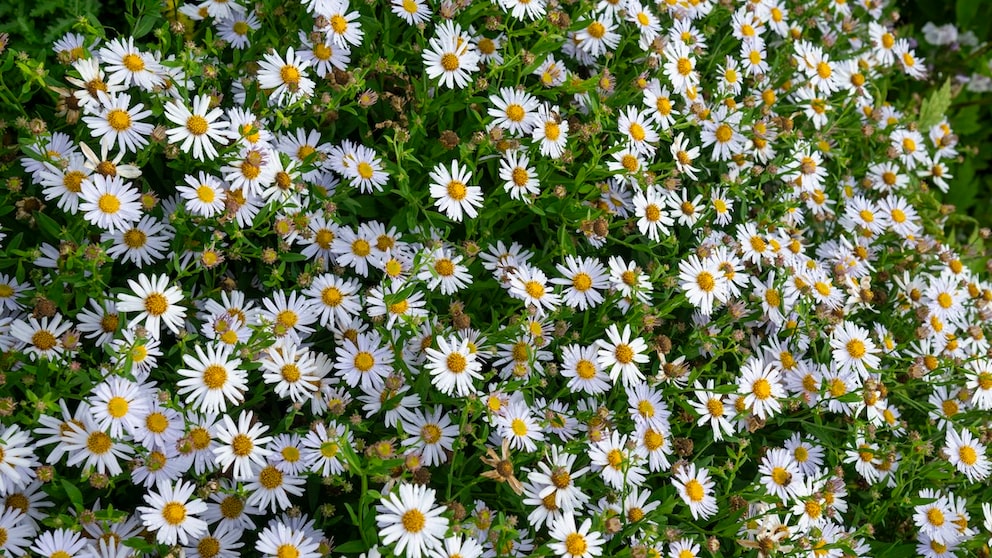
With a sea of star-shaped blossoms, the Kalimeris, also known as the beautiful aster, invites numerous insects such as bees and butterflies to visit. It’s no wonder that this easy-care plant has now been named the Perennial of the Year 2026 by experts.
Once a year, the Association of German Perennial Gardeners (BdS) selects the Perennial of the Year for the upcoming year. For 2026, the choice fell on the beautiful aster (Kalimeris), which is still relatively unknown here. Due to its star-shaped flowers, it is easily confused with asters: “That’s no shame, as both belong to the family of composite flowers (Asteraceae),” explains Ulrike Leyhe, perennial expert at BdS and technical director of the trial garden in Freising-Weihenstephan. The Kalimeris has only been considered its own genus for about 100 years. Previously, it was classified with asters. No wonder it is also known here as the beautiful aster or Siberian aster.
Beautiful and Easy to Care For
Originally, the beautiful aster comes from East Asia. But it also thrives here with remarkably little care. As long as the ground isn’t frozen, it can be planted in the garden from March to November. The beautiful aster has no special location requirements: It thrives in both sunny and partially shaded spots and tolerates fresh as well as moderately dry soil. Since its nutrient needs are low, it’s enough to provide the plant with a bit of compost once a year to promote vigorous growth and a wealth of star-shaped flowers.
While other perennials need a protective winter cover of garden fleece in the fall, the Siberian aster remains uncomplicated. Neither a sheltered location nor additional winter protection is required to survive the cold season. And what about pruning? “Kalimeris still looks good after blooming and maintains its form throughout the winter. Frost-covered shoots are particularly pretty,” explains the perennial expert. A close-to-ground pruning is only necessary in spring.
Kalimeris Is Especially Valuable for Insects
The sea of blossoms produced by the perennials is particularly impressive. And not only that: As a long-bloomer, the star-shaped flowers appear over an especially long period. “Kalimeris opens its buds when the abundance of early summer is over and the time of late bloomers is yet to come.” Depending on the region, blooming begins between June and September.
This makes the plant an attractive food source for numerous insects. Pollen and nectar attract bumblebees, bees, and butterflies—those who want to observe these creatures in their own garden will find the beautiful aster ideal.
While winged insects love to visit the perennial, snails usually leave it alone. Other pests or diseases like mildew practically never occur.
Different Flower Shapes and Colors: Variety Overview
The selection of varieties is still manageable. But the existing variants have much to offer:
- ‘Alba’ impresses with white, slightly larger flowers and reaches a height of up to 70 centimeters.
- ‘Madiva’ features strong violet flowers, is considered particularly stable, and grows compactly to about 80 centimeters high.
- ‘Blue Star,’ ‘Jürgen Wever,’ and ‘Antonia’ (a variety of the Mongolian beautiful aster) enchant with delicate blue-violet flowers.
- The Japanese beautiful aster with its double flowers resembles chrysanthemums in appearance.
- ‘Shogun,’ a Korean false aster, stands out with its strikingly patterned foliage. Its flowers are also noteworthy, appearing in delicate pink or violet.
The various varieties share a common trait: “Beautiful asters are very stable and don’t need supports. That’s truly a big plus in the garden,” says Leyhe.

Why you need sedum plants this fall

7 Colorful and Hardy Plants for Your Garden and Balcony
Ideal Bed Partners for Kalimeris
As an adaptable perennial, Kalimeris fits harmoniously into both natural gardens and splendid borders. Thanks to its clump-forming growth, it doesn’t crowd out other plants but rather proves to be an ideal companion in the bed—whether next to the three-leaf spirea (Gillenia trifoliata), tall sedum (Sedum telephium), or peonies (Paeonia lactiflora group).
Where Is the Perennial of the Year 2026 Available?
Kalimeris impresses with many advantages: It is easy to care for, delights as a long-bloomer with abundant flowers, and is considered particularly insect-friendly. Nevertheless, it is still relatively unknown. You can find the beautiful aster in garden centers only with luck—more readily in specialized perennial nurseries.