


October 30, 2026, 3:26 pm | Read time: 4 minutes
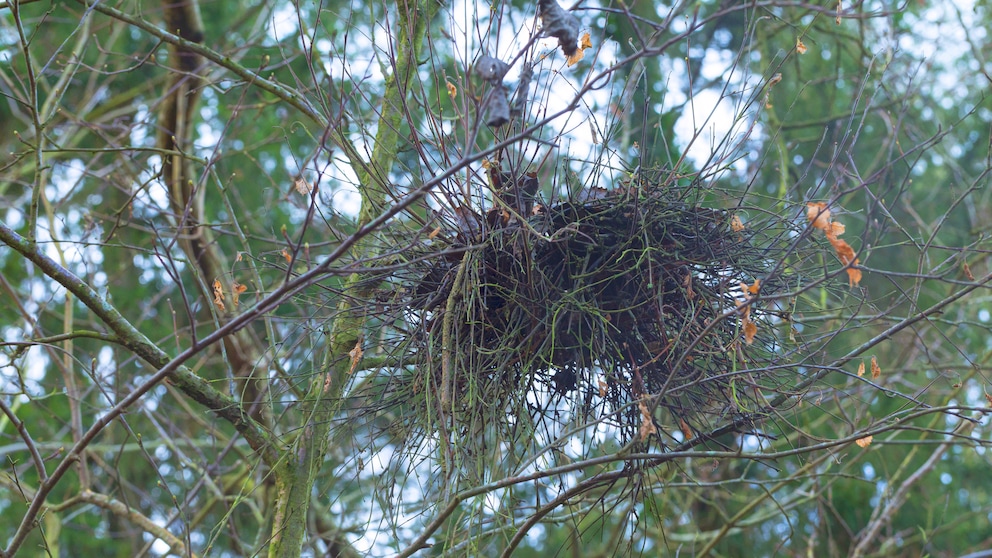
If you look closely at treetops in the fall or winter, you might spot some strange formations: Among the regular branches, there’s suddenly a dense cluster of numerous small twigs. From a distance, it somewhat resembles an old broom. These distinctive growths are actually called witch’s brooms. However, they have nothing to do with witchcraft. There can be a variety of botanical causes behind them.
What is a Witch’s Broom?
Witch’s brooms can appear on both deciduous and coniferous trees. They are often easier to spot when deciduous trees have lost their leaves. Then, it’s noticeable that in certain areas of the treetop, many short shoots are densely branched.
According to the Plant Protection Service Hamburg, various causes can be behind such witch’s brooms. Possible culprits include pathogens like fungi, bacteria, or viruses. However, some witch’s brooms result from a spontaneous genetic change in a bud.
This is an important distinction: Not every witch’s broom automatically means a tree is diseased.
A Fungus Can Cause the Unusual Growth
A well-known example is found in birches. As explained by Wald und Holz NRW on the specialist portal Waldwissen, the fungus Taphrina betulina can be responsible for the formation of witch’s brooms here. The infestation causes numerous so-called dormant buds to sprout. Over time, this results in the characteristic dense cluster of twigs.
The Plant Protection Service Hamburg also describes this connection. According to them, the fungus colonizes the bark of the shoot and, through growth substances, causes numerous dormant buds to sprout below the affected area.
Depending on the type of tree, however, completely different causes can be behind the phenomenon. The Plant Protection Service mentions viruses in ashes and locusts, as well as bacteria in larches. In firs, rust fungi can cause witch’s brooms.
Related: 6 Plants That Are Beautifully Spooky
Not Every Witch’s Broom Is Caused by Disease
Particularly interesting are witch’s brooms that are not caused by a pathogen. According to the Plant Protection Service Hamburg, spontaneous genetic changes in individual buds can cause a shoot to suddenly grow very compactly. The buds are thus particularly close together, developing the distinctive compact form.
Such compact growth can also be observed in coniferous trees. “In coniferous trees, it occasionally happens that they start to grow so compactly, usually in the treetops,” explains Sebastian Mühlemann from the Bauer Nursery when asked by myHOMEBOOK. What initially looks unusual can be particularly interesting for horticulture.
How Sour Cherries Thrive in the Garden

That’s why birch bark is white
New Dwarf Shrubs Can Emerge from Witch’s Brooms
A genetically formed witch’s broom can be deliberately propagated. Wald und Holz NRW also points out that such genetic forms have been used for breeding or developing dwarf shrubs for gardens and parks.
Mühlemann explains that such witch’s brooms have been deliberately propagated vegetatively, usually through grafting. He cites examples like the mountain pines Pinus mugo ‘Humpy’ and Pinus mugo ‘Mops’.
“Almost every conifer has a ‘ball form’ or something similar that has been propagated vegetatively,” the expert explains.
The Plant Protection Service Hamburg also confirms that such striking mutations can be of horticultural interest. According to them, weak-growing mutations have contributed to the expansion of the range of shrubs and have been deliberately propagated.
Thus, what initially seems like a strange growth form high up in the treetop can ultimately become a compact garden plant.
Do You Need to Remove a Witch’s Broom?
A witch’s broom does not necessarily need to be removed. According to the Plant Protection Service Hamburg, these formations often appear only on individual branches and usually do not affect the growth of the entire tree. Therefore, removal is generally not necessary.
Wald und Holz NRW assesses it similarly: Even larger witch’s brooms generally do not have negative effects on the tree’s growth. However, what is crucial is the cause of the witch’s broom. Since various causes can be behind the distinctive growth form, one should not automatically assume a specific disease based solely on appearance.