


March 31, 2026, 4:15 am | Read time: 3 minutes
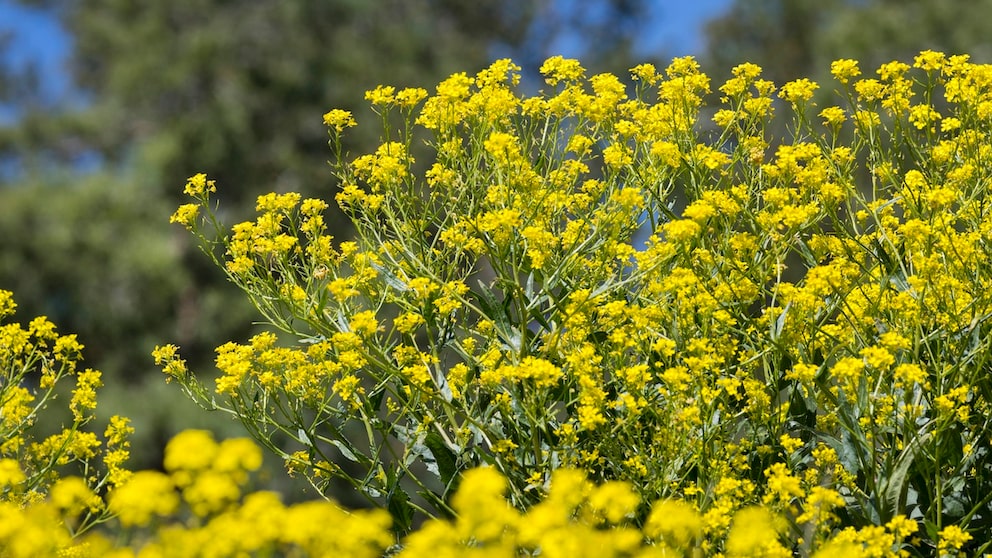
At first glance, the oriental rocket seems harmless: bright yellow flowers, similar to rapeseed, a real eye-catcher by the roadside. But appearances are deceiving. The plant, originating from Eastern Europe, is classified as a neophyte and is increasingly viewed critically by experts. Where it thrives, it spreads rapidly and can displace native species.
Officially, the oriental rocket, also known as false flax or hill mustard, is not yet listed as an invasive species at the EU level, but it is already considered potentially invasive. For garden owners, this means: pay close attention and take action if necessary. myHOMEBOOK explains what to do.
What Is the Oriental Rocket?
The oriental rocket (Bunias orientalis) belongs to the mustard family and is related to rapeseed, mustard, and cabbage. Originally from Eastern Europe and Western Asia, it is now widespread in Germany. It is characterized by its bright yellow flowers in late spring, robust, often feathered leaves, and a growth height of up to one and a half meters. As a perennial, it can persist for many years in the same location.
Why the Plant Can Become a Problem
The problem lies less in its appearance and more in its behavior: A single plant can produce several thousand seeds. At the same time, the plant is extremely robust and competitive. “It grows quickly, forms dense stands, and regenerates from small root remnants,” explains Sandra von Rekowski from the Federal Association of Allotment Gardeners in Germany. It also deprives other plants of light, space, and nutrients. Particularly in species-rich, nutrient-poor meadows, it can gradually displace native plants and significantly reduce biodiversity.
Where the Oriental Rocket Frequently Appears
The plant is mainly found along roadsides, on railway embankments, at field edges, or on fallow land. It loves sunny locations and copes well with dry, calcareous soils. Such conditions are often found in human-influenced landscapes, which is one reason why the plant has been able to spread so successfully in recent years.
Is It False Flax or Rapeseed?
At first glance, confusion with rapeseed is understandable: Both have yellow flowers and belong to the same plant family. But there are differences. False Flax usually blooms a bit later and often grows in irregular groups along roadsides, not in uniform fields. They also tend to be taller and have a strong, deep taproot. The leaves also appear coarser and more deeply incised than those of rapeseed.
Please Do Not Plant in the Garden
Even though parts of the plant are edible and the seeds are sometimes sold as wild vegetables, it is not advisable to deliberately establish it in the garden. The plant spreads quickly through seeds and can be difficult to remove. Once it is in the garden, it often requires years of effort to control. Therefore, it is better not to introduce it at all and to monitor existing plants early on.

Indian balsam is spreading and threatening native species
Which Trees to Avoid Planting in Your Garden
How to Get Rid of the Oriental Rocket
The right timing is crucial, explains the expert: “In the garden, it should be dug up early and removed before seed formation.” Since the plant can regrow after simply being cut, it is advisable to completely dig it out along with the root. A sturdy weed puller is usually needed, as the roots reach deep into the ground.
Use in the Kitchen
The plant can also be used: “Young leaves and buds are even edible, and the annual root tastes like mild horseradish,” explains von Rekowski. This makes it versatile in the kitchen, such as in salads or as a spicy addition to various dishes.