


May 6, 2020, 3:26 pm | Read time: 5 minutes
No Room for a Garage? Consider a Carport If there’s no space for a garage but you still want to keep your car safe, a carport is a practical solution. myHOMEBOOK outlines what you need to know when planning and building a carport–and where potential pitfalls may lie.
They protect the car from the elements, take up less space than a traditional garage, and sometimes even offer room for storage: Carports, the “open garages,” are quite popular. But can they simply be set up on your own property, or do you need a building permit? Do you even have to ask your neighbors for permission, and what should be considered when planning a carport for electric vehicles? myHOMEBOOK has the answers to these and other questions about planning and building a carport.
Can Carports Be Set Up on Your Own Property?
If you want to set up a carport on your own property, you can’t just do it without further ado. Even on your own land, legal regulations apply. In other words: Whether it’s an extension to the house, with a gate, or a free-standing carport with an integrated shed, these are constructions subject to certain regulations. Before building, be sure to check the nationwide regulations as well as the legal requirements of the respective state and municipality!
What Legal Regulations Must Be Observed?
Anyone planning a carport should, as with any construction project, inform themselves about the following legal regulations:
- nationwide planning law
- state building code
- municipal development plan
- municipal special regulations
- monument and environmental regulations
These regulations provide information on which areas of the property you can build a carport, how large it can be, and when a building application is necessary.
Is a Building Application Required?
In principle, carports are subject to approval. They are considered permanent structural alterations. However, there are exceptions. There is no nationwide regulation. Each state decides individually whether and how builders must submit a building application. Sometimes cities and municipalities have additional requirements.
The following documents are necessary for a carport building application:
- building description
- land registry extract with site plan (scale 1:500) no older than two years
- construction drawing of the carport with floor plan, views, and section
Many carport manufacturers provide the necessary documents to their customers.
Also interesting: Do you need a building permit for a garden shed?
Tip: Do not start building without proper information! Always check with your local building authority about your specific construction project beforehand. They decide whether a building application is necessary. You can also inquire about all applicable regulations there. This saves a lot of trouble later and prevents potential neighborhood disputes.
Do I Need to Ask My Neighbors for Permission?
Yes and no. When planning and building a carport, it’s essential to thoroughly check the municipal regulations on boundary construction. These regulations define the boundary construction and the distance of buildings from the neighboring property. Generally, a boundary distance of three meters must be maintained. Even if the carport is to be placed directly on the boundary, various requirements apply.
You don’t necessarily have to ask your neighbors for permission. However, it doesn’t hurt to have a friendly conversation with them before starting construction. If neighbors are informed about the building plans, they can voice any concerns in advance. Of course, the carport should not restrict access to the neighboring property. A written consent from the neighbors additionally secures the construction project.
What Types of Carports Are There?
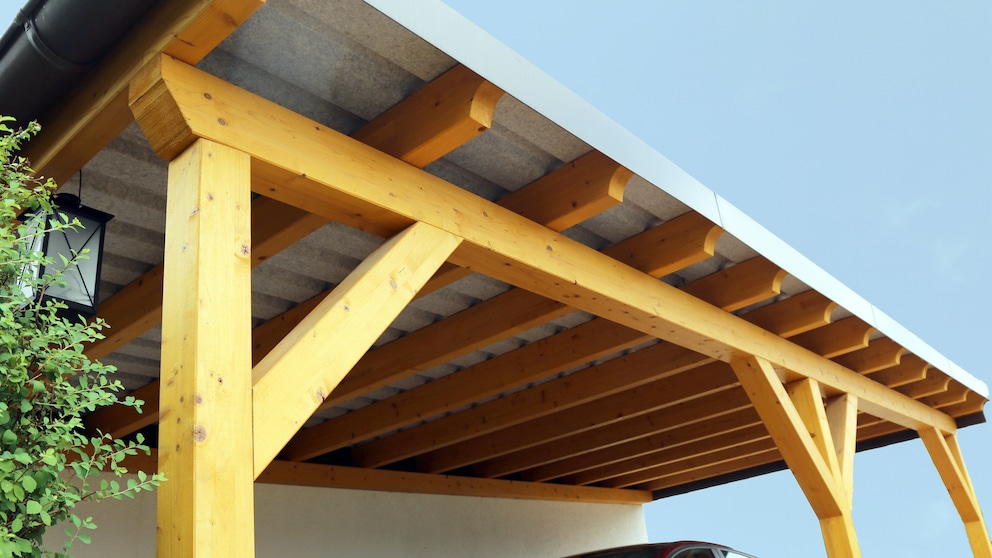
Not all carports are the same. Basically, there are free-standing carports and attached carports. Depending on the number of cars, one, two, or more vehicles can fit. If only one car is to be parked, attached carports with a base area of three to five meters are suitable. For two cars side by side, a double carport of six to eight meters is appropriate. Attached carports, also known as lean-to carports, can be built directly onto a house or outbuilding. With free-standing carports, the choice of location is more flexible.
Note: Carports are not limited to flat roofs. A gable roof, hipped roof, or arched roof is also possible.

Planning a garden shed: Do you really need planning permission?

Which Projects Are Possible Without a Building Permit
Electricity in the Carport for E-Cars – What to Consider
When planning a carport, it’s advisable to consider a separate power connection. To properly charge electric cars in the carport, a suitable electrical installation is required. This should definitely be installed by a professional! The power line must not only be compatible with the charging station but also have important safety features, such as its own residual current circuit breaker and a separate circuit breaker.
A smart charging station can also be planned. Additionally, the carport can be combined with a photovoltaic system. There are even so-called solar carports available now.
Also interesting: How to generate electricity with a solar system on the balcony
Can You Build Carports Yourself?
Theoretically, carports can be completely planned and built by yourself with some craftsmanship skills. Practically, it’s sensible to use a ready-made kit. These are professionally planned and checked for structural integrity. If you still prefer a custom carport, it’s better to realize it with a professional by your side.