



October 14, 2021, 8:42 am | Read time: 5 minutes
Operators of a photovoltaic system on the roof can benefit twice if they also use the electricity for the charging station of their electric car. How large should the solar system be at a minimum to make it worthwhile?
Electromobility is on the rise and is being supported by the government. For owners of a solar system, an electric car is even more worthwhile because they can “refuel” the vehicle directly at their own charging station. What you should consider and how far you can drive with climate-friendly and self-produced electricity is explained in this article.
Table of Contents
- What are the advantages of combining a solar system and a charging station for an electric car?
- What costs should operators expect?
- How environmentally friendly is electromobility?
- What should be considered in planning?
- What about charging other vehicles?
- What should be considered when operating multiple charging stations?
- What funding is available?
- How far can an electric car go with electricity from its own solar system?
What are the advantages of combining a solar system and a charging station for an electric car?
“Photovoltaic systems, electricity storage, and solar power stations are the dream team of modern buildings,” explains a spokesperson from the German Solar Industry Association (BSW) upon request from myHOMEBOOK. The experts provide a practical example: A 40-square-meter photovoltaic system with a nominal output of seven kilowatts produces around 6,650 kilowatt-hours of solar power annually. This would theoretically cover the average electricity needs of a family of four–and also provide enough power for about 15,000 kilometers of range in an electric car.
Related: What homeowners need to know about electric car charging stations
What costs should operators expect?
“Photovoltaic systems have become increasingly affordable in recent years,” says the spokesperson. A small system for generating your own solar power is available for just a few thousand euros. “You can produce solar power on your own roof for about ten cents per kilowatt-hour,” she continues. Planning, installation, commissioning, registration, and maintenance of the system are usually handled by the installation company.
Advertisement: Loans for PV systems – How to finance your solar system
How environmentally friendly is electromobility?
There is still much to be done in this area, as the BSW spokesperson explains. “For electromobility to truly serve climate protection, the expansion rate of solar energy must be significantly increased.” Without a multiplication of solar energy, the growing electricity demand due to the phase-out of nuclear and coal, as well as electromobility, cannot be met in a climate-friendly manner.
Also interesting: Generating electricity with a solar system on the balcony
What should be considered in planning?
If solar system owners are considering using it to power their electric car, they should plan carefully. “The metrological connection of the charging station within the customer system poses a challenge,” says the solar association spokesperson. “On one hand, it involves legal requirements for the measuring devices, and on the other, the clear distinction between self-consumption and delivery to third parties.”
What about charging other vehicles?
“If an electric vehicle is to be integrated directly from the PV system for self-consumption, it must be ensured that only company-owned vehicles are charged at the station,” explains the BSW spokesperson. If the wallbox also supplies other vehicles, a suitably designed measurement concept is needed to clearly delineate delivery to third parties. “Otherwise, the privilege of the reduced EEG surcharge on self-consumption for the entire customer system may be lost,” warns the expert.
What should be considered when operating multiple charging stations?
When operating multiple charging stations, special load management ensures that the permitted network capacity is not exceeded. Furthermore, unwanted power peaks must not occur. “The energy management of the customer system must be coordinated with the load management so that priorities in the readiness of various vehicles can be maintained,” says the spokesperson. Specialist companies ensure that, in addition to installing the components–PV, storage, and wallbox from a single source–appropriate energy management is also provided.

Not Just Buying – You Can Also Rent Solar Panels
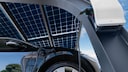
Power Your Home and Electric Car with a Solar Carport
What funding is available?
For the PV system, there is the EEG remuneration for the electricity fed in. Additionally, the self-consumption of the cost-effectively generated electricity contributes to the system’s profitability. “In some federal states, there are also special funding programs for home storage,” explains the spokesperson. Through the KfW, it is also possible to finance the investments with a low-cost loan. There are also funding opportunities for the charging station itself. The spokesperson mentions, for example, the KfW grant 440 for charging stations at privately used parking spaces of residential buildings.
How far can an electric car go with electricity from its own solar system?
To answer this question, the spokesperson refers to a model calculation. The nominal size “kilowatt-peak” measures the output of a photovoltaic system. Accordingly, an exemplary PV system generates approximately 950 kWh per kilowatt-peak of installed capacity annually, depending on location and orientation. Incidentally, the kilowatt-peak can often be higher in other countries; this refers to what is achievable in Germany.
Related (via TRAVELBOOK): The world’s first motorhome with solar power
Assuming an electric car consumes about 20 kWh/100 km, the electricity generation from a solar system with just one kilowatt-peak is enough for approximately 4,750 km of travel per year. Accordingly, a PV system with five kilowatt-peak can generate enough electricity to drive about 23,750 km per year without gasoline.