


April 13, 2026, 3:13 pm | Read time: 4 minutes
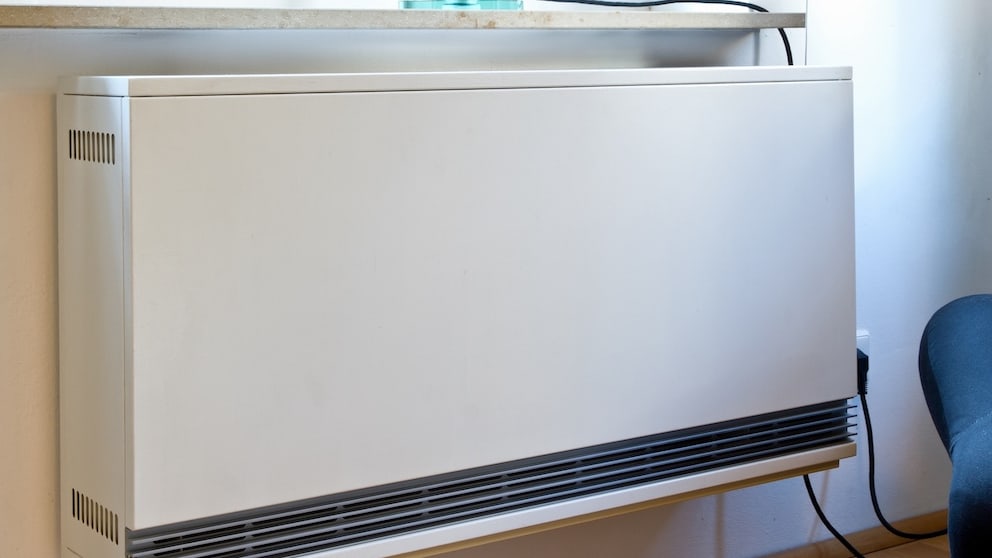
According to the 2022 microcensus by the Federal Statistical Office, nearly 1.6 million households use electric heaters. The vast majority are likely night storage heaters—a technology from the 1950s. They operate, they heat, but often cost significantly more than necessary. Whether a replacement is worthwhile depends on several factors.
How Night Storage Heaters Work
Night storage heaters operate on a simple principle: Electric heating elements warm a core of storage stones up to 600 degrees Celsius. This occurs at night. During the day, the stones release the heat back into the room. Utility companies offer cheaper heating rates for nighttime heating. However, night electricity has become significantly more expensive in recent years—partly because tax benefits were eliminated in 2007.
High Heating Costs Due to Night Electricity in Comparison
With an electricity price of 20 cents per kilowatt-hour and a heating requirement of 10,000 kilowatt-hours for an 80-square-meter apartment, heating alone incurs 2,000 euros in additional costs. Dr.-Ing. Matthias Wagnitz, an energy and heating technology consultant at the Central Association for Sanitation, Heating, and Air Conditioning (ZVSHK), sums it up: “Heating with night electricity is almost the most expensive option.”
Night storage heaters not only require expensive energy, but they also use it inefficiently. They convert only 30 to 40 percent of the energy used into heat. This raises the question of whether a replacement would be worthwhile.
When a Replacement Is Worthwhile—and When It’s Not
In principle, night storage heaters are not legally prohibited in Germany. A functioning system can continue to be operated. However, since 2024, there have been restrictions on the installation of purely electric heaters in new buildings with at least three residential units. “In general, existing night storage heaters can continue to be operated under the current GEG. There is no obligation to replace them,” confirms Wagnitz.
Whether a replacement is worthwhile, in his view, strongly depends on the usage profile. He cites a vacation bungalow, which is only heated on a few days and otherwise just kept frost-free, as an example. “Depending on the insulation standard, the energy costs are probably low and do not justify a complete replacement.” Night storage devices can also be useful as supplementary heating in rarely used rooms.
What Modern Night Storage Heaters Can Do
Modern night storage devices use outdoor temperature sensors and weather forecasts and can be combined with dynamic electricity tariffs, making them more efficient. However, these advantages do not justify a complete replacement of existing devices. “Modern night storage heaters are somewhat better regulated. But they are still night storage heaters. Therefore, I would only replace a night storage heater with a comparable modern device if there is a need for replacement due to failure,” says the expert.
When an Air-to-Air Heat Pump Is Worth It for Heating
Heat Pump in an Apartment Building? The Most Important Questions and Answers
Heat Pump as a Modern Alternative
Anyone looking to significantly reduce the energy costs of a night storage heater cannot avoid changing the energy source. Converting to a heat pump pays off relatively quickly despite the acquisition costs. Depending on the building’s structural conditions and insulation, energy costs can be halved. Additionally, a heat pump is more environmentally friendly. “Switching from night storage to a heat pump would reduce CO2 emissions to a third or a quarter with the same comfort and electricity,” says Wagnitz. The living comfort can also increase, as the expert explains. Due to the high costs of night storage heating, some rooms remain unheated.
“Since the house connection of the old night storage is likely to be adequately dimensioned for a heat pump, the different heat pump technologies are an option.” Those who switch have various options and should seek advice to determine whether an air-to-air or air-to-water heat pump is the better choice. An energy consultation is advisable anyway, as many energy-saving measures are eligible for funding, and some subsidies are even required. Moreover, it is difficult for laypeople to keep track of all funding opportunities.
Asbestos in Night Storage Heaters
Anyone operating devices from before 1984 should know that many of these night storage heaters may contain asbestos as insulation material. During regular operation, the risk to residents is relatively low. However, dismantling such old heaters should be handled by a professional company.