


October 21, 2025, 3:35 pm | Read time: 6 minutes
Creative fields like architecture, art, or fashion are constantly evolving. New trends and viral hypes ensure that old rules are continually questioned, adjusted, and discarded. In interior design, it’s also worth rethinking entrenched dogmas. We explain why you can now confidently break these five rules in interior design.
1. Use Uniform Materials
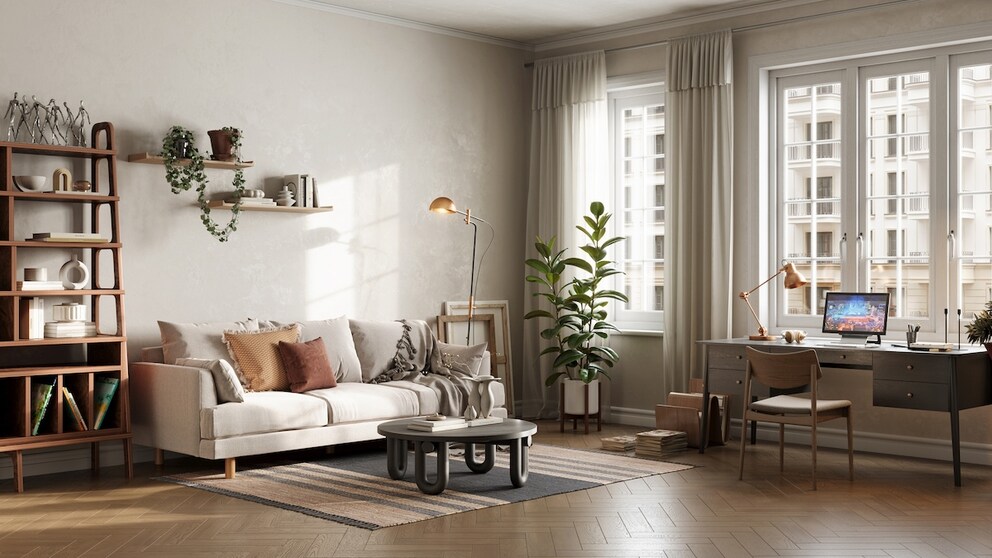
Opposites attract—everyone knows this saying. In interior design, it was long considered a major faux pas, but that’s no longer the case. Mix & Match is in—even in furnishings. Traditionally, care was taken not to combine more than two different materials in living spaces, but now it’s okay to be more colorful. Metal and wood, for example, no longer exclude each other but complement each other in modern concepts in an elegant way.
The same applies to different patterns and colors when used subtly and deliberately. The mix of materials is especially popular in textiles: Nowadays, a jute rug is paired with a bouclé couch without batting an eye, linen cushions alternate with those made of corduroy, and muslin bedding becomes a real eye-catcher with a velvet throw. More is more, as long as you don’t overdo it and the selection still follows a certain baseline. If you just throw everything together wildly, you risk a feeling of overload. Different patterns can only work if there’s more color calmness, and stone and wood are particularly effective when the rest of the decor also conveys naturalness. It can be exciting yet relaxing.
Why we break the rule now: Contrasts are exciting, and everyone should finally see that.
2. Always Place Furniture Against the Wall

In the past, a room was only considered perfect when all the furniture had found its fixed place near the wall. This was said to create more walking space in the center of the room and make it appear airier and freer, according to many guides. Additionally, symmetrical furnishings were supposed to suggest order and harmony. Not to mention, furniture against the wall could also achieve practical benefits. After all, there were outlets and free space for additional wall decorations or lamps.
Today, we know: There’s no black and white, and freestanding furniture can also have its charm. This concept, especially in open living spaces, which are increasingly found in city apartments and houses, creates structure. More than ever, shelves can function as room dividers, and couches, table arrangements, and desks divide the larger area into different defined zones, such as chill zones, dining zones, or creative zones. Islands are created that promise more dynamism and looseness.
Why we break the rule now: In open spaces, it’s no longer the walls that dictate the structure, but freestanding furniture. Additionally, an asymmetrical arrangement can appear more exciting and cozy.
3. Light Colors for Small Rooms
It’s not wrong to say that light colors expand the view and dark tones tend to feel constricting, thus affecting the room size—this effect is based on physical laws. White walls reflect light more strongly, making the room appear larger and the walls seem farther apart. It’s now clear that rooms gain not only in size through the use of color but also through exciting interior design with eye-catching factors.
If you love light colors, you can certainly stick with them, but a rich color palette is no longer a disqualifier in designing small rooms. Shades like Bordeaux red, pine green, or midnight blue can create an almost dramatic atmosphere and add depth, for example, on an accent wall or in the form of textiles. Modern lighting concepts dispel the fear that dark colors could overwhelm small rooms. Targeted lighting skillfully counteracts a constricting feeling.
Why we break the rule now: A room is as big as it is—what matters is how you stage it. Character and atmosphere weigh much more today than mere size effect.
How to Stylishly Incorporate Stripes in Your Decor
How to Stylishly Incorporate Animal Print into Your Decor
4. Place Art Only at Eye Level
The eye-level rule—placing wall decor at about 1.60 meters high—was once mainly for clear visibility and a sense of order. That’s long outdated. Consistent heights quickly make walls look boring and too rigid. People increasingly long for flexibility; a room should promise personality and create aesthetic tension. Therefore, it’s perfectly legitimate to hang art or other wall decorations unconventionally. Gallery walls with multiple artworks of different sizes and heights are more in trend than ever and can give a room a special look. Layering and overlapping are also allowed.
Another plus: Large artworks or mirrors no longer have to hang on the wall but can be casually leaned against it. This allows for more creative freedom and emphasizes the individual character of the room.
Why we break the rule now: What’s allowed is what pleases, not just what’s prescribed. Wall decor at different heights and a variation in material and color can make a room appear more interesting. Eye level is a guideline, but everything else works too.
5. Textiles Must Be Unobtrusive
In the past, textiles were primarily a means to an end. They were meant to provide warmth, shield views, or create coziness. Appearance played little role, which is why curtains, drapes, blankets, and cushions were often chosen to match the wall color so they would be as inconspicuous as possible. Yet there’s nothing more beautiful than making statements with them. Today, textiles can be more and completely dominate a room—for example, through color and material contrasts or pattern mixes.
If a room is rather understated, a velvet cushion, a patterned curtain, or a blanket made of striking material can draw the eye, create tactile depth, and evoke a sense of vibrancy. Designers also use this trend deliberately: Textiles are used as eye-catchers and consciously combined with more understated furniture or other decorative elements. The “Mix & Match” approach makes rooms particularly spectacular. Another advantage: If tastes or seasons change, textiles can be quickly swapped out or given new covers. This way, the room can quickly speak a new language and adapt flexibly to external influences.
Why we break the rule now: Textiles are too beautiful to remain invisible. They give a room warmth, depth, and personality—and deliberately set individual accents.