

July 16, 2026, 7:35 am | Read time: 4 minutes
Do you only have a small desk lamp on when working from home early in the morning or late in the afternoon? Especially in winter, this strains the eyes—and thus your productivity.
Many things in a home office are different from an office. But the lighting at your desk shouldn’t be one of them. Otherwise, your eyes will tire more quickly, and concentration and productivity will decrease. But what makes good lighting at the workplace?
1. The Ideal Place for Desk Lighting
“Ideally, the light comes from the side or the front,” says interior architect and lighting designer Ulrich Beckert from Munich. This way, incoming daylight and lamps won’t create reflections on the screen. Therefore, one of the most important tips is: Right-handed people should position the desk so that the light comes from the left, and left-handed people from the right.
“It’s not a good idea to sit with your back to the light, especially when working on a PC,” says Beckert. The reflections of the light on the monitor can cause the eyes to strain excessively, leading to headaches.
2. Evenly Distributed Light in the Room
It’s not a good idea to illuminate only the desk brightly—in an otherwise dark room. “This strains the eyes too much because they constantly have to adjust to new lighting conditions,” says Iris Vollmann from Portal Licht.de, an industry initiative of the German Electrical and Electronic Manufacturers’ Association ZVEI.
Therefore, in addition to direct desk lighting, it’s important to have general lighting in the study and to turn it on. This can include ceiling lights or floor or wall lamps. Additional lighting accents can be set with illuminated pictures, but they only create a cozy atmosphere in the home office.
No matter which lights are used, they should be directed at the desk in such a way that no glare from reflections on the screen occurs.
3. The Perfect Lighting Intensity
The lighting intensity on the work surface, meaning the area of visual tasks, should be at least 500 lux. This can be measured with a device called a lux meter or a light meter app for smartphones. The lighting level of the room beyond the actual workplace should be at least 300 lux.
But lighting designer Ulrich Beckert also advises that the lighting should be individually adjustable. Everyone has different preferences and needs. How bright the lighting needs to be also depends on age, as eyesight diminishes with age and eyes become more sensitive. “This starts as early as the mid-30s,” says Iris Vollmann.
Her further tip: Also pay attention to the correct distance from the seat to the screen when working on the computer—depending on the size of the screen, it’s between 50 and 80 centimeters.

The Right Lighting for Your Home Office

5 privacy screen solutions in the home office
4. Double Lighting at the Desk
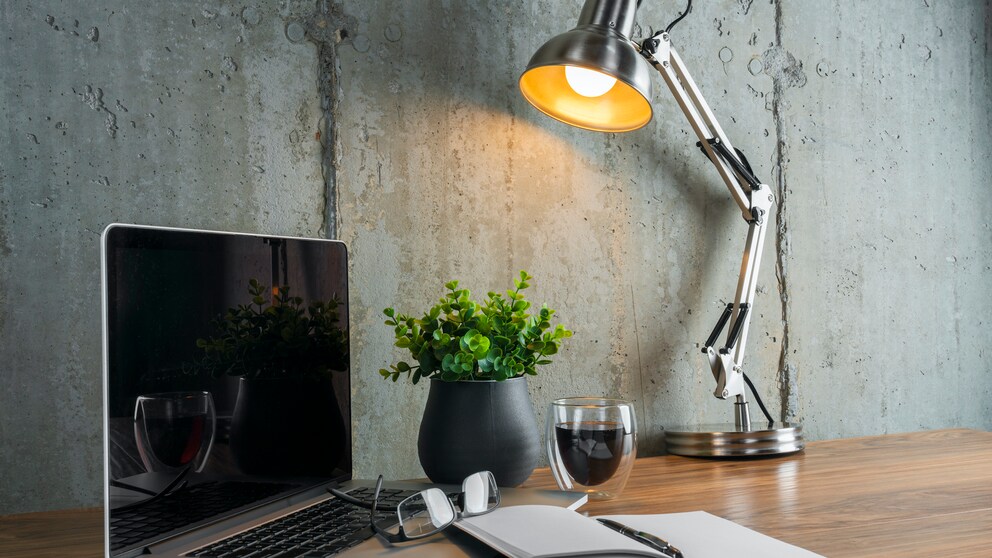
Ideally, there are two lights at the immediate workplace. One is a light source above the desk, such as a non-glare pendant light with direct light downward and indirect light upward. The other is a swivel and adjustable desk lamp.
For the latter, the same applies: For right-handed people, the light should come from the left, and for left-handed people, from the right. Especially when writing by hand, the light should not only come from above and cast shadows.
Also interesting: How to Make Your Home Office Desk Look Less Like Work
5. The Perfect Light for Video Calls
Those working from home may have to participate in video calls multiple times a day. “If the light comes from the front and slightly above, the participant looks best,” says Iris Vollmann. The background should be tidy and not too bright—otherwise, the person will appear only as a silhouette in the image, as the face is too dark. For this reason, you should avoid sitting with your back to the window.
with material from dpa