


August 7, 2025, 3:58 am | Read time: 7 minutes
The living room is the central place in our home. It’s where we welcome guests, spend relaxing hours with family, or enjoy a quiet evening. No wonder this room holds special significance in Feng Shui. With the right principles, you can design a living room that not only looks beautiful but also allows energy–the so-called Chi–to flow freely and positively. myHOMEBOOK shows how to arrange your living room according to Feng Shui.
Follow myHOMEBOOK on WhatsApp now
Overview
What is Feng Shui?
Feng Shui is an ancient Chinese philosophy of harmony that deals with the interaction between humans, space, and nature. The goal is to design the environment to support life in terms of health, wealth, or inner balance. The driving force of Feng Shui is the Chi (Qi), which should be kept in motion. By arranging the furniture in each room, you can actively contribute to allowing the Chi to flow unhindered through the spaces. This is intended to create a positive atmosphere and make you feel safe and protected in your home.
Proper Room Layout and Furnishing
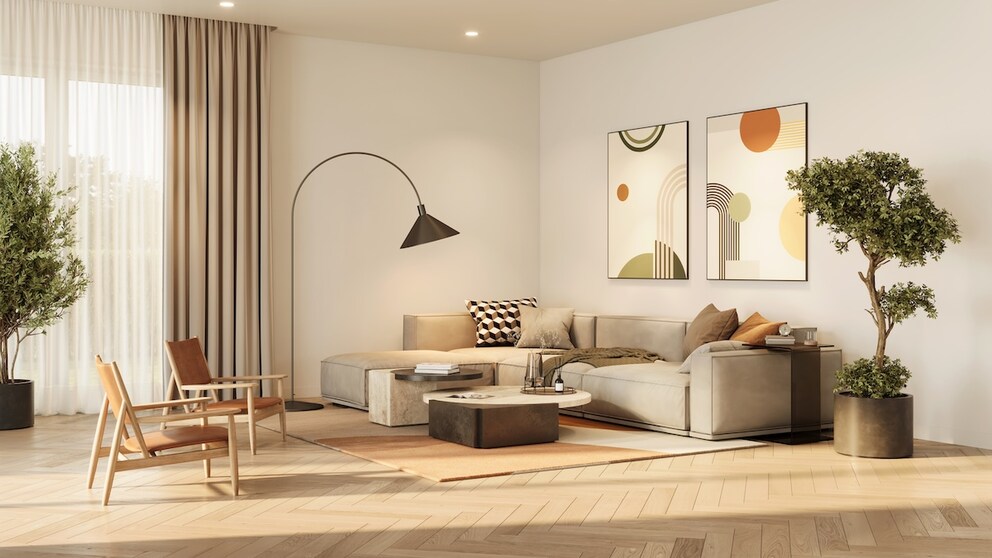
The correct positioning of furniture plays an important role in Feng Shui. In the living room, the sofa should ideally have a wall behind it, which according to Feng Shui, conveys security and stability. Ideally, choose a position from which you can easily see the door and windows.
To allow energy to flow freely in the room, the center of the room should be kept as open as possible. A coffee table and a rug can highlight the center, where the Chi gathers, without blocking the space. It’s also important to leave enough space between individual pieces of furniture. Large and bulky furniture should be avoided or used sparingly, as they can quickly block the room’s energy flow.
Using Colors and Elements Effectively
The teachings of Feng Shui encompass not only the orientation of rooms and objects but also the theory of the five elements. Those who want to furnish their living room according to Feng Shui principles should use the five elements specifically in furniture, colors, materials, and decorations. Each of these elements represents certain properties and brings its own energy quality into the room.
Wood
Wood symbolizes growth, vitality, and creativity. The element can best be integrated through plants, wooden furniture, or green accessories. Natural materials like cotton or linen also reflect the element in the decor.
Related: Types of Wood in Interesting Colors
Fire
Fire stands for energy, passion, and visibility. It brings movement into the room and can be symbolized by candles, a fireplace, or warm light sources. Warm materials like wool fit well, and color accents in red or orange enhance the element. However, these accents should be used sparingly, as too much fire can cause a certain restlessness.
Earth
Stability, calm, and energy are conveyed by the element Earth. It can be represented through natural materials like ceramics, clay, or stone and can be enhanced by colors like beige, brown, yellow, and ocher. Rugs or heavy furniture provide grounding and permanence to the living room.
Metal
Metal stands for clarity, precision, and structure. This element can be well represented by light colors like white, gray, or metallic tones like silver and gold. Smooth surfaces, metallic decorative objects, or chair and sofa legs made of steel or aluminum can emphasize the metal element and create a clear and focused atmosphere.
Water
The element Water brings calm, depth, and intuition into the room. It is symbolized by flowing lines, dark colors like blue or black, and reflective or transparent materials like glass. In the living room, the flowing water energy can be enhanced by a small decorative fountain, a well-placed mirror, or the use of satin and silk.
For balanced Feng Shui in the living room, it’s important to maintain a harmonious balance of all five elements. None should dominate or be absent.
Light and Plants as Energy Sources
A living room designed according to Feng Shui should not only look beautiful but also be a place of harmony and inner peace. Light and plants significantly contribute to this. In Feng Shui, light represents clarity and vitality, so natural daylight is especially valued as it activates the Chi and allows it to flow freely in the room. Large windows or light-filled rooms are ideal for a Feng Shui living room.
But not everyone has a light-filled living room. No worries–you can also create a good atmosphere with artificial light. Various light sources, such as floor lamps, wall lights, and table lamps, distributed throughout the room, ensure energetic balance. Dimmable lamps are particularly recommended, as they allow adjustment to different times of day and moods. Harsh, cold light or the creation of dark corners should be avoided, as both can disturb or even block the Chi.
Plants embody life force, growth, and energy in Feng Shui. They improve the room climate and support the free flow of energy. It’s best to place them near windows, where they can absorb and transmit the incoming Chi.
Popular plants include lucky bamboo, associated with prosperity and vitality, or the peace lily, which stands for purity and balance. The money tree or air-purifying plants like the areca palm or ferns are also suitable. Plants with thorns or sharp leaves should be avoided, as they are considered carriers of aggressive energy.
Also interesting: How to Design Your Garden According to Feng Shui
Shapes in Feng Shui
Shapes play a central role in Feng Shui design, as they are closely linked to the five elements and can direct energy in the room. Each geometric shape represents a specific element and carries different energetic qualities into the living space. Rectangular and columnar shapes symbolize the element Wood, triangular and pointed shapes represent Fire. The element Earth is represented by square and flat shapes, while round and oval shapes symbolize Metal. Water, on the other hand, is symbolized by flowing or amorphous shapes.
The conscious combination allows for a balance between activity and rest, structure and openness, and stability and change. Shapes can be used in both furniture and decoration. For example, a round coffee table can be ideally combined with flowing candle holders, or a vase with a triangular shape can be placed on a decorative column.
It’s important that the individual shapes in the living room are balanced–only then can they support the energetic balance in the room according to Feng Shui principles.
Decorating a Child’s Room According to Feng Shui
Why You Should Avoid Having a Mirror in the Bedroom
Living Harmony Despite Technology
According to Feng Shui principles, technology doesn’t belong in the living room, as devices like the TV disrupt the energy flow. However, if you understandably don’t want to do without it, you can hide cables with cable channels and store remote controls and other small devices like a router in attractive storage boxes.
Common Mistakes
When setting up the living room according to Feng Shui principles, there are some points to consider to avoid disturbing the harmonious and balanced energy. These include clutter and excessive dust, both of which block the room’s energy. Too bright or dark colors can also energetically burden the room.
To prevent the Chi from being reflected back and not flowing freely, avoid hanging mirrors opposite doors or windows and refrain from overcrowded shelves and too many decorative elements, as this can feel overwhelming.