


January 23, 2026, 7:09 am | Read time: 6 minutes
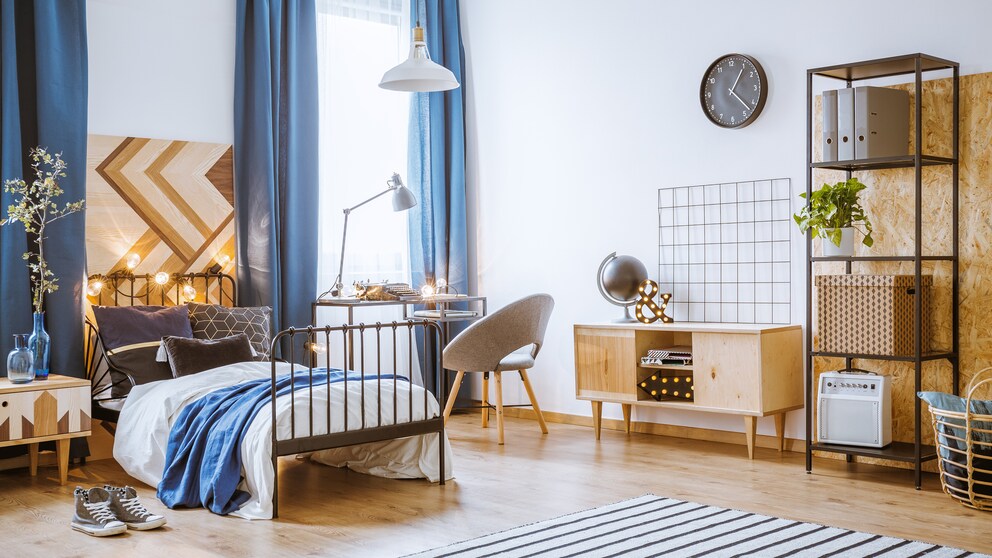
Is the childish motif wallpaper anything but cool? Are the furnishings in princess or firefighter design just embarrassing? When your little one outgrows not only their shoes but also their room, it’s time for a makeover.
It may feel like you’ve only just finished setting up the nursery or child’s room. But in the blink of an eye, the era of space-themed wallpaper, toy chests, and stuffed animals has passed. As children mature, it’s not only their tastes that evolve. Their needs for personal space also undergo a transformation. So it’s high time to transform the children’s room into a teenager’s room. But when it comes to furnishings, the tastes of parents and teenagers often differ considerably. Interior designer Juana Fritsch sees this as a positive development. In an interview with myHOMEBOOK, she explained the importance of this transition and shared tips for creating a teen’s room that’s free from conflict and stress.
Goodbye Kids’ Room, Hello Teenagers’ Room!
Unlike a baby’s or a child’s room, you rarely start from scratch when furnishing a teenager’s room. However, with a few straightforward steps, you can successfully transform the space:
- Sort out: The Berlin-based designer recommends that you start by getting rid of old toys and possessions that your teenager no longer needs. You don’t necessarily have to dispose of everything you no longer like. Stored temporarily in the cellar, some things can certainly be given new functions and uses. Otherwise, it’s better to resell rather than throw away. This can also give a nice boost to the teenager’s allowance.
- Design theme: If desired, the next step is to find and define a design theme. If you are unsure about developing a room concept or would like individual solutions, you can seek professional help. The advantage of this: “An interior design consultant can be used very well as a mediator, which usually makes the process less stressful and conflict-free,” says Juana Fritsch. Another tried-and-tested tip from the interior designer: “Please only think and implement in the now! Planning and designing for the long term is not advisable. Such an approach can stifle development and flexibility, and often falls behind the pace of real life.”
- Implementation: Once the concept is in place, joint implementation can begin. Important here: “Be sure to involve the teen! By participating, they take ownership of their space and learn to value and respect manual labor. There’s a special value in things that are made by hand!” It’s therefore a good idea to hand over feasible tasks and responsibilities to the next generation. Depending on their skills, these can be carried out with or without parental supervision. Possible activities could be: Sorting out clothes and books, ripping off wallpaper, painting a wall a color, taping sheets, etc.
One Room – Many Functions
Similar to decorating a child’s room, it makes sense to divide the teen’s room into different areas depending on the size of the room, the teen’s wishes, and the available space. The room can be divided into areas such as
- Sleeping
- Learning and working
- Relaxing (alone or with friends)
- Storage
- Space for hobbies (if required and desired)

The Best Tips for Decorating a Teen’s Room

Setting Up a Montessori-Inspired Children’s Room
Which Furniture Belongs in a Teenager’s Room?
In order to accommodate all these areas in one room in an optimal and structured way, flexible furnishings are an advantage. This approach not only offers significant potential for transformation. It also allows for easy adaptation to the evolving preferences and needs of the young occupant.
In smaller spaces, multifunctional furnishings have proven to be especially effective:
- The bed also becomes a relaxation area.
- Storage space can be moved upwards and made accessible with a ladder. A bed base also offers plenty of storage space and, at the same time, creates a calm and tidy impression.
Furniture should be selected according to its function and purpose. Equally important: pay attention to ergonomics when buying a bed and chair. Sufficient lighting in the work area makes learning easier.
Static fixtures and expensive designer furniture, on the other hand, make less sense for the interior designer in a teenager’s room. The big exception: the offspring has a soft spot for it, and the budget allows for it. Otherwise, it’s better to opt for second-hand furniture and allow style breaks in the teenager’s room.
Experiments and Creative Ideas – How Much Say Should Parents Have in the Design?
Speaking of style: when it comes to sense of style, parents’ ideas are sometimes not at all compatible with those of their children. Interior designer Juana Fritsch believes that they don’t have to and shouldn’t: “Teens must be free to express themselves and make different choices than their parents when it comes to decorating their rooms, as this fosters growth and development. Rather, the different sense of style is part of their personality development.”
Her recommendation: “Close your eyes and go for it! Take photos of crazy ideas and rooms. After a few years, you will laugh about it together or be full of admiration for your offspring’s courage. And enjoy the fact that you’ve done something right with their upbringing, because your child is developing their own ideas and is creative.” This process is also a crucial part of the journey towards independence and letting go.
But even the creative freedom in a teenager’s room has its limits. How much space is made available to teenagers must be decided on an individual basis. However, other family members and the substance of the room should not be damaged in the process. Basically, the designer recommends that structural changes or measures that cannot be easily corrected should be subject to parental decision. Everything else, such as colors, furniture, or the layout of the room, should be freely designed—if desired.
Parents can provide support for young people who are not yet very interested in the room design. In this case, Juana Fritsch advises decorating the teenager’s room as neutrally as possible: “For a son’s room, opt for a color that reflects his personality and is bold—perhaps a dark blue rather than a light yellow that mom might prefer.”