

January 27, 2026, 10:45 am | Read time: 4 minutes
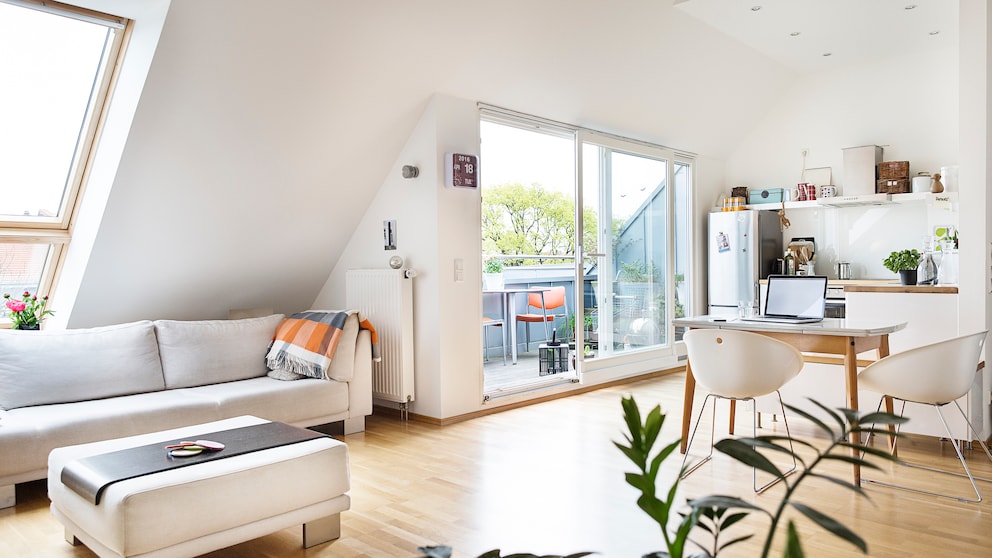
Attic rooms are often cramped, even with a large floor area. Even where you can stand upright in the room, the feeling remains due to the low side walls. What is the best way to furnish a room?
Attic rooms convey a sense of security, but are not always easy to furnish. Little space, lots of sloping ceilings, and often angled corners are a challenge. Here are some professional tips for creating a greater sense of space in the attic—and more storage space when furnishing.
Furnishing the Attic – Idea 1: Light, Small, and Discreet Furniture
“Small and multifunctional furniture is recommended. There shouldn’t be too much so that the room doesn’t look cluttered,” advises Ursula Geismann, Managing Director of Initiative Furnier + Natur. Light-colored furniture with clear shapes is advantageous. They appear lighter and airier in contrast to the somewhat constricting sloping ceilings.
Idea 2: Largest Piece of Furniture on the Gable Wall
The largest piece of furniture in the attic should be placed in the middle of the room or on the gable wall, which often leads up to the roof ridge. “The gable wall is ideal for cupboards or stepped shelves—ideally made to measure,” says Christine Scharrenbroch, press spokeswoman for the German Furniture Industry Association (VDM). In larger rooms, there is also room for open shelves in the middle as room dividers. However, there is often only room for low sideboards and shelves under the slope.
Furnishing the Attic – Idea 3: Expand Storage Space Options with a Sofa
The storage space can be expanded with drawers under the bed. If the section of wall under the slope—known as the knee height—is very low, it may be worthwhile installing a wall with a sliding door in front of it. “This creates walk-in storage space for lots of things, including a trolley and other mobile furniture,” says interior designer Pia Döll from Frankfurt.
The alternative is an idea that has to be practiced in some rooms out of necessity anyway: Move a sofa slightly away from the wall to not only give the head more space upwards under the slope. But also to use the gap for storage, advises Ursula Geismann.
If the sofa cannot be placed against the knee wall even with a little distance, it should be moved to the center of the room if possible, or a smaller récamière should be chosen instead of an L-shaped seating group, says Geismann. Upholstered stools and poufs offer even more design flexibility.
Idea 4: Low Bed Without Headboard
If the gable wall is already intended for the closet, the bed often has to be placed under the slope. This can be nice if it can be placed directly under the skylight – for waking up or lounging with a view of the sky. However, the height does not always allow for this.
That’s why low beds without a headboard that can be pushed right up to the knee wall are best suited here. But Döll, who is also President of the Association of German Interior Designers (bdia), notes: “Not everyone feels comfortable in a bed under a sloping roof, as the inclination above the head can be oppressive.” In this case, the bed should be planned in front of a straight (extension) wall.
6 Tips for Decorating a Living Room with Sloped Ceilings
How to Properly Furnish a Bedroom with a Sloped Ceiling
Furnishing the Attic – idea 5: Kitchen Without Wall Units
If the kitchen unit is against a high wall, Scharrenbroch recommends using the space up to the ceiling. For very high wall units, there are pull-out systems that make it easier to reach items stored high up. If the wall units are missing, “plan the worktops a little lower to gain more space in the base units,” says Geismann.
“Wall shelves on the slope serve as a supplement,” says Döll. There are shelves that can be adapted to the slope of the roof. You can do without an extractor hood on the wall: There are good models that can be integrated into the hob.
Idea 6: Deceive Visually
If the attic room is designed in light colors, it can appear larger. “A uniform color concept—in natural tones, for example—ensures a clear structure and a harmonious overall look,” advises Christine Scharrenbroch.
A room can be given more visual depth by painting the wall surface behind a light piece of furniture a slightly darker color, says Ursula Geismann. A similar effect can be achieved with matching wall decorations: “With pictures that allow you to look into the distance, you can create a sense of space even in a small room,” advises interior designer Döll.