


May 8, 2021, 11:38 am | Read time: 5 minutes
Finding the perfect rug isn’t always easy. Sometimes, choosing between different models can be challenging. So why not try a layered look? We have tips on how to skillfully overlap rugs.
Why lay down one rug when two make a much bigger impact? Not only does the layered look—where multiple rugs are placed on top of each other—create an interesting focal point in the room, but it also has several practical benefits. Discover what these are and how to skillfully overlap rugs here.
Overview
Layered Look for Practical Reasons
The layered look with rugs is not only original but is often used for functional reasons: A spilled glass of red wine that can’t be completely removed can be cleverly concealed with a second rug. If a floor is generally unattractive, overlapping rugs can significantly improve its appearance. Another practical reason is that in homes with generally flat-woven rugs, an additional high-pile model can provide more warmth and comfort, especially in winter.
How to Achieve the Layered Look with Rugs
Large Rug as a Base
There are various ways to create a layered look with multiple rugs. A common method is to use a large rug as a neutral base and place a second decorative rug on top. It’s important that the large rug is ideally short-pile or flat-woven. This way, the layered look doesn’t become a tripping hazard with each additional layer, and seating furniture of any kind doesn’t start to wobble.
Also interesting: 6 Beautiful Rugs for Your Home
In most cases, the shape of the base rug is rectangular or square. Placing a second smaller rug of the same shape on top creates an interesting look reminiscent of a mat in a picture frame. However, the overall look is less formal if the second smaller rug only partially overlaps the larger one. If both rugs are aligned in the same shape and only their ends overlap by a few inches, it creates a kind of bridge in the room. This form of an extended axis is ideal for large spaces or when an unattractive floor needs to be concealed. Either way, the interior gains significantly in coziness with more textile furnishings, which is especially beneficial in winter.
Another variant for the layered look with rugs seems to be inspired by the Orient, where it is often part of the culture to sit on the floor in a lounge-like atmosphere. This coziness is created with various textile small furniture and accessories such as poufs, floor cushions, as well as sheepskins and high-pile rugs. Here, where people tend to sit on furniture, a similarly cozy atmosphere can be created thanks to the layered look. This is achieved by randomly laying out and distributing many small rugs on a large rug model. The large rug acts as a visual link, ensuring unity rather than chaos in the look. However, it requires a good sense of colors, shapes, materials, sizes, and designs. This look either thrives on a unifying component in the form of a common color tone or a strong contrast, such as many round rugs on a rectangular base rug.
Two Rugs of the Same Size
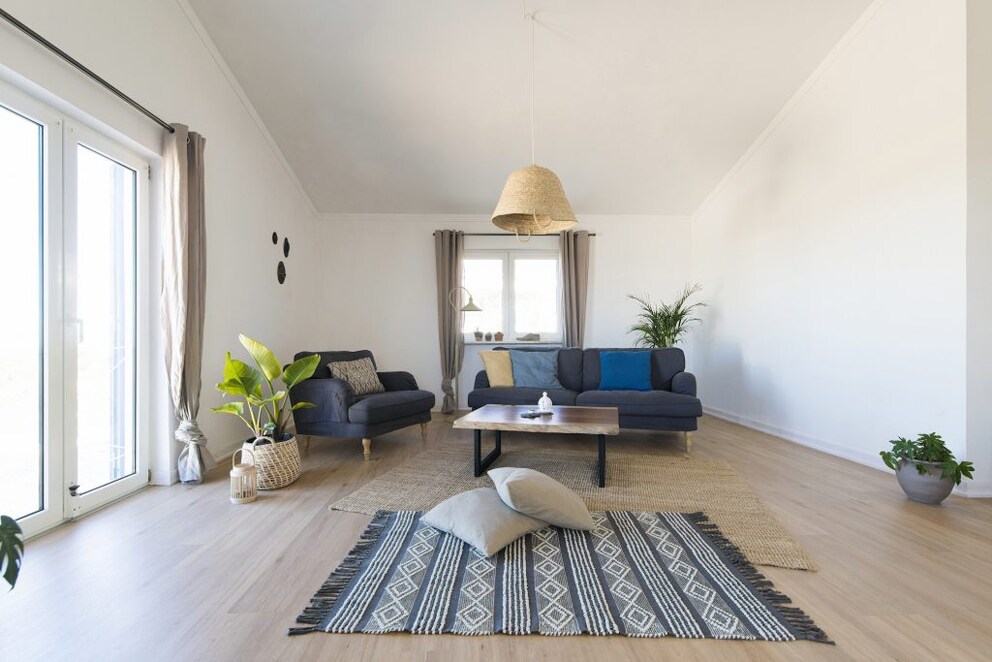
Often, rugs of the same or at least similar size are arranged overlapping for the layered look. The reasons for this vary: perhaps a decision couldn’t be made between two models, or a suitable large rug wasn’t found. The fact is, two rugs instead of one are always a comfortable, original furnishing solution.
If two rugs are the same size, a strong contrast on another level is necessary. For example, a refined twist occurs when a completely contrasting choice is made regarding color, pattern, shape, style, or material. An irregularly shaped cowhide overlapping an Oriental rug or a colorful kilim meeting a coarse-fibered, natural-colored sisal rug are extremely contrasting yet harmonious combinations.
Multiple Rugs of Similar Size
Particularly large rooms, such as in a loft, often offer a lot of free floor space. Here, an exciting look can be created by arranging multiple rugs of the same or similar size. This solution offers several functional advantages: it dampens unpleasant echoes, adds warmth to the room, especially in winter, and always ensures a cozy atmosphere.
Also interesting: Properly Laying Out Rugs in a Room – Tips from an Interior Designer
With a layered look involving more than two rugs, it’s advisable to have a unifying element, such as a color, appear in all the rugs or to stick entirely to one style. Otherwise, the look quickly becomes restless and not very cozy. For a casual arrangement, all rugs are laid out randomly and often asymmetrically. The resulting overlaps can vary in intensity.
However, if you prefer a wilder look and also have a good sense of colors, shapes, materials, styles, and so on, you can also play with different textures (e.g., sheepskin or sisal), shapes (such as round or irregular cowhide), patterns (stripes or circles), or styles (ethnic or oriental). In such a case, it’s recommended to keep the rest of the ambiance rather calm and monochromatic. This way, the focus on the floor gets a suitable counterbalance.