

November 22, 2026, 1:23 pm | Read time: 5 minutes
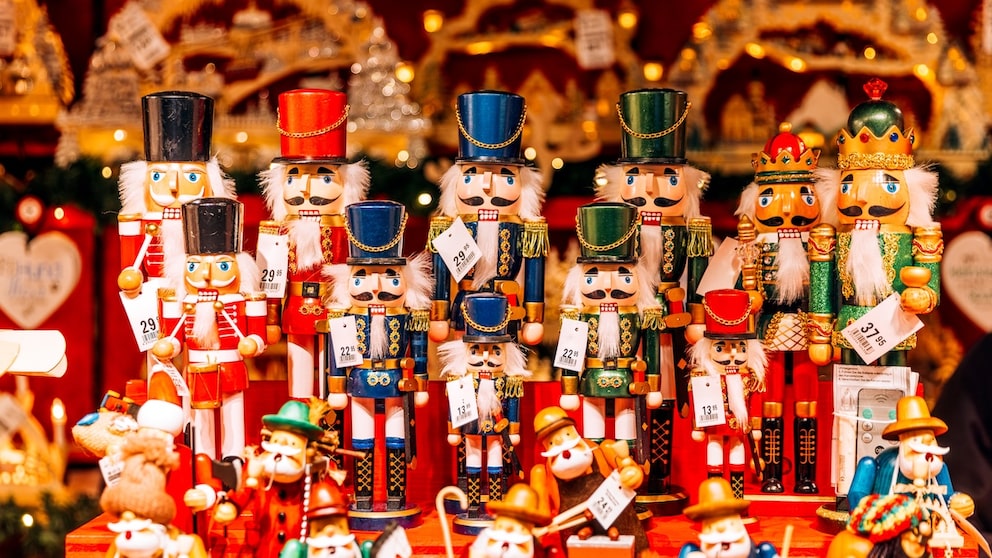
When Schwibbogen lights suddenly illuminate windows, small incense smokers spread their scent, and painted nutcrackers adorn living rooms, Christmas is not far off. Many of these symbols are an integral part of the Advent season for us. Yet few know the stories behind the traditional Christmas decorations from the Ore Mountains.
The home of some well-known Christmas decorations is the Ore Mountains—a region closely associated with the German Christmas. Here, artfully crafted wooden figures tell of hard work underground, the desire for light, and the ingenuity of a population that turned economic hardship into a unique craft tradition.
From Mining to Christmas Art
The story of Christmas decorations from the Ore Mountains begins deep underground. For centuries, mining defined the lives of people in the Ore Mountains. Silver, tin, and other mineral resources made the region economically significant. Entire towns and villages developed around the mines. But as ore deposits dwindled and many mines became increasingly unprofitable, numerous families faced financial difficulties.
People had to find new ways to earn a living. Since wood was abundant in the forest-rich region and many miners had crafting skills, woodworking became a new source of income. Miners became turners, carvers, and toy makers. What initially arose from economic necessity evolved over time into an art form with worldwide recognition.
The small town of Seiffen, in particular, developed into a center of Ore Mountain folk art. To this day, figures, pyramids, Schwibbogen, and other Christmas items are created in the workshops of the so-called toy village, often by hand in the traditional way.
The Schwibbogen as a Light Symbol from the Miner’s World
Few objects represent the Ore Mountain Christmas as much as the Schwibbogen. With its glowing candles and artfully sawn motifs, it adorns countless windows during Advent. Its history dates back to the 18th century.
The oldest known Schwibbogen dates from 1740 and was made of metal. It was created in Johanngeorgenstadt and differs significantly from the wooden versions known today. The origin of the characteristic arch shape is not definitively clarified. A common interpretation links it to mining: the Schwibbogen is said to resemble the arched entrance of a mine tunnel.
Its special significance, however, comes from the light. For miners, light held particular importance. Those who worked many hours underground saw little daylight, especially in the winter months. The glowing arches in the windows were thus associated with the longing for brightness and a happy return home.
Today, Schwibbogen come in a wide variety of designs–from traditional landscape motifs to wintry village scenes and elaborately lit and mechanically moving artworks.
Why Nutcrackers Often Look Like Kings and Soldiers
With its distinctive face, large teeth, and striking uniform, the nutcracker is one of the most famous Christmas figures. The traditional nutcrackers from the Ore Mountains are particularly well-known. But why do the figures often look like kings, soldiers, or stern officials?
The trail leads to the 19th century. One of the pioneers of the classic Ore Mountain nutcracker is the Seiffen turner Friedrich Wilhelm Füchtner. Around 1870, he crafted a nutcracker in the shape of a king, which became a model for many later figures.

The grim faces and striking uniforms are often interpreted as humorous or satirical depictions of the authorities of the time. Kings, soldiers, foresters, and gendarmes became popular motifs.
Originally, nutcrackers served a practical purpose: their lever mechanism allowed hard nutshells to be cracked open. Today, however, nutcrackers are mostly used as decorations or collectibles.
The Herrnhut Star: How a School Project Became a Christmas Classic

3 creative ideas for Advent calendars in 2024
Why the Incense Smoker is Typical for the Ore Mountains
Another classic Christmas decoration from the Ore Mountains is the incense smoker, affectionately called “Raachermannel” in the regional dialect. The small wooden figures are not only pretty to look at but also provide a special Advent scent with their smoke.
The first wooden incense smokers likely emerged around the mid-19th century. The idea behind them is as simple as it is ingenious: a cone of incense is placed inside the figure. The smoke escapes through a small opening in the mouth or pipe head, making it look as if the figure is actually smoking.
Here, too, the motifs reflect life in the Ore Mountains. In addition to miners, there are foresters, night watchmen, hikers, traders, and many other figures. They tell little stories from a bygone everyday world.
The incense smokers thus combine two things that are especially important during the Christmas season: loving craftsmanship and a sensual atmosphere. As soon as the first incense cone is lit and its scent spreads through the room, many people feel a sense of home and childhood.
A Piece of Living History
Schwibbogen, nutcrackers, and incense smokers are now far more than decorative accessories for the Advent season. They represent a region whose history has been shaped by hard work, economic change, creativity, and craftsmanship.
What once arose from economic necessity is now a cultural heritage known far beyond the Ore Mountains. Schwibbogen, nutcrackers, and other wooden figures are therefore not just Christmas decorations. They embody a piece of the region’s history, working world, and craftsmanship.