


July 28, 2025, 6:05 am | Read time: 3 minutes
Maximalism is considered a counter-movement to the minimalist style. myHOMEBOOK editor Katharina Regenthal reveals what defines this interior style and how you can decorate your home in a maximalist way.
Unlike other interior styles, maximalism is not a classic style in the traditional sense–it describes the way you decorate your home. It doesn’t matter if your home is decorated in Mid-Century, Boho, or eclectic style. In maximalism, colors, shapes, textures, and their interplay are key. Learn how to decorate your home in a maximalist way here.
The Big Debut in the ’80s
Maximalism doesn’t have a specific origin–it’s more of a counter-movement to minimalism. In the quest for more individuality, patterns, materials, and colors were mixed and combined, leading to the emergence of maximalism. It had its first big debut in the 1980s, during the rise of a new design movement: the so-called Memphis Design. This was also a counter-trend to emotionless design, focusing instead on extravagance and a variety of colors.
Over the years, maximalism has evolved into a style where old furniture and accessories with history are combined with modern designs. Traditional styles are mixed with futuristic designs.

4 Variants for Fabric Wall Decor

Decorate Your Apartment Like Monica Geller From ‘Friends’
What Matters in Maximalism
Contrary to popular belief, maximalism doesn’t necessarily mean owning a lot of things. It requires a keen sense to decorate your home in a maximalist way. A multitude of styles, textures, and colors are combined–which is not easy. Without an eye for the right mix, it can quickly look cluttered and chaotic.
It’s important to feel comfortable in a maximalist style. Those who prefer a more reduced and functional style should choose a different direction. However, for those who love colors, variety, extravagance, and creativity and want to showcase this in their home, maximalism is perfect. Design enthusiasts who want to express their personality through decor and integrate personal collectibles or heirlooms will benefit from this style. Maximalism also invites creativity, experimentation, and trying new combinations.
Implementing Maximalism in Your Own Home
Maximalism means combining colors, patterns, and textures. Unlike minimalism, not everything needs to have a function. Decor that serves purely decorative purposes is even desired! This creates an exciting overall picture.
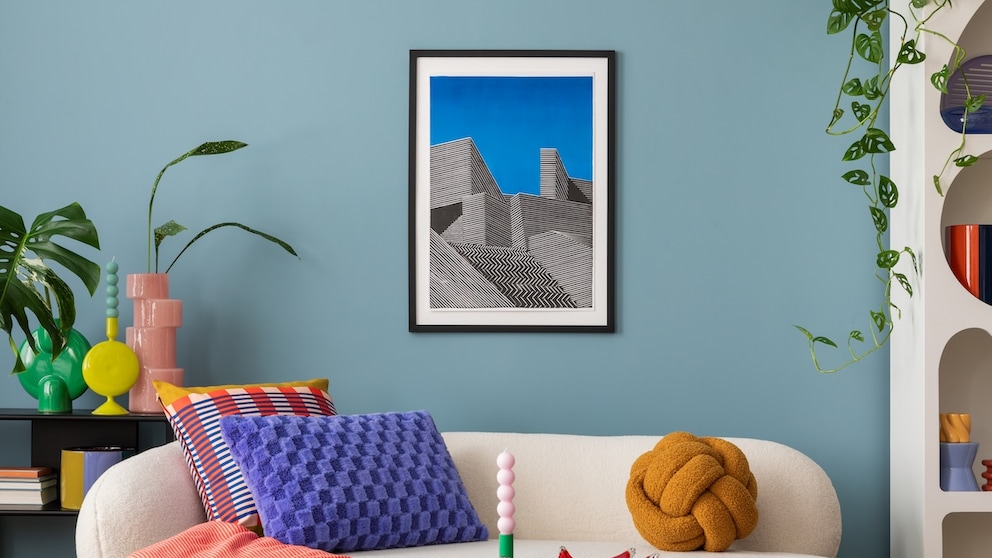
When it comes to colors, strong contrasts are key. A bold blue with a vibrant pink or an emerald green with a bright orange create a lively palette and still appear harmonious. These colors can be incorporated through colorful walls or wallpapers, as well as furniture. A colorful rug or a lacquered table also fits well.
But it’s not just the colors; patterns are also crucial in maximalism. These are freely mixed and combined–floral meets stripes, dots meet jungle. Different textures and materials are important here.
In terms of decor, wall and table decorations are the secret to a maximalist setup. On the wall, it’s not just about hanging many pictures or frames, but a variety of items. From neon signs to fabric wall decor, smaller sculptures, or larger paintings–the mix is what counts! On the table, coffee table books, small statues, vases, or other souvenirs and keepsakes are particularly suitable.