


February 25, 2026, 11:08 am | Read time: 4 minutes
The living room is considered the heart of the home. It’s a place for relaxation, socializing, and increasingly, self-expression. However, interior design is often subject to constant change. What was considered stylish, cozy, or modern in recent years seems outdated in many places by 2026. New living needs and the desire for individuality and personality are causing certain trends to quietly fade away. myHOMEBOOK editor Mareike Schmidt reveals what will no longer be in vogue in living rooms in 2026.
Acoustic Panels as Pure Style Elements
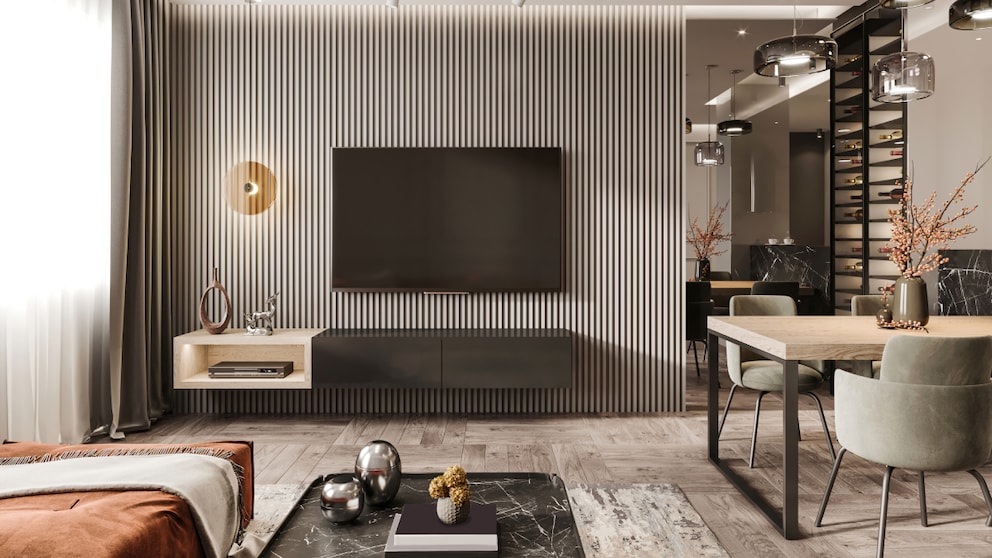
Originally from room acoustics, vertical acoustic panels made of wood or wood-look have become ubiquitous decor elements over the past two years. However, by 2026, they will be considered clearly outdated and will no longer be in vogue in living rooms. People have simply grown tired of them.

Especially when used purely as decorative elements, they no longer appear modern but rather like a typical influencer accessory that appears almost identically in countless living rooms. The panels symbolize a trend that arose less from genuine living needs and more from social media aesthetics. In many cases, they lack functional purpose while visually dominating and strongly defining the space.
8 Tips for Indirect Lighting in the Living Room
3 Tips for Designing a Unique Ceiling
LED Lighting Around Furniture
Indirect LED lighting around furniture pieces was long considered a modern design tool. Light strips under sofas, behind lowboards, along living room walls, or in shelf compartments were meant to add depth and atmosphere to the room. However, by 2026, living rooms will increasingly move away from this form of permanent staging. The reason: What was once meant to be subtle has become constant lighting in many places, making it visually tiring.
LED lighting around furniture often creates an artificial, almost scenographic effect, giving the living room a stage-like quality. Instead of calm, a constant tension arises, stripping the room of its naturalness. It becomes particularly problematic when lighting is used not functionally but solely decoratively and is constantly present. The room then feels less homely and more like an exhibition or hotel lobby.
Additionally, LED strips are strongly associated with short-lived living trends. In combination with acoustic panels, TV walls, or high-gloss surfaces, they have become a recurring design pattern that is considered overused and out of style in living rooms by 2026.
Also interesting: What Will No Longer Be in Style in Bathrooms in 2026
In terms of light quality, permanently installed LED strips also reach their limits. They are often only dimmable to a limited extent, age unevenly, or quickly appear unharmonious in terms of color. In living rooms, lighting is now used more consciously: spotlights, warm, and changeable. Mobile lights, floor and table lamps, and zoned light sources replace permanent furniture lighting, allowing the atmosphere to be redefined according to use and time of day.
Living Walls and TV Walls as Dominant Design Elements
Living walls and elaborately staged TV walls will significantly lose relevance by 2026. What was long considered a functional solution to combine technology, storage, and design now often appears oversized and visually overwhelming. Large, meticulously planned wall constructions take away the lightness of the living room and lock the space into a design for years—a clear disadvantage in a time when flexibility and adaptability are becoming increasingly important.
Especially TV walls, where the television is stylized as the central focal point of the room, are increasingly considered outdated. Whether with dark panels, stone-look, integrated LED lighting, or custom-built installations, the focus on the screen contradicts the desire for a homely atmosphere. In 2026, people want technology to be integrated but as unobtrusively as possible, not as the design center of the room.
Additionally, many living and TV walls were designed with strong trend influences. Combinations of acoustic panels, floating lowboards, black metal lines, and indirect lighting are so commonly seen that they have lost their exclusive character. Instead of appearing individual, they resemble catalog or influencer layouts that hardly differ from one another.