

October 9, 2026, 10:35 am | Read time: 5 minutes
The Tulip Table, designed by Eero Saarinen, is much more than an iconic piece of furniture. It represents a new, radically simplified design language. But what idea lies behind its design, how did it come about, and what makes it a timeless design classic today? Interior expert Mareike Wegener has taken a closer look at its history.
Follow myHOMEBOOK on WhatsApp now
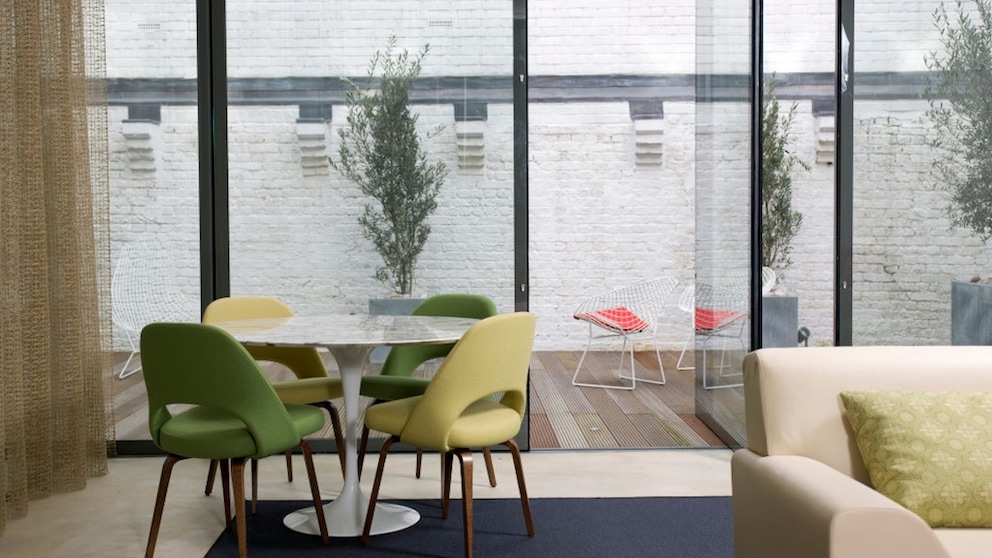
Some pieces of furniture simply occupy a space. Others change how we perceive a room. The Tulip Table by Eero Saarinen, one of the most significant representatives of the second generation of modernism, clearly belongs to the latter category. At first glance, the table appears almost surprisingly simple: a round or oval top, supported by a single, elegantly flaring base. No four legs, no visible braces, no complicated construction. Yet behind this apparent simplicity lies one of the most radical ideas in 1950s furniture design.
Designed in the 1950s and Ahead of Its Time

The creation of the Tulip Table occurred during a period when design was fundamentally changing. Classical modernism had long worked with geometric, functional, and rather strictly constructed forms. In contrast, Saarinen began to conceive furniture and architecture increasingly as flowing, organic forms. He was known for his intense focus on proportions, models, and revisions. The company Knoll describes how he created numerous models and scale or life-size prototypes to continually refine curves, lines, and proportions.
Museum collections date the design phase of the table to between 1953 and 1956, while Knoll cites the collection as 1957 and describes its introduction in 1959. The design thus clearly belongs to the mid-1950s.
The Idea Behind the Design
To understand why the Tulip Table looks the way it does, one must take a step back. Saarinen did not start with the question of how to make a table as spectacular as possible. He began with a very specific problem. He was bothered by the tangle of legs under tables and chairs. In a much-quoted phrase, he described the traditional furniture situation as a “slum of legs.” His intention was to eliminate this visual clutter and make furniture perceivable again as cohesive, clear forms.
This initially sounds like a purely aesthetic consideration. In fact, Saarinen was concerned with more. He wanted to redefine the relationship between people, furniture, and space. When tables and chairs no longer stand on four separate legs, a completely different spatial situation arises beneath the seating and table surfaces: calmer, more open, and more generous. The Tulip Table is thus not just a table with an unusually shaped base. It is the consistent answer to a design question: How little does a piece of furniture need to perfectly fulfill its function?
Also interesting: What makes the Egg Chair by Arne Jacobsen so special
From Pedestal Table to Tulip Table

The naming history is also interesting. Saarinen’s designs originally belonged to the Pedestal Collection–the name refers to the central pedestal or single base.
The term “Tulip” primarily describes the organic appearance of the entire series. The connection is particularly evident with the accompanying Tulip Chairs: the seat and base seem to emerge from a single, flowing form. The Museum of Modern Art in New York describes the chair as a form reminiscent of both a flower and a wine glass.
With the table, the association is more subtle. The slender base flares out organically upward and downward, making the construction appear almost like a single sculpture. This departure from visible individual parts was crucial to Saarinen’s concept.

Trends at the World’s Largest Furniture Fair in Milan
4 Trendy Chrome-Look Decor Ideas
The Technique Behind the Apparent Simplicity
As natural as the form seems today, technically it was by no means simple. Saarinen experimented intensively with modern materials and manufacturing techniques. The table base is made of cast aluminum, and the tops were and are made in various materials, including wood, marble, and laminate.
The construction is designed so that the connection between the top and base does not disrupt the form. The beveled, finely tapered edge of the tabletop also enhances the visual lightness. Knoll sees this combination of slender shaft, elegant top, and precise construction as defining the design. It is crucial not only that Saarinen designed a table with just one base, but how consistently he aligned every detail with this principle.
Why the Tulip Table Is a True Designer Piece
A designer piece is not defined solely by having a famous name attached to it. With the Tulip Table, the design idea can actually be traced down to the smallest detail.
First, the design has a clear, recognizable design language. Second, it solves a specific functional and spatial problem. Third, it combines new materials and production techniques with a strong aesthetic idea. And fourth, the design is so distinctive that it remains unmistakable even decades later.
This combination of innovation, function, material, and form makes the Tulip Table a milestone in modern furniture design. Today, the table is a symbol of mid-century design and appears surprisingly contemporary. It fits seamlessly in elegant dining and living rooms, minimalist apartments, spacious lofts, or historic buildings. Its form can hardly be assigned to a specific era–and that is part of its fascination.