


August 20, 2025, 3:37 am | Read time: 4 minutes
Rice paper lamps have become indispensable in many households. Whether in children’s rooms, shared apartments, design lofts, or family homes—they are found worldwide. myHOMEBOOK reveals where their design originally comes from and what makes them so popular.
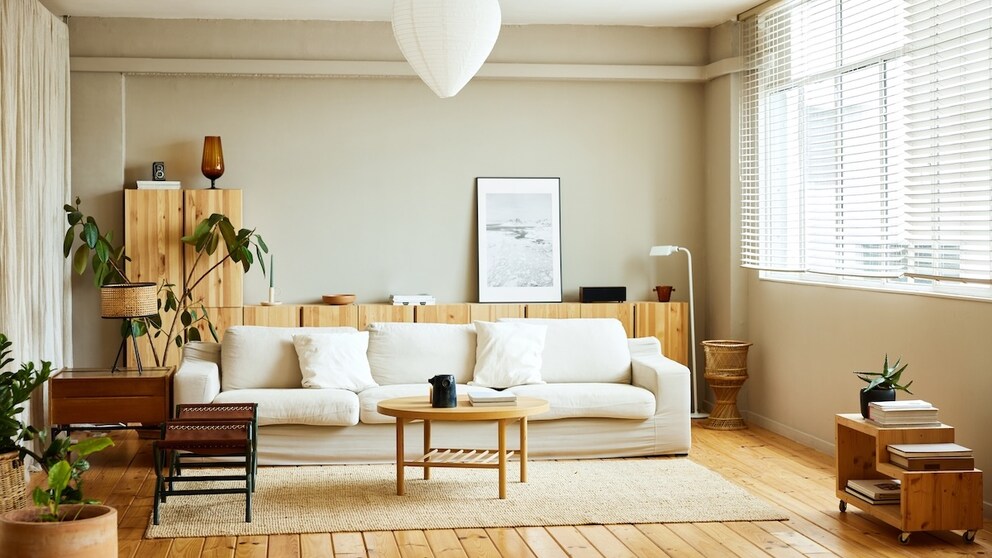
Some lamps do more than just provide light. Rice paper lamps definitely fall into this category. Few other lights can illuminate a room so gently—almost as if the moon itself were hanging in the living room. These lamps have been among the most popular home accessories for decades. They are characterized by their simple elegance and uniquely soft lighting effect. The thin paper ensures that the light diffuses into the room, creating a warm, calm atmosphere. Rice paper lamps have long been a staple in minimalist or Scandinavian interior styles, not least because they are affordable, versatile, and very decorative.
Origins in Japan and China
Behind the seemingly simple constructions of rice paper lamps lies a centuries-old tradition. The roots of these lamps are in Asia, particularly in Japan and China. For centuries, lampshades made from hand-crafted Washi paper have been produced there. They are often referred to as rice paper lamps here, even though rice is rarely involved. Instead, the fine, translucent paper is made from plant fibers, which is what creates the special lighting effect.
In their countries of origin, the lamps played not only a practical role as a light source but also held aesthetic and cultural significance: They represented purity, simplicity, and the harmony between nature and living space.
Also interesting: Which Lamp Suits Which Interior Style
The Classic Design and Its Longevity
The round shape, reminiscent of a floating moon, is probably the most well-known design of rice paper lamps. It became popular in Europe in the 1950s, mainly through furniture stores specializing in affordable design. For them, the lamp is a perfect product: simple, inexpensive, and versatile. However, similar forms were common long before in traditional Japanese homes. The fact that this design has remained almost unchanged to this day speaks to its timeless modernity.

Lighting Trends 2026

Which Light Fixture Matches Which Interior Style
Famous Designers and New Interpretations

In the 1950s, the rice paper lamp experienced its international breakthrough, and not by chance: The Japanese-American artist and designer Isamu Noguchi created true icons with his “Akari Light Sculptures.” His designs, handcrafted from bamboo frames and Shoji paper (white, translucent paper made from wood fibers), transformed a simple lamp into an art object. Noguchi combined Eastern craftsmanship with Western design sensibilities, making rice paper lamps a recognized part of international design. Today, his Akari lamps hang in museums and the living rooms of design enthusiasts worldwide.

Contemporary designers also repeatedly embrace the concept, sometimes in traditional, sometimes in modern versions, with new materials or geometric shapes. A prominent example is the Formakami series by Spanish designer Jaime Hayon for the Danish label &tradition. Hayon took the traditional form of the Asian lantern but reinterpreted it with playful proportions and striking black accents made of wood. The result: lamps that appear both airy-light and powerfully modern. Formakami shows how vibrant and adaptable the ancient principle of the rice paper lamp remains, bridging tradition and contemporary design.
Why They Are More Popular Than Ever Today
But why is the rice paper lamp still so popular in the 21st century? For one, it’s due to its versatility: It fits just as well in minimalist spaces as in cozy old apartments. Additionally, it fulfills a need that is increasingly coming into focus—sustainability. Paper and bamboo are natural materials that can be processed resource-efficiently. Moreover, the lamps are affordable and, despite or perhaps because of their simplicity, never seem outdated.
Rice paper lamps are far more than a decor trend. They are a shining example of how an ancient craft tradition has found its way into modern home culture. And they demonstrate that good design doesn’t have to be complicated. Sometimes, all it takes is a bit of paper, a bamboo frame, and a light bulb.