


September 8, 2026, 11:14 am | Read time: 5 minutes
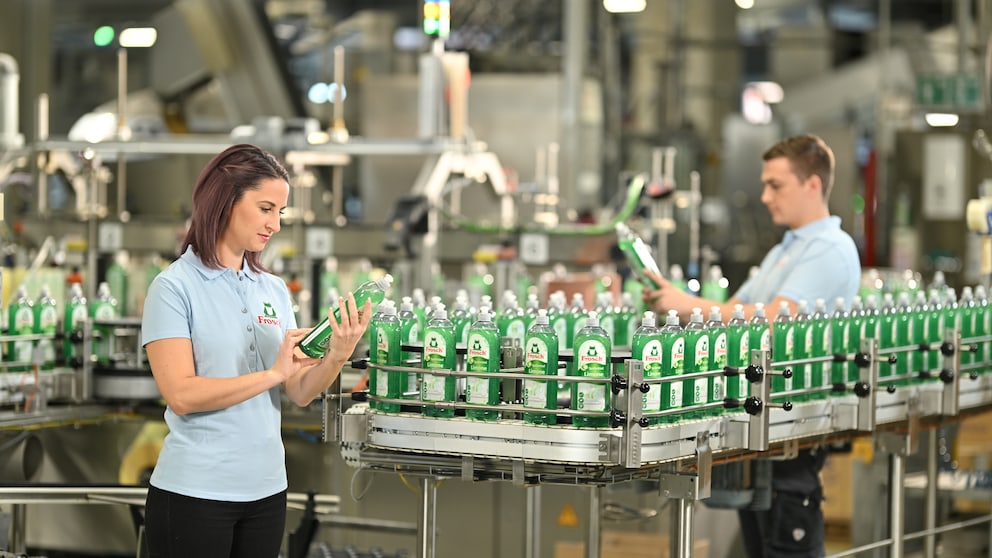
Cleaning products, but sustainable: That’s exactly what the brand Frosch has committed itself to. Forty years ago, the company from the cleaning product manufacturer Werner & Mertz was among the first to consistently market ecological products. Today, the green bottles with the distinctive Frosch logo can be found in almost every supermarket. myHOMEBOOK explains what the company is all about and has asked Frosch directly.
Follow myHOMEBOOK on WhatsApp now
When Sustainability Became a Trend
The 1980s were marked by upheavals: The world was in turmoil, with climate change, forest dieback, and air pollution increasingly coming into public awareness. Climate change became a topic of societal discussion following several environmental disasters. A stronger focus on an ecologically valuable everyday life became not only essential but also a trend for an entire generation. “Werner & Mertz” understood the new zeitgeist and increasingly worked on forward-looking household products.
In 1986, the traditional family company from Mainz launched a plant-based neutral cleaner under the name “Frosch” for the first time. The eco-product was a commercial success and paved the way for the young brand’s success story. Around the turn of the millennium, “Frosch” also made a name for itself beyond national borders. “Currently, Frosch can be found in almost all European countries and is even in high demand in some Far Eastern countries, such as Japan or South Korea,” reports Karin Greve, head of marketing Germany at Werner-Mertz, in response to a query from myHOMEBOOK.
According to its own statements, the company produces in Mainz and Austria, and the products are delivered to Europe and also exported internationally through seven distribution locations. The company did not explain how it considers environmental aspects in terms of transport methods and routes.
Also interesting: Places where cleaning products should not be stored
Product Lines for Big and Small
As Frosch had long since established itself as a pioneer in eco-cleaning products, one thing suddenly came into focus: sensitive children’s skin and the idea that climate protection should not start only in adulthood. This led to the creation of the Frosch Baby line, which focused on a reduced formulation and hypoallergenic, pH-neutral recipes. A wide range of gentle products for the little ones was developed, from detergents to hygiene cleaners. Other product lines focus on room fragrances as well as shower gel, soap, and shampoo.
Green and Harmless?
According to the company, the holistic green brand promise is the reason why the now more than 80 cleaning products, from detergents to glass cleaners, have become known worldwide. The distinctive logo with the green frog and the red lettering underneath likely contributed to this as well. But how green is Frosch really? myHOMEBOOK also inquired about this.
Frosch publicly advertises its commitment to consistently ecological values. These include recycling packaging without microplastics, supporting projects to promote the circular economy, and formulations based on renewable raw materials. “From the beginning, we have been consistently on the path to independence from petroleum. Like nature, Frosch operates in cycles: with plant-based ingredients from renewable raw materials, without petroleum, and without animal components,” explains Greve.
The company’s self-image also includes various environmental certifications and collaborations with conservation organizations. The pronounced sustainability image is highly valued at Werner & Mertz.
What Are Laundry Detergent Sheets?

Are the New Paper Coffee Pods Worth It?
Is the Cleaning Product Industry Really Fully Sustainable?
Central criticisms from environmental groups concern less the company itself and more the entire “green” cleaning product industry. The focus here is on the point that even ecological cleaning products are not automatically harmless to the environment and not all products are comprehensively certified by independent bodies. The accusation of deliberate “greenwashing” has so far largely bypassed Frosch. When asked how Frosch views this issue, myHOMEBOOK received the following response:
“Of particular importance to us is EMAS, the world’s most comprehensive and high-quality system for sustainable environmental management. We introduced it in Mainz in 2003 and in Hallein in 2005. This system enables objective and metrics-based environmental management with ‘climate monitoring.’ […] With the EMAS validation of our production sites, we can transparently demonstrate how consistently we actually live our sustainability philosophy.”
Regarding the ingredients, Frosch has been criticized in the past for using synthetic fragrances. Individual products are said to contain declarable fragrances such as hexyl cinnamal or benzyl salicylate. While these are generally allowed, they can cause allergic skin reactions in sensitive individuals. Additionally, in 2019, Öko-Test found synthetic polymer, a liquid-dissolved plastic, in a citrus full detergent. This was immediately removed after the test, as the company announced.
Good to know: EMAS stands for “Eco-Management and Audit Scheme” and is an environmental management system developed by the European Union. It is voluntary and is intended to specifically improve environmental performance in companies and organizations.
Too Expensive?
Even though Frosch has consistently secured top positions in various customer satisfaction surveys by other media for years, users occasionally criticize the price-performance ratio and cleaning performance in online reviews. The products, despite their higher price category, are said not to perform significantly better than cheaper store brands.
Similar brands to Frosch include everdrop and Sonett.