


October 24, 2026, 7:34 am | Read time: 6 minutes
Grates, brushes, and screens promise a clear gutter. But no system fits every house. A gardening expert and a master roofer explain to myHOMEBOOK what to consider when choosing and why even the best leaf protection doesn’t replace regular inspections.
In fall, leaves fill the gutter; in spring, it’s flower debris and seeds. Leaf protection is meant to at least reduce the amount. How well such a dirt catcher works mainly depends on the trees around the building. “Someone with a large oak in front of the house has a different problem than someone with pines, spruces, or birches,” explains Torsten Brämer from the online gardening community “We Are Garden” when asked by myHOMEBOOK.
Follow myHOMEBOOK on WhatsApp now
What Leaf Protection Systems Are Available?
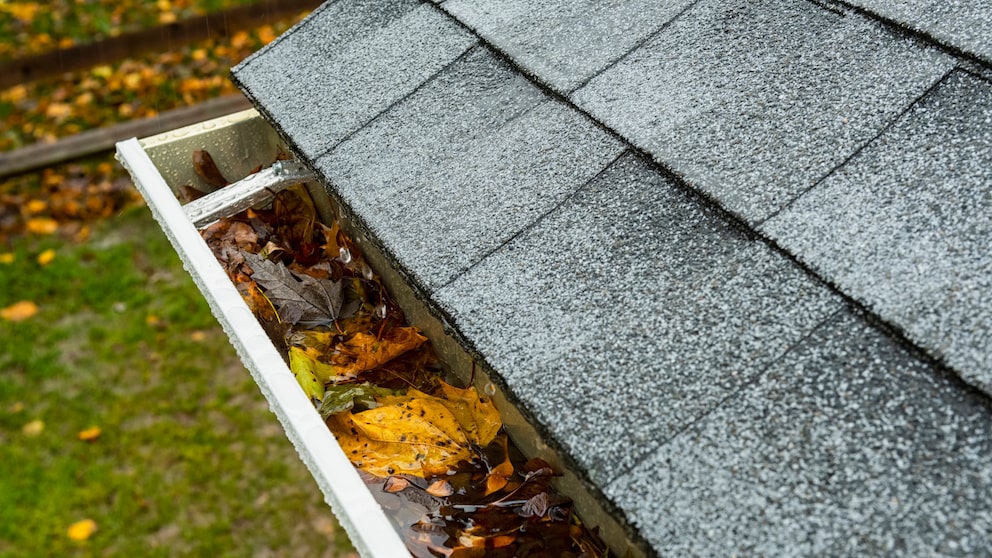
Fall brings beautiful colorful leaves, but for gutters and the associated drainage of rainwater, too many leaves are not good. That’s why there are numerous protection systems designed to stop leaves and prevent clogs in the gutter.
- Leaf grates and leaf protection nets sit on or in the gutter. They mainly block larger leaves.
- Gutter brushes lie directly in the gutter. They hold back leaves while water flows through the bristles.
- Solid covers, also known as gutter hoods, channel rainwater through slots or openings into the gutter.
- Downspout screens and leaf catchers are located at the transition to the downspout. They primarily prevent the pipe from clogging.
- Additionally, there are leaf baskets and systems with fine mesh screens or microfabric.
- Another solution is downspout filters, also called leaf separators. Leaves can be removed directly at the downspout through a cleaning opening. Some models even automatically eject them.
Leaf Protection Has Its Limits
Most systems reliably catch large leaves. It becomes more challenging with fine needles, small seeds, flower debris, and moss. They pass through coarse screens or settle on fine screens. Over time, a real layer of dirt forms. In the worst case, plants even grow on it.
A coarse screen works well against maple or oak leaves. For pine needles, it’s not necessarily the best solution, according to Brämer. Despite such weaknesses, leaf protection significantly reduces maintenance effort. A large portion of the leaves remains on top, and the wind carries some away. However, the gutter does not become maintenance-free. Homeowners should regularly check the gutter, protection, and especially the inlet to the downspout. How often depends on the location. More debris accumulates under large deciduous or coniferous trees than at a freestanding house. “I would therefore consider leaf protection more as a labor-saving measure rather than a maintenance-free solution,” says Brämer.
Also interesting: How to effectively clear the gutter of leaves and dirt
Bernd Redecker, master roofer and technical advisor at the Central Association of German Roofing Trades (ZVDH), sees it similarly. According to the master roofer, grates, brushes, and screens are “only helpful with sufficient control at certain intervals.”

How to Effectively Clean Leaves and Debris from Your Gutter

How Often Should You Clean a Rain Barrel and Cistern?
Weather Determines If the System Helps
Whether leaf protection is effective becomes apparent during heavy rain. Significant quality differences emerge then. A good system allows large amounts of water to pass through quickly. A too fine or clogged screen, on the other hand, slows the water down. Then it shoots over the gutter. Similar happens when leaves lie on the screen. According to Redecker, the gutter may not take in any water at all.
A blockage at the downspout is particularly critical. A screen at this point keeps leaves out of the channel but quickly clogs itself with leaves, the master roofer notes. Additionally, according to ZVDH, a downspout screen reduces drainage capacity by about half. If water backs up in the gutter, it spills over the edge. If it continuously runs down the facade or masonry, moisture damage threatens.
If excess rainwater flows onto the neighboring property, it also causes disputes at the garden fence. Your rainwater must not end up at the neighbor’s. In most states, this is even explicitly prohibited by law.
In winter, two more problems arise. Frozen leaves and dirt can block the openings. Additionally, snow and ice burden both the gutter itself and the protection system. “Leaf protection should never lead to neglecting gutter inspections,” emphasizes Brämer.
What Installation Costs and Who Handles It
The question of price remains. The range for different leaf protection solutions is wide. Simple plastic grates, brushes, or leaf baskets are relatively inexpensive. High-quality metal grates, sturdy covers, or customized solutions are significantly more expensive. The exact cost remains unclear. Even the roofing association doesn’t venture a price estimate. There are at least 100 different systems, Redecker explains the caution. Additionally, no house is the same, neither in height nor location.
The larger expense is often installation. At a single-story house with an easily accessible gutter, the effort is manageable. If scaffolding, boom lifts, or fall protection are needed, installation costs quickly exceed the material price. When considering offers, it’s worth looking at the price for the fully installed system.
Those looking to save on installation costs can install many simple systems themselves. The real risk, according to Brämer, lies in the height. A fall from the ladder can have serious consequences. At a low, easily accessible gutter, experienced homeowners can manage alone. If the gutter is high or there’s a risk of falling, the job should be left to a professional. The roofing association views DIY installation more critically. Those without experience working on ladders should leave it to professionals, Redecker advises. A household ladder doesn’t offer a secure stand, and even on professional ladders, absolute caution is required. “Falls, especially from low heights, often have drastic consequences,” warns the ZVDH expert. Redecker believes the money for a professional is well spent. Upon request, the guild roofer can also perform a roof check, a thorough inspection of the entire roof.
Also interesting: How often homeowners should inspect their roof
A professional is also needed for special roof shapes. Most systems are designed for external gutters on steep and gable roofs. According to ZVDH, flat roofs and internal gutters also pose a risk of falling over the roof edge. There and with complex drainage, a roofer should choose the solution. They know how much water flows from the roof during heavy rain. Accordingly, they select the size of the gutter. A leaf catcher at the downspout is included in the calculation.
In the end, the same applies to every solution. The gutter “must primarily continue to fulfill its most important task without problems, namely safely channeling large amounts of rain,” Brämer emphasizes.