


September 25, 2026, 4:43 am | Read time: 4 minutes
More and more household devices require electricity. Yet, no one wants a tangle of cables in the living room. So, display cabinets or sofa sets hide the mess of wires. Or a power strip with five devices plugged in gets tucked under the couch or cabinet. Hiding plugs can become a risk, as myHOMEBOOK has discovered.
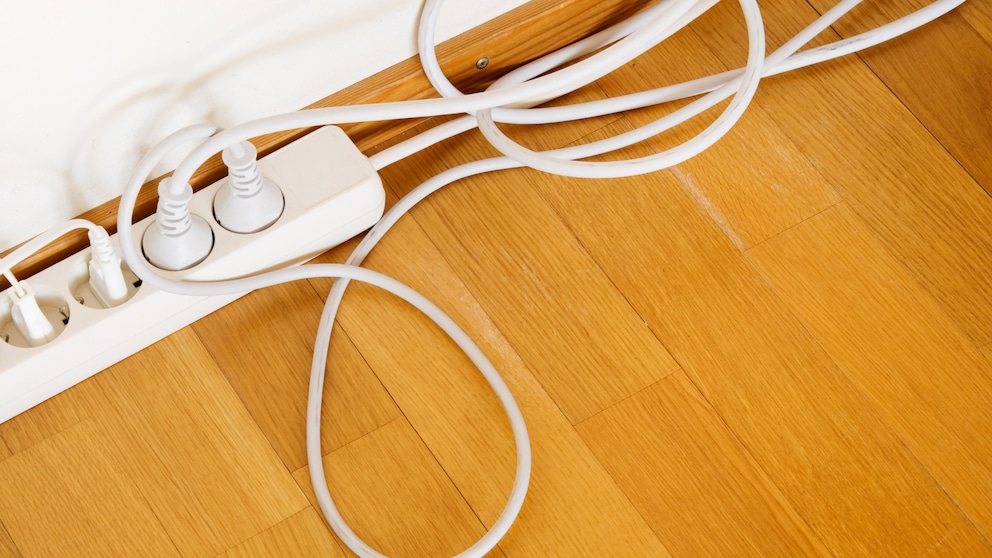
A power strip behind the sofa is common in many households. TV, router, lamp: All cables should ideally disappear from view. However, electrical experts warn against this practice. Electricity generates heat, and this heat needs a way to escape.
Follow myHOMEBOOK on WhatsApp now
How Great Is the Fire Risk Really?
Every power strip heats up during use. This is completely normal. If the strip is freely accessible, the heat can dissipate. If it’s wedged behind a cabinet, the heat builds up.
Especially because the power strip is not constantly visible, no one initially notices overheating. Electrical experts also warn against placing such power strips behind curtains or other devices. Here, too, the heat cannot escape adequately. Thus, the risk of a fire increases in case of overload or malfunction.
Also interesting: These 5 energy guzzlers should definitely be turned off at night
Risk: Power Strip
Power strips are usually designed for a capacity of about 3,500 watts. If several high-power devices run simultaneously, this limit can quickly be exceeded. Therefore, households should not opt for the first cheap solution but invest in power strips with a recognized external test seal. A GS or VDE mark stands for quality. Then, an independent testing body, not the manufacturer, has tested the power strip.
In general, the Central Association of the German Electrical and Information Technology Trades (ZVEH) advises caution when using power strips. These are generally not designed for heavy loads. While they can handle high loads briefly, continuous stress can lead to overheating. The risk applies to both the power strip itself and the cable, warns the ZVEH.
Devices with high power consumption, such as space heaters, washing machines, dryers, dishwashers, or household grills, should therefore be plugged directly into the wall outlet, with a clear view of the plug.
How High Is the Fire Risk With Clothes Dryers?

Expert Tips for a Safe Home Workshop
Couch or Cabinet: Should the Strip Be Left Exposed?
An accessible power strip offers three advantages:
- First, heat can dissipate unhindered.
- Second, the strip can be regularly checked for damage, such as scorched spots or an unusually warm plug.
- Third, it remains immediately accessible in an emergency to unplug.
The area behind furniture is a popular gathering place for dust and lint, the so-called dust bunnies. Thus, dust also accumulates around power strips or multiple outlets. A spark from a short circuit is enough, and the dust can ignite.
Another issue concerns visual inspection. A concealed power strip is unseen. Damage usually doesn’t announce itself suddenly but is indicated by scorched cables or discolored insulation. If such signs go unnoticed for days, the risk of a fire increases.
Additionally, access to concealed power strips is difficult in an emergency. With a scorched smell or smoke, every second counts. A heavy couch or living room cabinet in the way costs valuable time.
Mechanical wear can also provoke fires. Moving furniture can kink and damage cables. A damaged cable increases the fire risk further, regardless of location.
Also interesting: How to clean an outlet properly and safely
If Concealment Can’t Be Avoided: Here’s What Matters
By following a few rules, you can make your cable management nearly invisible at home:
- Keep a distance: The strip should not be tightly wedged between furniture and the wall. A few centimeters of space are often enough for heat to escape.
- Don’t cover with textiles: Blankets, curtains, or rugs over the strip further intensify heat buildup.
- Choose tested quality: A GS or VDE mark indicates a power strip tested by an independent body.
- Observe load limits: The maximum wattage is usually on the underside of the power strip. Before connecting multiple devices, a quick comparison with their power consumption is worthwhile.
- Regularly check: Even if the strip is concealed, a quick touch is enough to regularly check temperature and condition. If the plug feels warm, it should be unplugged immediately.
- Don’t daisy-chain strips: Connecting two power strips doesn’t increase total capacity. The first strip still bears the full load of all connected devices. The risk of overheating increases.
- Avoid damp areas: Power strips have no place behind furniture in the bathroom or near the kitchen sink.