


January 5, 2026, 4:16 pm | Read time: 5 minutes
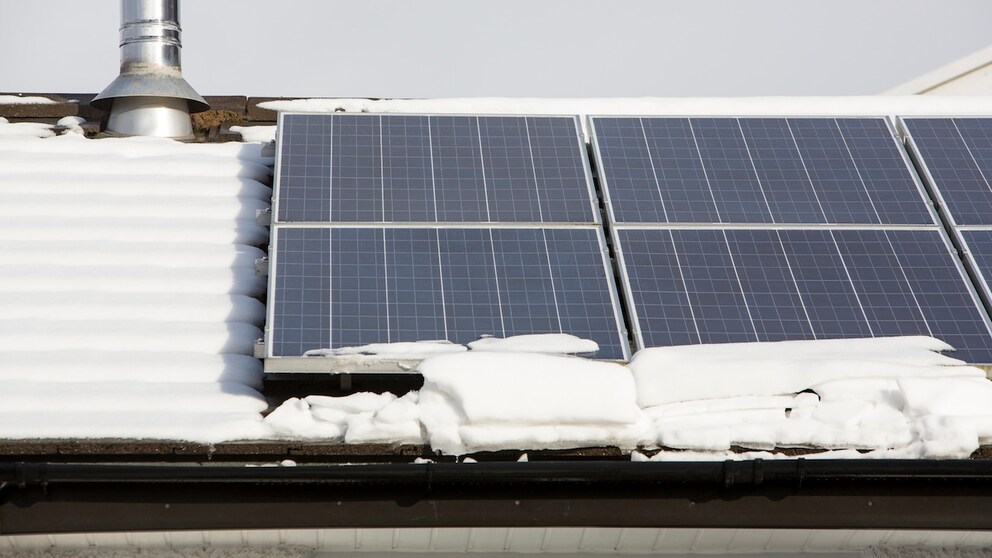
When the roof disappears under a thick blanket of snow, burying the solar panels beneath it, homeowners might wonder if they need to take action. Can the solar panels be damaged, and do they need to be cleared of snow and ice?
The winter sun shines, but the roof is completely covered with snow. Solar panel owners may ask themselves if they need to grab snow and ice scrapers, like for car windows, to remove the “white wonder.” It’s clear that the snow layer reduces the system’s output.
How Much Does Snow Affect Solar Panel Output?
The winter months from October to March are comparable to an agricultural lull for PV system owners. During this period, yields are significantly reduced. It’s not uncommon for December to produce only a tenth of the yields seen in a sunny June.
However, electricity production rarely comes to a complete halt. The sun’s UV light can penetrate snow layers up to 15 centimeters thick. Paradoxically, the efficiency of the panels even increases at lower temperatures. This is because the conductivity for electricity in a semiconductor increases at lower temperatures.
Do Solar Panels Need to Be Cleared of Snow?
“A photovoltaic system generally does not need to be cleared of snow or ice like a car windshield,” explains a spokesperson from the German Solar Industry Association in response to a myHOMEBOOK inquiry. “The panels are designed for very low temperatures and function reliably even in frost.”
Solar panels have a self-cleaning effect. When sunlight hits the panels, they generate voltage and warm up slightly. This small temperature difference often causes the snow to slide off on its own, provided there is a slope of at least 30 degrees. The effect is better if the panels are frameless. The lower edge of a frame is a mechanical obstacle that must first be overcome.
Actively removing snow can be sensible if the panels remain completely covered for an extended period or if, due to structural conditions like a flat roof, snow cannot slide off. However, as mentioned earlier, the yield in winter months is already low, so the minimal gain may not justify the effort.
How to Safely Remove Snow
“As a private individual, you should never climb onto the roof yourself—risk of accident!” warns the spokesperson. “If very large amounts of snow completely block the yield for a long time, clearing should only be done by professional companies.”
If you can easily reach the panels, such as through nearby roof windows, and want to clear them of snow, you can do so. However, proceed with caution—safety first. A soft broom or snow brush can be used to make the snow slide off. The panels should not be touched if possible.
Sharp tools like snow shovels or scrapers are completely unsuitable and thus off-limits. They can damage the glass surface of the panels. Scraping off ice can quickly lead to microcracks in the structure, causing permanent damage. Hot water must never be used. A so-called “thermal shock” can cause glass damage and, in the worst case, shatter the glass. Icy and snowy roof surfaces pose a risk of falling. Direct access should be avoided.
Power Your Home and Electric Car with a Solar Carport
Only one balcony power plant receives a “good” rating from Stiftung Warentest
Can My Panels Withstand Snow Load?
Homeowners worried about snow load can relax. Solar panels are robustly constructed. Standard panels can withstand a pressure of up to 2400 pascals, equivalent to 240 kilograms per square meter. For snowy regions, there are even panels that can withstand up to 5400 pascals (540 kilograms per square meter).
Depending on its composition, snow develops different densities and thus weights. A ten-centimeter layer of powder snow weighs about ten kilograms per square meter. Very wet snow of the same thickness weighs 40 kilograms per square meter. If it freezes, it quickly weighs double. These values are still far from the load limit of solar panels.
For traditional pitched roofs, considering the maximum load is usually unnecessary, as the snow will continuously slide off due to the slope. Regardless of whether they are equipped with PV panels, snow loads can be a concern for flat roofs. But owners of such properties are already aware of this.
Beware of Roof Avalanches
Mechanical damage to solar panels from snow masses is relatively unlikely. Homeowners should monitor the snow cover on the roof for another reason. They are legally required to ensure that the property poses no danger. And this is where the PV panels come into play again.
The smooth surface of the panels, plus the possible warming, favors the faster and uncontrolled sliding of the snow cover. Depending on the angle and load, such “roof avalanches” can gain momentum and descend several meters from the house walls. If a person or object (such as a nearby parked car) is damaged, the homeowner is liable for compensation. Homeowners should therefore ensure adequate snow retention systems. Snow guards should be sufficiently dimensioned. It’s best to consult with a roofing company to see if existing protective measures are sufficient for a roof equipped with PV panels.