

August 7, 2025, 3:11 pm | Read time: 3 minutes
Upgrading a front door to protect against break-ins is a major concern for many homeowners. A simple door lock is no longer sufficient to reliably prevent a burglary. The security of a front door depends on several factors—from the door itself to additional security elements. The good news is that many of these components can be specifically upgraded. The police explain what to consider when doing so and when a complete door replacement is advisable.
Follow myHOMEBOOK on WhatsApp now
Retrofitting or Replacing–When Is It Worth It?
“In principle, any door can be retrofitted,” explains Chief Inspector Tina Elsner. “However, if the overall condition of the door is so poor that retrofitting is more expensive than a new, burglar-proof door, the investment isn’t worth it.” In such cases, it’s more sensible to replace the old door with a modern, secure model.
Pay Attention to Certified Security
When replacing a door, certified standards are crucial. “You get good burglary protection by installing certified burglar-resistant doors according to DIN EN 1627,” says Elsner. These doors are classified into resistance classes, marked with RC (for “Resistance Class”). RC 1 represents the lowest, and RC 6 the highest resistance class.
According to Elsner, a secure front door should have at least RC 2. “This ensures that there is no weak point in the overall construction–from the door leaf, frame, lock, and fittings. It is thus a door element ‘cast in one piece,'” the expert says.
If you’re unsure whether your door is suitable or where retrofitting would be beneficial, you can get free advice from police crime prevention advisory centers. They also offer home visits to inspect the door on-site. The nearest center can be found online through the advisory center search.
Also of interest: Properly Secure Patio and Balcony Doors Against Burglary
These Retrofitting Solutions Enhance Security
If the existing front door is stable enough, it can be retrofitted with targeted measures against burglary. Tina Elsner, managing director of the Police Crime Prevention of the States and the Federal Government, names specific retrofitting options.
- Additional locks and door limiters: These complement the existing lock. “The door limiter prevents the door from being forced open when it’s ajar,” explains Elsner.
- Security fittings: They significantly hinder drilling or tampering with the lock and door.
- Security bolts: These are mounted on the inside of the door, providing additional security at multiple points.
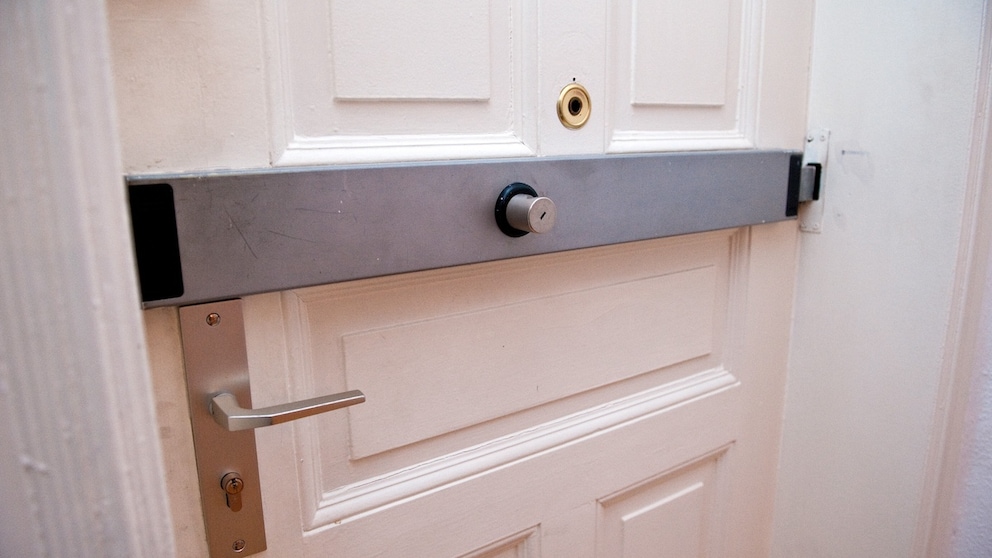
Especially for old building doors, which often have weak door leaves, replacing them with solid variants is recommended. Certified bar lock systems that close vertically are suitable for this.
“You can also secure your door well overall with a crossbar lock,” says the expert. Further retrofitting is usually not necessary then.

How to Tell if Your Door Is Burglar-Proof
This Measure Truly Protects Against a Break-in Involving Acid
Professional Installation Is Crucial
According to Elsner, effective security always depends on the interaction of all components: “It’s important that the retrofitting for the door leaf, door frame, door hinges, door locks, fittings, strike plates, and additional security measures are sensibly coordinated in their effect and professionally installed.”
If you’re looking for a reliable company, you’ll find it on the “k-einbruch.de” portal: The police list recommended specialist companies there that specialize in door retrofitting.
Other Sensible Measures
Additional security measures such as motion detectors and peepholes offer supplementary protection: “These can be installed near the front door to detect potential intruders and activate lights,” explains Elsner.
A peephole also allows you to identify visitors before opening the door–thereby avoiding possible surprises at the front door.
With material from dpa