

October 9, 2023, 3:05 am | Read time: 5 minutes
The expansion of district heating is a key component of the federal government’s energy transition plans. By 2045, all heating networks must be climate neutral. What does this mean for homeowners?
District heating is an important topic in the energy transition–especially for property owners. In many municipalities, heating networks are to be expanded or newly established. Do homeowners have to or should they get involved? Answers to key questions.
What is district heating?
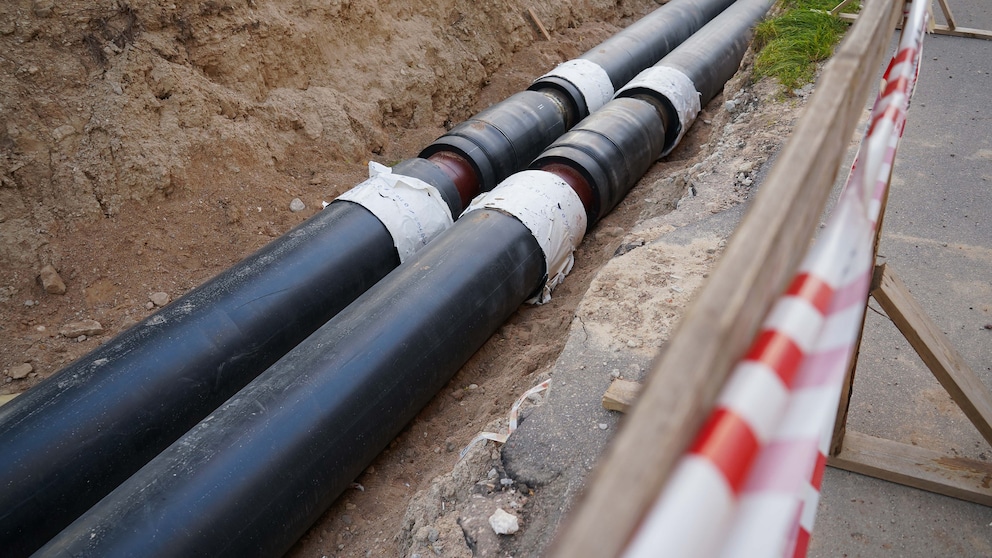
“District heating refers to the supply of buildings with space heating and often also hot water, which is delivered directly to the connected residential buildings through predominantly underground, insulated pipelines,” explains Alexander Steinfeldt, energy expert at the nonprofit advisory company co2online. Energy carriers such as oil, natural gas, coal, biomass, waste, or industrial waste heat, and increasingly other renewable energy sources like geothermal energy, solar thermal energy, or (green) hydrogen are used to produce the heat.
“New heating networks must contain at least 65 percent renewable energies. Existing networks must be gradually converted to 50 percent by 2029 and to 100 percent renewable energies by 2045,” says Steinfeldt. Therefore, municipalities must create a heat plan by mid-2026 or mid-2028 and define areas where a heating network or a hydrogen network is planned.
More on this: Using district heating–the most important questions and answers
Do owners have to use district heating if it is offered?
It varies. “In principle, the more connections there are, the more economically a district heating network can be operated,” says Martin Brandis, energy expert at the Federation of German Consumer Organizations. There is therefore a great public interest in having as many households as possible connect. In some municipalities, there is even a requirement to connect and use. Those who build or renovate there must use district heating.
However, not everyone benefits equally: “Such a requirement particularly disadvantages owners of low-energy or passive houses. They have to pay the high basic prices–even if they need little or no energy,” says Steinfeldt. However, there can also be exceptions to the connection requirement, which must be decided by the municipality.
Do I have to shut down my old heating system?
If the municipality now decides in its heat plan to build a new district heating network, homeowners do not have to give up their old heating system. “There is no legal obligation for residents to switch to district heating,” emphasizes consumer advocate Martin Brandis.
What impact does it have on prices?
With decreasing energy demands in existing buildings and new constructions, many district heating projects become less economical for the energy supplier, which usually leads to higher basic prices and thus increases the burden on homeowners connected to the district heating network.
What speaks in favor of district heating?
District heating customers do not need their own heating system at home, which would require regular maintenance. If district heating is predominantly generated with renewable energies, it is a good opportunity for consumers to participate in the use of renewable energies without having to invest in their own heating system, says Brandis.
However, the prices for district heating vary greatly by region, so everyone should calculate individually whether it is worthwhile. “Especially in houses with low energy demand, a heat pump, for example, can be cheaper.”
What are the disadvantages?
Consumer advocates criticize the lack of transparency in district heating prices. The district heating suppliers, usually the local utilities, do not compete with each other and set prices at their discretion. “The consumer must know that they are being supplied by a monopolist,” says Brandis. “There is only one provider in the area, you cannot switch.” Customers are at the mercy of any upward price adjustments.
“So-called price adjustment clauses allow price increases solely based on public price indices predetermined by the provider. For the customer, the price increases are usually not transparently understandable,” says Alexander Steinfeldt from co2online.

Using District Heating: Key Questions and Answers

Agreement on Heating System Replacement! What Homeowners and Renters Need to Know
How is the price for district heating composed?
“It consists of a basic price and a working price,” explains Steinfeldt. The basic price covers all costs that arise independently of actual consumption. For example, the costs of generation and transport facilities as well as personnel costs for the operation and maintenance of the networks. Its amount depends on the connection value or connection capacity and is around 20 to 30 euros per kilowatt of connected capacity per year.
Good to know for owners of particularly energy-efficient properties: “Customers have the option to reduce the connection capacity and thus the basic price in the ongoing contract if they consume less district heating than agreed,” says Martin Brandis.
With the working price, suppliers bill the actual consumption costs. It arises for every kilowatt-hour that consumers draw from the network.
Also interesting: So many new buildings already heat with heat pumps
So how much does district heating cost?
An example: In 2022, the costs of district heating for a single-family house with 110 square meters of living space ranged from 1,145 to 2,540 euros according to the heating mirror. The large cost differences are mainly due to the energy condition of the respective house.
Regional weather differences and the heating behavior of the house residents are other factors that influence the price. Currently, the district heating price for 80 percent of consumption is capped at 9.5 cents per kilowatt-hour.
Note: Information and decision-making aids regarding district heating can be obtained from independent energy consultants and also from the consumer centers.
With material from dpa