


November 5, 2026, 2:56 pm | Read time: 4 minutes
A gentle crackle, a flickering play of light, a stylish design piece: Open fireplaces indoors have a unique allure. They combine experience and warmth with architecture, making them a special focal point. However, the aesthetics are not only technically regulated but also legally. myHOMEBOOK spoke with an expert about what to consider when bringing a hanging fireplace into your home.
Follow myHOMEBOOK on WhatsApp now
What Makes Fireplaces So Popular
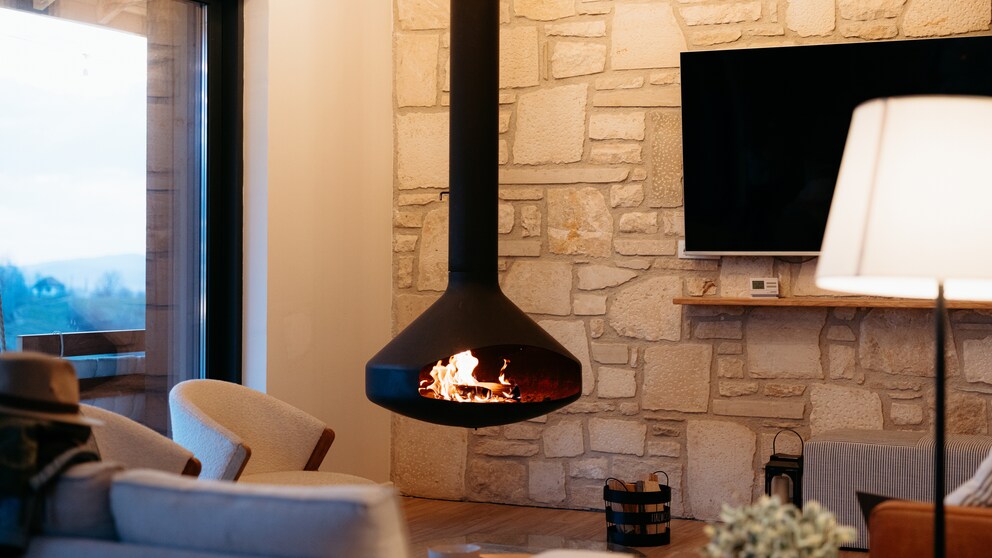
Warming fireplaces like wood stoves or fireplace boxes often appear bulky in the house and have a direct impact on interior design due to their size. That’s why the hanging fireplace has become popular in many homes: a designer piece that visually simulates a sense of weightlessness and an open campfire. Most commercially available free-floating stoves feature curved shapes. They are often connected to the room only by a slim exhaust pipe.
The idea of the cozy campfire effect goes back to Dominique Imbert. He presented the first free-hanging design fireplace with the “Gyrofocus” model in 1968. His design from back then is more in demand today than ever. Particularly popular are objects made entirely of metal, which appear more futuristic. They blend almost seamlessly into existing styles or break up rigid room structures. Used as a stylish room divider, the play of fire can be admired from multiple living areas simultaneously.
As beautiful as hanging fireplaces are, you should thoroughly inform yourself before purchasing. This is because strict rules apply to the mostly open-designed fireplaces.
Also interesting: What you need to know about heating with firewood
Is Every Open Fireplace Allowed at Home?
“Open fireplaces are not generally prohibited in Germany,” explains Iris Dohmen, head of press and public relations at the Federal Association of Chimney Sweeps. “However, clear building and fire protection requirements apply to their installation and operation.” According to Dohmen, it is crucial that the fireplace is suitable for the intended use indoors. Additionally, the necessary documentation for the use of the fireplace should be available.
The most important federal legal basis for commissioning is the Federal Immission Control Ordinance (1. BImSchV) from 2010. It regulates the construction of small and medium-sized combustion plants, their characteristics, and operation. In Paragraph 2, Point 12, it fundamentally defines an open fireplace as a “fireplace for solid fuels that can be operated openly as intended.” Paragraph 4, Point 4 does not exclude the use of open fireplaces but points to occasional use. Open fireplaces are therefore not intended for regular and permanent heating of a living space. Where exactly the line is drawn is not clear.
What Legal Requirements Apply to Use
The design of hanging fireplaces aims for maximum visibility of the flame. Therefore, many choose minimalist glazing with a panoramic effect or forgo a glass pane altogether. The latter is problematic, as the legal situation shows, because special regulations apply to open fires. Since carbon dioxide, fine dust, and other combustion products are produced during use, safe exhaust gas removal must be ensured, as Iris Dohmen also reports. “Adequate combustion air supply and the necessary distances to combustible components” must also be observed.
It is also stipulated that open fireplaces may only be fueled with natural wood logs (described in Paragraph 3, Points 1 to 4 of the 1. BImSchV) and pressed wood briquettes (Paragraph 3, Points 1 to 5a). Each solid fireplace requires approval by a chimney sweep, depending on the federal state. Additionally, the building and combustion regulations of the respective federal states provide information on how exhaust gases must be safely discharged through a chimney and what safety distances must be maintained when setting up the fireplace.
Is It Permissible to Burn Bamboo in the Fireplace? Expert Offers Clear Opinion

How to Protect the Floor Around the Fireplace
Approval by the Chimney Sweep
To ensure that the fireplaces can actually be classified as operational, they must be approved by a chimney sweep in many federal states. Iris Dohmen explains: “As part of the inspection, the authorized district chimney sweep assesses the safe installation of the fireplace, fire protection, combustion air supply, and proper exhaust gas removal.” They also check whether the required usability certificates are available and whether the installation requirements have been met.
According to the expert, it is important to contact the authorized district chimney sweep early in the planning process–even before purchase. This way, it can be clarified in advance whether the fireplace can be safely built and operated.
Also interesting: Why a smoking chimney is a warning signal
The Best Alternatives to Hanging Fireplaces
If you want to completely bypass the legal hurdles but don’t want to miss out on the cozy atmosphere of an open fire, you can opt for an electric fireplace. Using LED technology, water vapor, and mirror projections, high-quality models create an absolutely realistic flame image. No harmful emissions are produced, making these variants suitable for apartments where a traditional fireplace would not be feasible.