


January 5, 2024, 10:13 am | Read time: 8 minutes
Many homeowners are currently interested in photovoltaics. However, there are some uncertainties. When is a PV system profitable? An overview of the most important questions and answers.
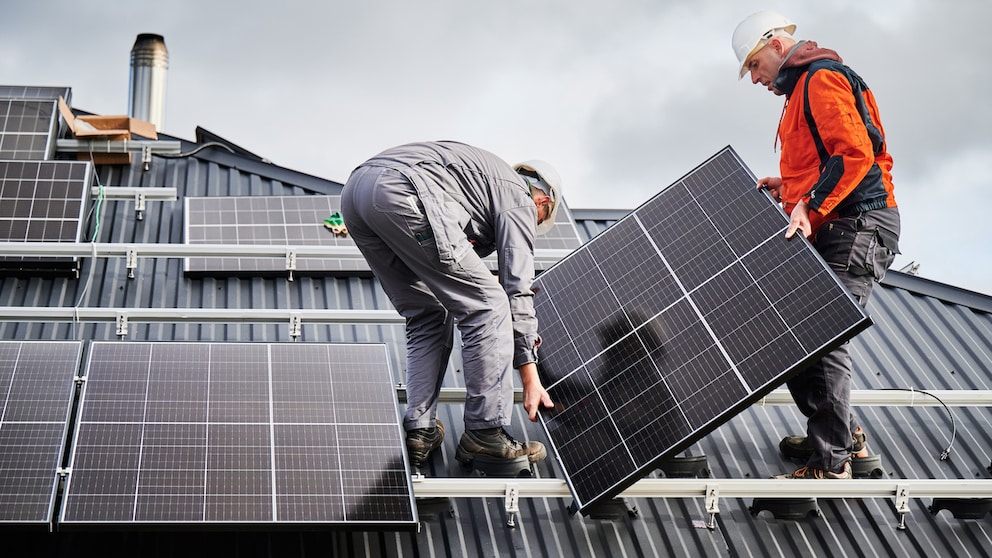
Photovoltaics (PV for short) involves converting sunlight into electricity. With a PV system on the roof, a household can be supplied with electricity–at least partially. Additionally, photovoltaics is a crucial component in the transition to renewable energy sources. This is also true in Germany: The Renewable Energy Sources Act (EEG) sees the federal government pushing for a massive expansion of PV. In 2024, 13 gigawatts (GW) of new capacity are expected to be connected to the grid, and from 2025, even 22 GW. About half of this is expected to come from rooftop solar installations.
However, there are still many uncertainties surrounding this topic. It’s no wonder, as it is complex, and the regulations change at irregular intervals. Feed-in tariffs must be considered, acquisition costs and self-consumption calculated, efficiencies, electricity meters, and taxes taken into account, and in the worst case, even building regulations may be affected. But: Anyone who understands a few basic principles can quickly determine whether and how electricity from the roof is worthwhile for them.
Also interesting: When a second photovoltaic system on the roof can be worthwhile
1. What does a photovoltaic system offer me?
First things first: There are various reasons to install a solar system on a roof or balcony. To promote climate protection without regard to personal benefit. Or to be independent of electricity supplies in times of crisis. The former is expensive, the latter is expensive and almost unattainable: Without the use of fuel cells or other hydrogen technology, even very large PV systems can hardly cover more than about half of a typical household’s self-consumption.
For most homeowners, tenants, and condominium owners, however, profitability is likely the most important factor–a PV system should save costs or even generate income. And here, there are mainly three principles to consider: What does the solar power cost and yield? What needs to be registered or applied for? And what else is important besides the PV system itself, from the suitability of the roof or balcony to the possible installation of a battery storage system?
Related: This map shows where a solar system is particularly worthwhile
2. How high is the feed-in tariff?
A thicket of feed-in tariffs, installation years, self-supply, and full-feed systems awaits the potential solar operator. But one thing is especially important: The more solar power you consume yourself, the better. “The feed-in tariff itself is not cost-covering,” says Tina Schmidt from the Photovoltaic Network Baden-Württemberg. “The profit is generated by self-consumption for household electrical devices.”
A simple calculation illustrates this: The cost of a kilowatt-hour (kWh) produced at home is, according to Schmidt, around 11 to 14 cents for smaller rooftops. The same amount of electricity from the grid costs between 35 and 40 cents under existing contracts. This results in savings of 24 to 29 cents per kilowatt-hour.
The current feed-in tariff for feeding into the grid, however, is only 8.2 cents per kilowatt-hour; each unit of electricity fed in costs more than it brings in. The feed-in tariff only contributes to the profitable operation of the solar system by refinancing the acquisition costs.
Additionally, from February 1, the tariff drops to 8.11 cents, from August 1 to 8.03 cents, and from February 1, 2025, to just 7.94 cents per kilowatt-hour. The applicable rate is determined by the date the system is commissioned, and the respective price is valid for 20 years. For larger solar systems, the tariff decreases to a lower level of currently 7.1 cents once a certain maximum output is exceeded.
But beware: There are sometimes significant differences and ongoing rules for older systems that affect prices, maximum self-consumption rates, and even technical equipment. So, anyone who already owns a solar system will need to schedule an appointment with a consultant or use an online calculator like the one from Stiftung Warentest for an accurate calculation of the circumstances. A visit is also recommended for all other interested parties.
Also interesting: What changes in photovoltaics from February 1
3. Is a storage system for the PV system worthwhile?
Depending on the weather, usage times, and other factors, only about a third of the generated electricity can usually be consumed directly. For the estimated consumption of a family of four of just under 4,500 kilowatt-hours, this would result in savings of between 360 and 435 euros per year according to the calculation above. That’s not insignificant–but given the prices of solar systems, it’s not overly much either. Although the devices are currently becoming cheaper, an average home system with a capacity of ten kilowatts still costs between 13,000 and 16,000 euros, according to the “Zukunft Altbau” initiative. It can take decades for the electricity from the roof to really pay off. An own battery storage can improve this calculation–instead of only being able to consume electricity when the sun is shining, it can be stored for later use.
Advertisement: PV calculator for your roof–how much electricity and money is in the roof
However, this is still more theoretical. “Between November and March or on cloudy days, a battery storage system is of no use,” says Stefan Hoffmann from the Consumer Center North Rhine-Westphalia and provides the following calculation: “Assume that with a consumption of 4,500 kWh per year, a third of the produced electricity can be consumed directly. Another third is fed into the grid, and only the last third (1,500 kWh) increases self-consumption through a battery storage system.”
With an average lifespan of the storage system of ten years, the savings would amount to about 3,750 euros. This is the maximum the device should cost to break even–without any positive return. However, even inexpensive batteries with a storage capacity of five kilowatt-hours currently cost around 3,000 euros, and for ten kWh, you quickly reach 5,000 euros or (much) more. The Berlin University of Applied Sciences and Technology (HTW) has researched which storage size fits which electricity consumption, but for most private households, it is likely that before prices drop further, a battery storage system is often more of a zero-sum game.
More on this: Solar system with electricity storage–the most important questions and answers
Installing a Solar System in 2026? What That Means for Homeowners
What Changes Are Coming to Photovoltaic Systems in 2023
4. How high is the bureaucratic effort?
At least: The bureaucratic effort for the installation and operation of a PV system has significantly decreased. Because the EEG surcharge has been abolished, many PV systems no longer require an additional electricity generation meter. The value-added tax on new systems is also permanently eliminated, and neither sales tax nor income tax is levied on the paid feed-in tariff. From 2025, installation requests to grid operators should be possible easily and quickly via an online portal. Deadlines will also be set for how quickly grid operators must process these requests.
The “Solar Package 1” passed in August 2023 also includes regulations for the debureaucratization of balcony solar systems. “The connection via conventional Schuko plugs is now supposed to be allowed,” says consumer advocate Hoffmann. Previously, so-called Wieland plugs were required, which could only be installed by an electrician. Other formalities are also being simplified: In the future, registration with the grid operator will no longer be necessary; instead, only an online registration in the so-called Market Master Data Register will be required. And the system can also be larger: “Up to 800 watts of power are now possible,” says Hoffmann.
Related: Balcony power plants–the best mini solar systems in comparison
5. Does my roof fit?
Given the limited capacity of such devices, most homeowners are likely more interested in rooftop systems–and the question of whether their roof is suitable. The answer here is: Most likely yes. Even steep roofs with a 60-degree pitch are no problem for modern PV systems. On flat roofs, the devices are mounted on support structures. Partial shading during the day, such as from trees, is less problematic than it used to be. And the notion that only south-facing gable roofs are optimal is outdated. While the electricity yield is maximal with a southern orientation,
the Consumer Center NRW points out on its website that systems on east and west roofs are often sensible because “electricity generation is more spread out over the day, allowing more electricity to be used in the house.” This is because the typical household consumes a lot of electricity in the morning and evening when the sun is in the east or west. A house with an east-west oriented gable roof is therefore usually optimal for self-consumption.
With material from dpa