


October 22, 2026, 10:17 am | Read time: 6 minutes
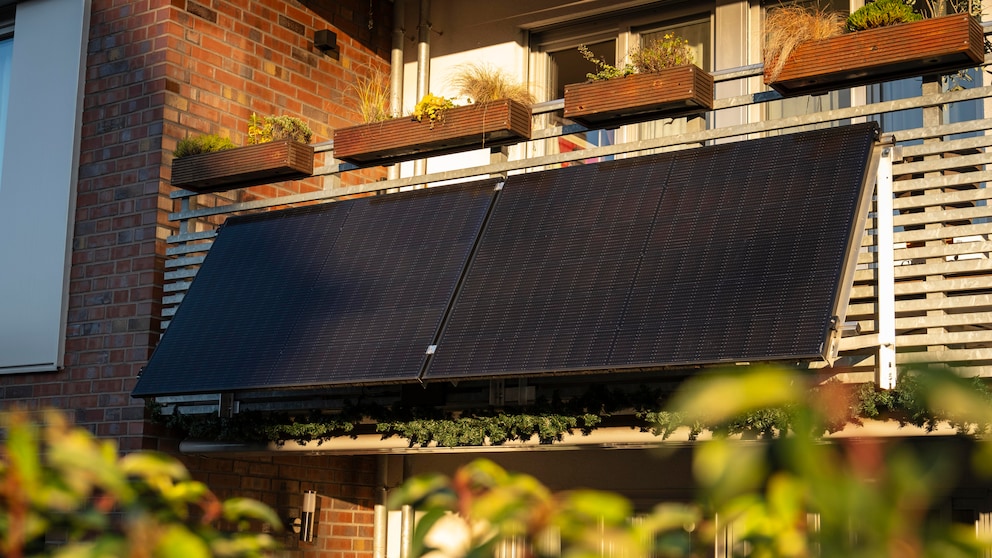
Starting in October, balcony solar panels generate noticeably less electricity. The sun is lower in the sky and hits the panels at a shallow angle. A steeper angle captures more light, as myHOMEBOOK learned from the Federal Association of the Solar Industry. Shadows, dirt, and the location of a storage unit also affect how much electricity is generated in the fall.
Follow myHOMEBOOK on WhatsApp now
How sunlight changes in the fall
In summer, the sun is high above the balcony at noon. In fall, it moves low across the horizon. Its rays then hit the panel at an angle. “With a shallow angle of incidence, significantly less sunlight hits the entire panel surface,” explains Lucas Flügel, spokesperson for the Federal Association of the Solar Industry (BDSH), when asked by myHOMEBOOK.
The principle is familiar from a flashlight. Pointed directly at the wall, it casts a small, bright spot of light. Held at an angle, the spot becomes larger and dimmer. The same energy is spread over a larger area. Shorter days, longer shadows, and cloudy weather further reduce output.
Experience shows how much it decreases. According to BDSH, rooftop systems generate about 85 percent of their annual yield between March and October. Only about 15 percent is produced from November to February.
Flügel cites similar figures for balcony solar panels. In August, they produce about 12 percent of the annual yield, in October about 7 to 8 percent. In November, it’s about 4 percent, and in December and January, about 3 percent each. These are average values. Exact figures depend on orientation, tilt, and sunlight at the location.
Also interesting: Is a battery storage system worth it for the balcony solar panel?
The most important thing is to adjust the angle
The most crucial factor for optimal performance of the balcony solar panel is the angle. Referring back to the flashlight example: A steeper panel is more directly aligned with the low sun. “In general, a steeper panel tilt is advantageous in these months,” says Flügel. Many balcony panels are already hanging almost vertically on the railing. They capture the shallow rays better than a flat-mounted panel. With adjustable mounts, the angle can be set steeper for winter. However, according to Flügel, a steeper angle only compensates for the losses compared to sunny months ‘a little’.
What this means in numbers is shown by an example calculation with the EU Commission’s PVGIS solar calculator. myHOMEBOOK assumed a balcony solar panel with 800 watts of panel power in Kassel, facing south and without shade:
- At a 30-degree tilt, the system delivers an average of about 20 kilowatt-hours in December.
- At a steeper 60 degrees, it’s nearly 25 kilowatt-hours, an increase of a quarter.
- This means: Over the four months from October to January, the steeper alignment yields nearly 20 kilowatt-hours more.
- Even vertically on the railing, the panel delivers more from November to January than at 30 degrees, about a fifth more in December.
- In summer, the high sun hits a vertical panel very shallowly. Over the year, it therefore generates almost 30 percent less electricity.
The numbers are for illustration only. In locations with a lot of shade, the values may vary and be lower.
Shadows, dirt, and gray light
The low sun casts long shadows. Neighboring houses, trees, or the balcony above can block the panel more quickly than in summer. Modern panels mitigate this. Thanks to bypass diodes and half-cell technology, the free cell groups continue to generate electricity. However, Flügel notes: “Shading is only limited and not completely compensated.” How much is lost depends on the orientation, duration, and area of the shadow.
On gray days, mostly scattered light reaches the panels. High-efficiency panels now utilize this diffuse light well. However, according to Flügel, it does not replace direct sunlight, no matter how good the panel is.
At the same time, leaves and dirt tend to accumulate more easily in the fall. According to Flügel, most of it slides off by itself on vertically mounted balcony panels. He refers to this as the self-cleaning effect. Other experts consider vertical panels less self-cleaning because water beads off less effectively.
“We recommend occasionally checking the panel or panels,” says Flügel. Bird droppings, in particular, tend to stick. For cleaning, clear, low-lime water and a soft sponge or microfiber cloth are sufficient. Pressure washers and abrasive cleaners can scratch the surface. Important: Unplug before cleaning.
Solar System with Battery Storage: Key Questions and Answers
Is a Solar Panel on My Balcony Worth It?
Storm-proof installation is important
In fall, storms also increase. They tug at every panel. Flügel calls a stable substructure “the be-all and end-all.” Wind not only presses on the front of the panel. If it catches from behind, it creates a suction. Freestanding panels are particularly susceptible. “This means that panels must be secured in both directions,” emphasizes Flügel. For panels on the railing, module hooks plus a stainless steel safety cable handle this. The wind load planners should expect at a location is specified by the standard DIN EN 1991-1-4, part of the European Eurocode 1. It divides Germany into four wind zones. In the north, the wind load is significantly higher than in the south.
If a panel falls, the owner is liable. According to Flügel, private liability insurance covers damage to third parties. The device itself should be included in the homeowner’s insurance. This is confirmed by the German Insurance Association (GDV). The association advises reporting the system to the insurer.
Also interesting: What insurance to consider for a balcony solar panel
Install retrofitted storage units frost-free
A battery storage unit is not part of the basic equipment but can be retrofitted. The storage unit is sensitive to cooler temperatures in fall and especially in winter. The internal resistance in the lithium cells increases. Charging and discharging slow down, and usable capacity decreases.
Flügel compares this to a cellphone in winter. The smartphone battery also discharges faster and charges more slowly in the cold until it warms up. Some PV storage units deliberately feed electricity into the grid when cold. This keeps them in a safe charge range. Flügel’s advice: The storage unit should be in a ‘temperature-stable’ room. The room should be dry, frost-free, easily accessible, and protected from direct heat.
The inverter, on the other hand, usually tolerates cold well. Heat is more problematic. Although the voltage of the panels increases in frost, this is generally not critical for typical balcony solar panels with one or two modules, according to Flügel. The condition: The voltage of the panels must remain below the value the inverter can handle according to the data sheet, even in frost. This is usually the case with complete sets.