


October 3, 2026, 7:18 am | Read time: 4 minutes
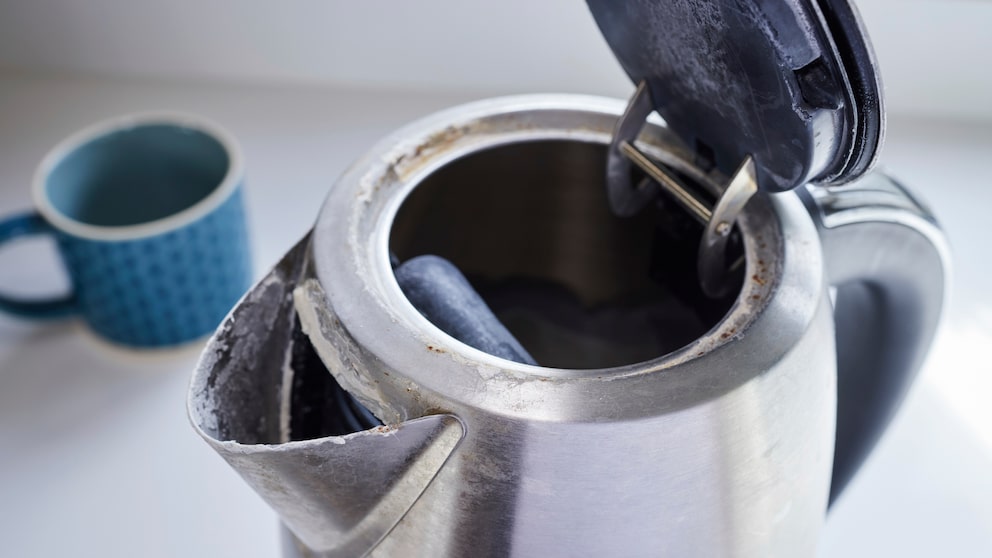
Autumn is kettle season. For many tea lovers, the last months of the year mark a particularly cozy time. However, the increased use of this kitchen appliance can also lead to frustration. Often, after just a few uses, a white film forms on the heating elements and the inside of the device, which quickly reappears after cleaning. We reveal how limescale forms and what really keeps it at bay.
Follow myHOMEBOOK on WhatsApp now
How does limescale actually form?
Anyone who regularly uses a kettle is familiar with it: the unsightly white limescale deposits that quickly spread inside the device. The film especially likes to settle on the heating elements and gets thicker with each use.
According to Dr. Christian Höra from the German Environment Agency, two substances in the water are primarily responsible: “Calcium and magnesium are dissolved in drinking water.” When filling the water, these substances are hardly visible to the naked eye. Only when the water dries do they leave white spots. Moreover, “When water is heated in the kettle, some of the dissolved calcium can precipitate as solid calcium carbonate. This particularly settles on the hot surfaces,” the expert explains. That’s why the heating elements are always affected first.
Also interesting: 5 home remedies to descale the kettle
What the white deposits reveal about water hardness
As one might suspect, the mineral ions, also known as hardness builders, are responsible for the hardness of the water. “Water hardness itself describes the concentration of dissolved calcium and magnesium ions in the water,” Höra explains. “The harder the water, the more likely such deposits are to form.” Therefore, limescale in the kettle can indeed provide insight into how hard (or soft) the tap water is. Water hardness varies by region, and the exact levels can be obtained from the local water supplier.
No matter if it’s soft, moderately hard, or hard drinking water–according to the German Environment Agency, any tap water in Germany can be “safely consumed.” It just needs to meet the requirements of the drinking water ordinance. Water hardness is not a decisive factor in whether tap water is safe to drink. However, for household use and the longevity of appliances like dishwashers and washing machines, water hardness can be quite relevant. After all, a high limescale content can clog pipes and cause serious damage to machines.

Why Tap Water Tastes Different Everywhere
Testing Water Quality at Home – How to Do It Yourself
Avoiding limescale with still bottled water?
If you want to avoid limescale in the kettle, the question eventually arises whether bottled water could potentially solve the problem. myHOMEBOOK looked at the ingredients of the largest bottled water brands and came to a clear conclusion: Even still water from the supermarket contains varying amounts of calcium and magnesium ions, depending on the brand.
For example, Volvic Naturelle contains about 13 milligrams of calcium and 9 milligrams of magnesium per liter, along with other minerals, while ViO Still contains 51 milligrams of calcium and 5.3 milligrams of magnesium. In comparison, German tap water contains an average of between 50 and 100 milligrams of calcium. Magnesium levels average between 8 and 15 milligrams.
Gerolsteiner Naturell has by far the highest values. The still version contains, among other things, 125 milligrams of calcium and 44 milligrams of magnesium. According to the company’s website, this covers 1/6 (calcium) and 1/9 (magnesium) of the recommended daily intake. These minerals are essential for the human body, as it cannot produce them itself. The EU regulation provides a reference intake of 800 milligrams of calcium and 375 milligrams of magnesium.
Since limescale formation depends solely on the mineral content in the water, even non-sparkling bottled water in the kettle can lead to limescale deposits–sometimes even faster than tap water. Therefore, water from the supermarket is hardly a real alternative to tap water.
Permanently removing limescale–is it possible?
If bottled water is not an alternative, can limescale in the kettle be permanently defeated? No, says Dr. Höra from the German Environment Agency: “With limescale-containing tap water, new formation in the kettle cannot be permanently prevented by a single descaling.” Calcium carbonate forms with every boiling process, regardless of whether the water comes from the tap or a bottle. Therefore, regular descaling of the device according to the manufacturer’s instructions is advisable. The German Environment Agency recommends using citric acid for this purpose.