

September 30, 2025, 8:32 am | Read time: 4 minutes
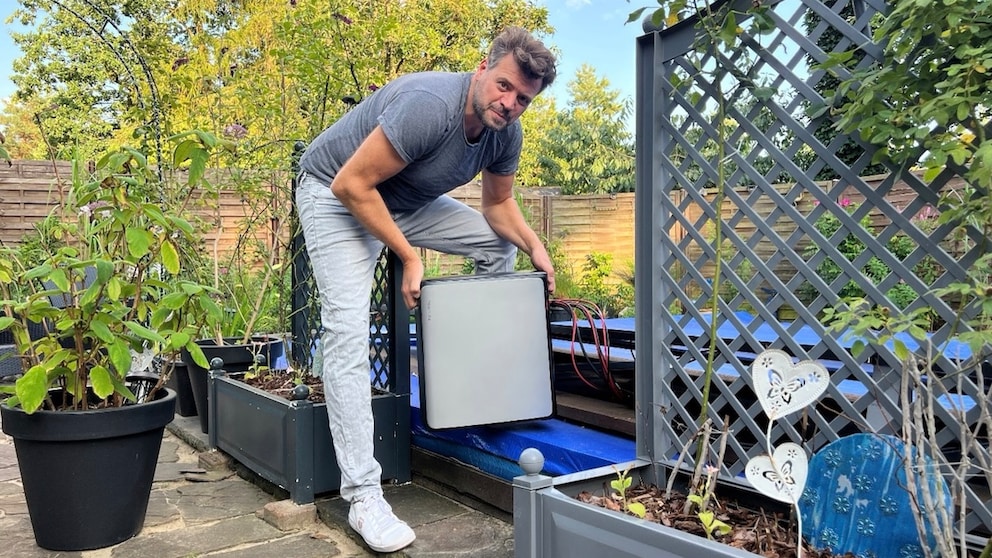
A balcony solar power system allows you to use self-generated solar power directly in your home. Since electricity production only occurs when the sun is shining, there are often not enough kilowatt-hours available in the evenings or on cloudy days. A storage unit can fill this gap: It stores excess energy and releases it at a later time. In a practical test by Computer BILD (like myHOMEBOOK, part of Axel Springer) of models up to 1,000 euros, significant differences in features and handling were observed.
Overview
How Balcony Solar Power Systems and Storage Units Work
A typical balcony solar power plant consists of solar panels and an inverter. Typically, solar panels with up to 2,000 watts of power are used in balcony solar power plants. The connected inverter converts this energy into alternating current and outputs a maximum of 800 watts into the socket.
Storage units expand this system by buffering excess energy. The release is controlled via apps that allow either fixed schedules or automatic adjustments to current consumption in conjunction with external sensors.
The 4 Top-Rated Storage Units in the Computer BILD Test
Four models received the highest rating in the Computer BILD test and were awarded the “very good” seal. Below, you’ll find out which models these are.
Anker Solix Solarbank 2 E1600 Pro
The test-winning model impressed with its easy operation and an integrated inverter. Up to four solar panels can be connected, and the capacity of 1.6 kilowatt-hours can be expanded to 9.6 kWh with additional batteries. In conjunction with a smart meter, consumption-based control is possible.
Anker Solix Solarbank 2 E1600 AC
The AC variant offers similar capacity values, is also expandable, and is designed for a compact build. It also features an integrated inverter with space for connecting two solar panels. Alternatively, an existing balcony power plant with an inverter can be directly connected here.
Jackery HomePower 2000 Ultra
With a storage capacity of 2.048 kilowatt-hours, this model offers more reserve and can be expanded to up to 8 kWh. A socket directly on the device also allows for emergency power use, just like the Anker models.
EcoFlow Stream Ultra
This storage unit offers 1.92 kilowatt-hours and can be expanded to up to 11.52 kWh. In addition to app control and easy installation, it scores with two integrated sockets that can be used even during a power outage and continuously power devices over the network, even if the storage is empty. This makes it one of the most versatile solutions in the test.
Also read: These Balcony Power Plants Are Currently in High Demand

These balcony power plants are currently in high demand

Affordable Balcony Solar System at the Discount Store–But There’s a Catch
How the Balcony Power Plant Storage Units Were Tested
The storage units were tested in everyday use in various households of editorial members. The focus was on three points: installation and initial setup (connection, handling, app setup), power control (fixed schedules or intelligent adjustment via smart meter), and emergency power capability (direct use via sockets on the device).

The storage units with integrated emergency power sockets offered additional practical benefits. Differences were noted in weight and ease of use. The quality of the app also played an important role.
Conclusion: Who Should Consider a Storage Unit
A storage unit is worthwhile for those with high energy needs in the evening hours. It’s important to have enough panel area available to generate sufficient energy. Users should also be aware that conversion losses occur with each charge and discharge cycle.
All models from the test offer app control. The ability to adjust the feed-in via a smart meter to match household consumption is also available.